

Academic Rigour in Canada
"None of those men, or those who served with them, would now be eligible to teach at the university named in honour of their sacrifice.""DEI has gone too far for too long."Former Alberta premier Jason Kenney"In a 2025 study, the Aristotle Foundation examined 489 job postings issued by ten Canadian universities and found just a dozen that did not contain some element saying that candidates would be prioritized based on their race, gender or sexual identity.""Despite this, it's still somewhat rare for a university to explicitly turn away candidates based on identarian characteristics.""In the Aristotle Foundation study, only16 of the 489 jobs they analyzed 'discriminated against candidates based on natural, uncontrolled factors or group identity'."Tristin Hopper, Journalist, National Post
 |
| Aristotle Foundation |
The sole university in Newfoundland, founded post-World War I in St.John's in memory of the contribution made by Newfoundlanders that was outsized to their population when fully one percent of the province's males died during the First World War -- giving birth to Memorial University, which now has a policy, sponsored by the Canadian federal government, of offering academic positions in favour of LGBTQ, women, Indigenous populations given priority to members of the 'white community' regardless of academic merit.
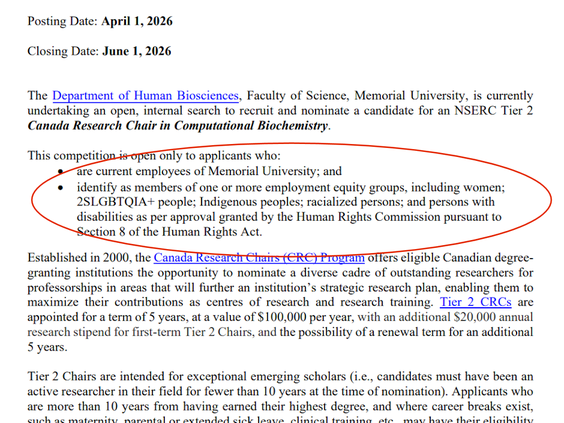
Founded as a 'living memorial', job postings while containing a reminder to applicants that the school was founded on the premise of honouring white-male sacrifices defending democracy to ensure that their "cause and sacrifice might not be forgotten", while denying positions to white-male Newfoundlanders presents a conundrum of mixed messages. At the present time, five job postings come complete with itemized restrictions that effectively shut the door to 'privileged' white males. Those five jobs are exclusively limited to "women, 2SLGBTQIA+ individuals, Indigenous peoples, racialized persons and those with disabilities".
 |
| (L-R) Muna-Udbi Ali, Assistant Professor, Black Studies in Geography and Environment, Faculty of Environment and Urban Change, York University; Cornel Grey, Assistant Professor, Department of Gender, Sexuality, and Women’s Studies, Western University; and Stephanie Latty, Assistant Professor, Department of Criminology, Toronto Metropolitan University. |
These five-year postings in the hard sciences for the most part, include research positions for computational biochemistry, musculoskeletal health and 'AI-driven navigation for Arctic and harsh environments'. 'Indigenous knowledge, youth and digital technology' and 'community health and substance use', make up the last two of the postings. Universities now throughout Canada post academic positions that emphasize an 'equity' component meant to advantage some identity groups over others; the favoured from the disfavoured.
The Canada Research Chairs Program funds all of these screened positions, a $311-million federal program that financially supports roughly 2,000 academic posts at universities across the nation. Since 2021 the funding expresses strict targets on "equity, diversity and inclusion". At the least, 22.9 percent of all academic positions funded by the program must favour "racialized" individuals, 4.9 percent Indigenous people, 7.5 percent those with disabilities, and 50.9 percent either women or trans individuals. This, in a province where 87.4 percent of the population is of European stock in comparison to 69.8 country-wide.
 |
 |
Those looking to find work at Canadian public universities based on their qualifications alone might be hard-pressed as a recent study found that 98% of job postings had diversity, equity and inclusion requirements. Public universities now overwhelmingly mandate DEI policies for academic jobs across Canada. True North |
New Frontiers in Research Fund (NFRF) Webinar on best practices in equity, diversity and inclusion (EDI)"NFRF expects applicants to clearly demonstrate their strong commitment to EDI in their applications and in the implementation of their research projects, if funded.""This webinar accompanies the “Best practices in equity, diversity and inclusion in research practice and design” guide to support NFRF applicants and reviewers in achieving greater equity, diversity and inclusion (EDI) in their research practice and design"."Applicants and research administrators are encouraged to attend the EDI webinars to learn more about how to integrate EDI into a research project. These webinars apply to all NFRF competitions, including special calls."Canada.ca Canada Research Coordinating Committee New Frontiers in Research Fund
Labels: Canada Research Chairs program, Diversity-Equity-Inclusion, Exclusionary Academic Posts
posted by Pieface | 9:19 PM


0 Comments:
Post a Comment
<< Home