

Opioid Prohibition on First Nation Territory
"[There is no] hate [for those involved in drug offences; they are not considered] bad people.""We are now seeing much more dangerous substances, like meth and fentanyl, creeping into our region...""We cannot afford to ignore the signs [in considering the safety of the community]."Chief and Council, Buffalo River Dene Nation, Saskatchewan"In Manitoba and across Canada, fentanyl poisonings are taking lives daily.""Our front-line workers and families are doing all they can, but support from federal and provincial governments remains fragmented, underfunded and reactive."Chief Angela Levasseur, Nisichawayasihk Cree Nation"Families are torn apart, two children are left without parents, and our social fabric is broken.""The scale of this crisis demands immediate, co-ordinated federal action.""Piecemeal funding and short term pilots are not enough. The federal government has both fiduciary and treaty obligations to act."Cold Lake First Nations Chief Kelsey Jacko
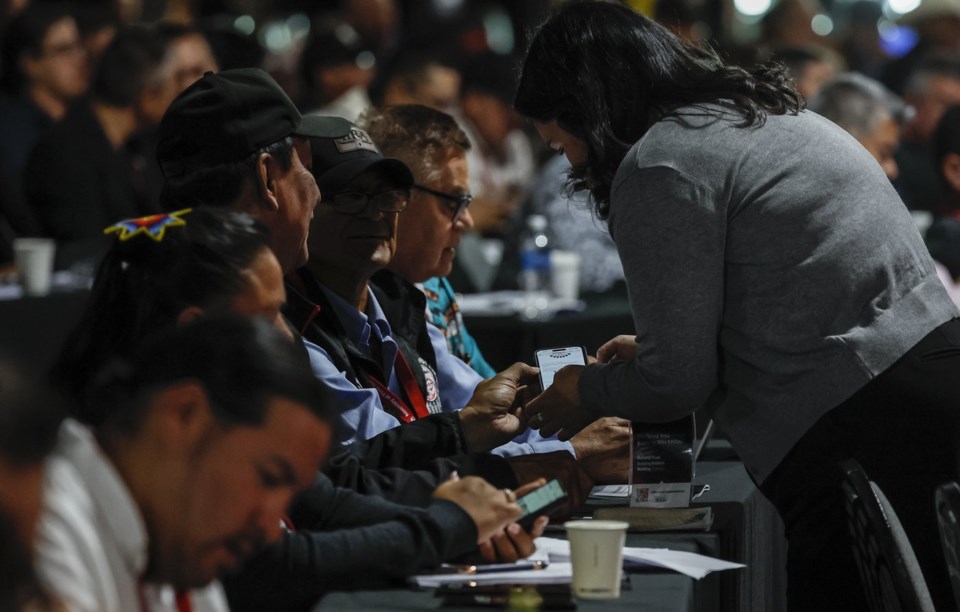 |
| Delegates vote electronically on resolutions at the Assembly of First Nations (AFN) Annual General Assembly in Winnipeg on Wednesday, Sept. 3, 2025. THE CANADIAN PRESS/John Woods |
Friday saw a proposed law that First Nations chiefs voted unanimously to support while calling on the federal government to begin enforcing a crackdown on drug dealers selling illegitimate drugs in their communities that claim the lives of users. The Assembly of First Nations was also called upon to declare a state of emergency among all First Nations, and to appeal to the federal government for greater support for treatment and prevention. The law, as proposed, would see sentences for drug traffickers to a 15-year minimum where death occurs from tainted drugs.
Law enforcement, furthermore would be given authority to access the cellphones of victims in search of those traffickers responsible for the proliferation of the drugs. The resolution appealed to the Assembly of First Nations to advocate for federal resources required to address root causes of drug use, focusing on prevention, intervention and rehabilitation. The proposal called for "legal reforms that reflect the true scale and human impact of the fentanyl crisis, and that prioritize the protection of life over the criminal impunity currently enabling traffickers and dealers."
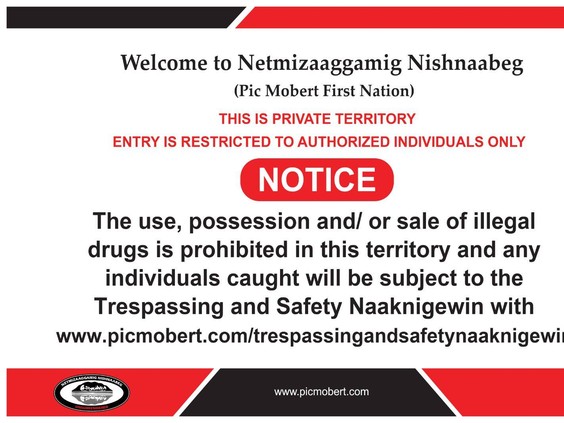
Countrywide, Canada's First Nations have become actively involved in banishing drug dealers from their communities, their effort to curb the skyrocketing rate of drug overdoses, in sharp contrast to government strategies which prioritize harm reduction and drug trafficking-lenient treatment. September 3 saw the Ojibway community of Netmizaaggamig Nishnaabeg in Ontario authorize the Anishinabek Police Service to treat unauthorized visitors as trespassers.
 |
"Unfortunately, there's people coming into the community with these drugs that are taking advantage of our people", stated deputy chief Thurston Kwissiw. Saskatchewan's Buffalo River Dene Nation last month announced it planned to begin evicting its own members from reserve housing who are involved in drug activities. Kwakiutl First Nation on Vancouver Island looked at available options for the eviction of members accused of drug dealing. Hereditary chief David Knox informed local media "we're tired of watching our loved ones get killed from these toxic drugs".
The family of an alleged drug trafficker and accused murderer's family on Haida Gwaii saw their home demolished and were forced to leave the islands. Pickets followed the family to the mainland, intercepting them at bus stops to ensure they moved on. Multiple Indigenous communities in the North enforce blanket bans on alcohol, assisted by the RCMP. In the northern Alberta community of Fox Lake, a bootlegger was recently detained while attempting to smuggle in 124 bottles of illicit vodka.
 |
| Opioid Addiction – image: depositphotos.com |
Fatal overdoses among Indigenous people in British Columbia is seven times greater than the average. Overdose deaths in Alberta have been responsible for a sharp drop in Indigenous life expectancy. The average First Nations person in Alberta lives to 62.8 years, down in a decades' time from a 2013 peak of 72.4, much less than the current non-Indigenous life expectancy in Canada of 81.8 years.
It has long been acknowledged by government health authorities that Indigenous communities are affected more dramatically by illicit drugs than non-Indigenous communities. Yet, official strategies have tended to sidestep the issue of drug trafficking interdiction. Published in 2023, the official Canadian Drugs and Substance Strategy, posits that high Indigenous drug use is attributable to "historial and intergenerational trauma, including the impact of colonization".
The self-flagellating federal government gave expression to then-attorney general David Lametti's statement that "We hare repealed the mandatory minimum penalties that have most contributed to the over-incarceration of Indigenous people, Black persons and racialized Canadians", in explaining the 2022 passage of Bill C-5, the Liberal legislative gift influenced by Critical Race Theory to non-punishable minority groups held to be disadvantaged and not responsible for their misdemeanors, thus removing mandatory minimum penalties for drug trafficking offences.
Finally, the Assembly of First Nations is signalling that this approach has not worked, and will not work, to address these habitual problems of sociopathy prevalent in specific groups. The 1,500-member Mississauga First Nation last October scored a precedent-setting legal victory with an Ontario court upholding their trespassing order against an accused drug dealer who continually frequented the community. In the process the Mississauga leaders emphasized their long struggle to have police enforce their community codes.
 |
Labels: Assembly of First Nations, Diminished Life Expectancy, Drug Trafficking, Federal Government, First Nations, Indigenous Territory, Overdose Deaths
posted by Pieface | 9:10 PM


0 Comments:
Post a Comment
<< Home