

Grim Diagnosis, Grim Circumstances, Grim Outcome
"They just can't get in, so the only other resource available to them is the emergency department."[A patient has symptoms suspicious for cancer, and] now you've got to get him to a specialist who can do a biopsy and then they can get to an oncologist.""But the emergency department isn't set up for that.""Like, if the patient misses their biopsy date or if there's some sort of problem ... I am not set up to track that or take responsibility for that.""But when people don't have a family doctor who can do that, there's really no clear place to send them, and it's a real problem and it's upsetting."Dr. Keerat Grewal, emergency doctor, Mount Sinai Hospital, Toronto, study lead author"There is a huge portion of the population that are unattached, and they don't have any primary care followup, so I can't even say, If you don't hear [about a referral] at least talk to your family physician about this."Unnamed emergency room physician"The emergency department is one silo, and then oncology is another silo, and you can't really move between them unless you have a tissue diagnosis.""It's kind of a little bit shocking to me that given how many people cancer affects and how devastating a diagnosis it can be to receive, that we haven't figured this out better."Unnamed emergency room physician"The emergency department has become a catch-all, or, some people think, the garbage can of our health-care system, and everything that no one else can find out what to do with, they send them to us, and we are left holding the bag to try to figure out how we can care for these poor people that don't have access to what they deserve."Unnamed emergency room physician
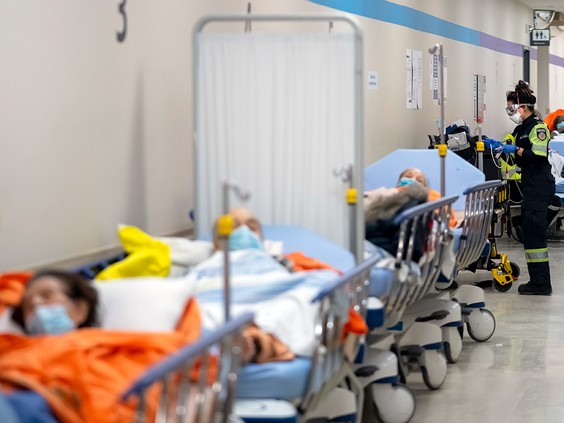 |
| The emergency department has become a catch-all, or, some people think, the garbage can of our health-care system, and everything that no one else can find out what to do with, they send them to us," according to one doctor. Photo by Nathan Denette/The Canadian Press/ |
A study of Ontario emergency doctors' experiences has revealed that people who visit hospital emergency rooms with unexplained symptoms are sometimes informed that "this may be cancer", and the appropriate followup simply doesn't occur, all the more so if these people are among the millions who cannot call on the services of a general practitioner as their family doctor. Ontario emergency doctors' experiences as they manage those with suspected cancer reveals a grim situation of emergency staff immobilized in their capacity to act within the health care system in times of acute personal crisis.
Wait times for tests for suspected cancer often stretch through months of waiting, and with one in five Canadians wanting a family doctor, a diagnosis of cancer has become 'routine' in Canadian emergency rooms. Those with a new diagnosis of possible cancer are left on departing emergency, not knowing when they may be able to see a specialist or have scans or biopsies. Research indicates that people diagnosed with cancer through this system at emergency rooms have poor outcomes "with higher stages of diagnosis and increased mortality".
Processes and protocols to ensure appropriate followup in such instances are absent in most hospital emergency rooms. Physicians manning emergency speak of "ongoing inefficiencies" driving people with suspected cancer to emergency initially, as a reflection of being without a family doctor, along with long waits of months ahead to see specialists, to receive a CT scan or to undergo biopsy for a suspected cancer. And without a biopsy they cannot be referred to an oncologist.
The same team that produced this study earlier found that a third of those with cancer in Ontario were in emergency in the 90 days prior to diagnosis, for reasons related to cancer. They are then likelier to die over a seven-year period than are those whose cancers are discovered through screening, for example. Doctors in emergency have no path available to refer to "who's going to take ownership of these [followup] investigations".
Dr. Grewal describes scenarios where some people with worrisome symptoms like severe abdominal pin arrive at emergency, and a scan shows a mass that is cancer-suspicious. Someone may arrive with shortness of breath they believe is a flu,while a chest X-ray reveals a nodule in the lung. There is scant time "to sit down and have this conversation for over an hour or so" with 30, 40, or 50 others waiting to be seen in the emergency department.
Published in BMJ Open, the study interviewed 20 emergency doctors from six health regions in Ontario. "We're all seeing this", reported Dr. Grewal; receiving a cancer diagnosis in emergency has become "routine" in Canada.

"They aren't expecting to get a cancer diagnosis that day. So, they don't come prepared with people that would be there to support them through that conversation.""We don't often have enough information to know further what that means, in terms of prognosis, in terms of the type of treatments that they're going to get.""Then, to also add on the burden and say, 'I also don't know when you're going to be seen, is just a gut punch for them."Unnamed emergency room physician
Labels: Cancer Diagnoses, Emergency Room Physicians, Lacking Protocols, Long Wait Times, No Clear Procedural Paths, Ontario Hospital Emergency Rooms, Patient Mortality
posted by Pieface | 9:44 PM


0 Comments:
Post a Comment
<< Home