Politic?

This is a blog dedicated to a personal interpretation of political news of the day. I attempt to be as knowledgeable as possible before commenting and committing my thoughts to a day's communication.

Sunday, January 18, 2026

Prospective Regime Collapse...

"In Iran's political psychology, two factors are traditionally essential for a fundamental transformation: first, the bazaar must enter into sustained strikes and protests; second, the army or national armed forces must side with the people against the ruling power."
"At this stage, the first condition has partially materialized."
"However, it remains unclear whether bazaar strikes will continue or fade."
"The large number of protesters killed by security forces demonstrates the continued allegiance of the armed forces to Khamenei and the IRGC."
Hussain Ehsani, research fellow, Turan Research Center, Washington think tank 
 
"In 2009, it was still based on a disputed election. People were asking, Where is my vote?' They were still trying to operate within the framework of the Islamic Republic."
"Iran's regime was humiliated in the 12-day war. It no longer has the proxies it once relied on, so it can't project strength."
"It's far more financially squeezed, and the economy is in free fall. Donald Trump is in the White House and appears, at least rhetorically, to be taking a much tougher line on Iran's regime."
"That's what makes this protest more significant than those in the past."
"I think it really depends on U.S. involvement. If the U.S. gets involved, you could very well see the regime collapse."
"But if it's just ordinary people fighting, the regime may be able to hold on for another day. Still, these protests will flare up again. There's simply no doubt."
Kaveh Shahrooz, senior fellow, Macdonald-Laurier Institute, Ottawa 
https://assets2.cbsnewsstatic.com/hub/i/r/2026/01/13/554a3a3f-d457-452d-96d2-664bb608a8e7/thumbnail/620x413/7cb8c806cd7452987d1b5b27fe1a2251/gettyimages-2255965252.jpg
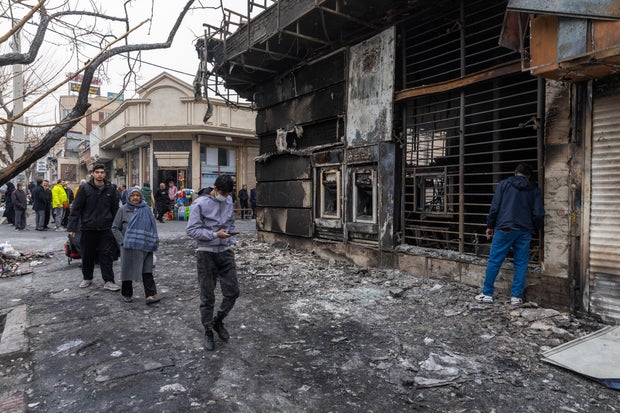
Pedestrians pass a burned-out building on Jan. 10, 2026, in Tehran, Iran, following widespread protests against the regime. Stringer/Getty
 
Twenty days have passed since protests first began in Iran, unremarkable at first and little-noticed outside the country, then when the protests spread from city to city, covering the entire country in hundreds of thousands, finally millions of Iranians out in the streets, damning their government, calling for its downfall, for the death of the Grand Ayatollah Khamenei, the government response changed as well, turning guns and live ammunition on those the regime called 'terrorists', inspired by foreign governments.
 
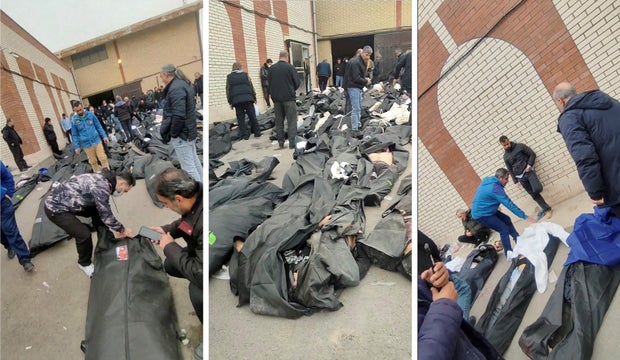
Over 3,500 civilian protesters were killed by some accounts, while other analysts claim a death toll in the tens of thousands, with greater numbers of protesters injured and hospitalized. Sparked initially by bazaaris (shopkeepers) in the main bazaar of Tehran considered the country's financial hub, demonstrations spread across major cities with demands of the protesters calling for an end to five decades of oppression under theocratic rule.
 
The price of basic food items increased in the space of three years, by 72 percent. Critical water and energy shortages compounded people's misery. Major cities ran out of electricity and gas. Iranians resented their government using billions in state funds to support their proxy militias, terrorist groups like Lebanon's Hezbollah, the Yemeni Houthis and Hamas in Gaza, while families in Iran struggled with food scarcity, a shortage of medications, cooking and heating oil.
 
https://i.abcnewsfe.com/a/771cae6a-af90-4d05-97fb-89f529973dac/iran-2-ap-gmh-260116_1768592409388_hpMain.jpg?w=750
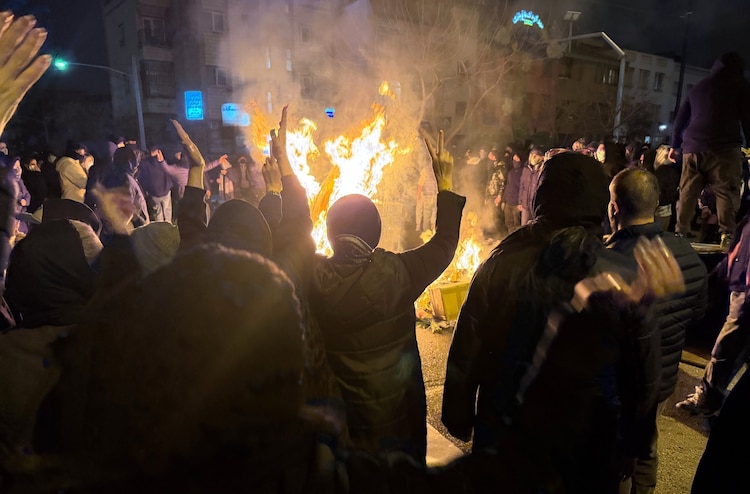
Iranians attend an anti-government protest in Tehran, Iran, Jan. 9, 2026.   UGC via AP
 
Following days of threats to strike Iran should authorities continue killing the protesters, the issue was taken to the UN Security Council for deliberation. While urging protesters to "take over your institutions", saying that "help is on its way", the impression was left that the powerful United States of America planned to come to the aid of the protesting public. The tension of guessing what form that help might take ranged from long-distance empathy to the commitment of military strikes.
 
From Iraq to Lebanon and Yemen, the IRGC special Quds Force orchestrated funding, training and equipping Shi'ite militant groups regionally, Hamas included. This past summer, decades of shadow warfare culminated in direct conflict in a 12-day war that saw Israel strike weapons depots, IRGC command posts, government buildings and eliminate a number of senior military and government figures. The U.S. flew warplanes equipped with bunker-penetrating bombs targeting Iran's nuclear installations. Iran both regionally and domestically was left reeling and diminished.
 
Earlier conflicts by Israel with Hamas, following the 7 October 2023 Palestinian terrorist incursion into southern Israel to commit mass atrocities, and with Hezbollah which joined Hamas in sending rockets into Israel, then finding itself engaged in battle, and Yemen with its ballistic missiles supplied by Iran entering Israel airspace and attacking marine traffic linked to Israel in the Red Sea, all engaged militarily with a responding Israel military to their hapless detriment. Leaving Tehran no dedicated outside terror proxy to call upon.                 
 
President Trump's intention to intervene in the regime crackdown on the protests as well as its execution of protesters was circumvented at the behest of Saudi Arabia, Egypt, Oman and Qatar, informing  him that Iran had put a stop to the executions and the killing of protesters. The threat of U.S. intervention subsided. The regime instituted a total internet lockdown, along with a moratorium on texting, so no information came or went. And under lockdown executions continued, arrests and torture recommenced, and Iranians fled for safety to their homes.
 
The conditions for a prospective regime collapse, according to analysts, would depend largely on positions taken by the military and the national police; to ally with the protesters, or the government. Hopeful claims expressed by Iranian opposition groups in exile aside, no such scenario of police defections laying down their arms and the military supporting the protesters materialized.                                                        
"First is street protests, which we have, but the other two things we don't have."
"Second is just the crippling of the economy through strikes, most importantly, the oil sector."
"And third would be defections from the security services, and we haven't seen that either."
Kaveh Shahrooz   
https://assets2.cbsnewsstatic.com/hub/i/r/2026/01/13/f864b885-ecda-46f1-b026-8a4596c99bd9/thumbnail/620x360/b7e182198b1ce1021bd8905f4224f8b0/iran-body-bags-reuters.jpg
Bodies lie in body bags on the ground outside Kahrizak Forensic Medical Centre in Tehran, Iran, in these images from video obtained from social media, Jan. 11, 2026.  Social Media/via REUTERS
                                        

Labels: , , , ,

Tuesday, October 18, 2016

Crediting the Iraqi Military

Barzani said the joint Iraqi force are launching the offensive from south and east of Mosul [Reuters]

"[The offensive to be led by Kurdish Peshmerga] Then they will stop. We'll [Iraqi military] start after them and move after them to support them."
"The operation [to retake Mosul] will take much longer because of this [the large presence of well over a million Iraqi civilians]."
"For their safety, but it also means each neighbourhood needs to be surrounded and searched as we clear it."
Brig.Gen. Haider Obaidi, Iraqi special forces commander

"We do provide our intelligence capability, we provide our logistics, these are capabilities that the coalition has that are singularly distinctive. We are very capable in these areas, and it is a big help to the Iraqis as they move into position," he said. 
"The plan is for the Iraqis to liberate Mosul, They are going to be the ones that will move in to the city."
Colonel John Dorrian, spokesman, U.S. forces

"Today is a turning point in the war against terrorism. This is the first time that Peshmerga forces and Iraqi army have cooperated and fought in the same area,"
"We are hopeful that this operation will be successful and that Mosul will be liberated. But this does not mean that the terrorist threat is over."
Kurdistan President Masoud Barzani
Barzani said the joint Iraqi force are launching the offensive from south and east of Mosul [Reuters]
Kurdish leader Masoud Barzani said the joint Iraqi force are launching the offensive from south and east of Mosul [Reuters]

Restoring the honour of a demoralized military, which, though trained and equipped by the U.S., turned and ran the very instant they became aware that Islamic State fighters were marching to enter Mosul and take the city from the command and protection of the Iraqi military. Rather than face the enemy whose ruthless reputation for slaughter and shedding blood in the most medieval-engaged atrocities, Iraqi forces, from commanders to enlisted men, chose to turn tail and decamp in such a panic that they left all their advanced military gear in their barracks, gifting Islamic State with up-to-date technically advanced arms and vehicles.

The staging for the retaking of Mosul has been in the planning stages for well over a year. Islamic State has been in possession of the city of over two million Iraqis -- of mostly Sunni Muslims, bordering on Kurdistan by Islamic State, considering it their Iraqi capital just as Raqqa is considered the Syrian capital of the caliphate -- for over two years. It is starkly obvious that the Iraqi military would be incapable of mounting an offensive for the return of Mosul on its own. Without the air- and fire-power of the U.S.-led coalition, and significantly, of the Peshmerga, Mosul would remain in ISIL possession.

The estimated 30,000 assembled forces of Peshmerga, Iraqi troops, Shiite militias representing tribal warlords, target an ISIL opposition of an estimated three to four thousand fighters. This unequal contest on a battlefield might readily be seen to be heavily in favour of the larger contingent of adversaries. But in a city the size of Mosul with its huge remaining population of over a million residents, with all the buildings and houses, the underground tunnel system, the IED-rigged buildings and back-alleys, the complications are diverse and numerous. With ISIL well ensconced and familiar with their surroundings, using explosives-laden vehicles in suicide attacks, their threat is ominous.

They will exact a steep price for the privilege of retaking Mosul from their grasp. In their wisdom, the United States persuaded the Peshmerga and Iranian backed Shiite militias to remain on the perimeter of Mosul, enabling the Iraqi army's counter-terrorism special force, Iraqi federal police and local tribal fighters to initiate and conduct house-to-house fighting in Mosul. The purpose, to ensure that sectarian violence is kept to a minimum once the battle for Mosul has succeeded and ISIL ousted.

Considering that Mosul's population is mostly Sunni, with a smattering of ethnics such as Arameans and Armenians, and the Islamic State occupation was likely comprised of no more than several thousand administrator/fighters, the city of two million might conceivably have put together a core group of opponents to oust ISIL. But for the majority Sunni Iraqis in Mosul there is no love lost for the Iraqi government comprised mostly of Shiites in an unequal sharing of national trusts. Many of the dismissed former Saddam Hussein military commanders came from Tikrit and Mosul.

And the core group of leaders of Islamic State were represented by many of these former Saddam-loyalist Sunni Iraqis. It stands to reason there was sympathy in Mosul for the Islamic State and its defense of Sunni Iraqis. With the incursion of Shiite militias and the Iraqi military comprised largely of Iraqi Shiites there will be an eventual reckoning meted out to the Sunni population of Mosul. Many of whom will be vacating Mosul as expeditiously as possible, leaving the UN to settle them in refugee camps for their own protection.

The resumption of Iraqi government control of Mosul will be months in the making while ISIL fighters are being routed from the city. The need to ensure that the terrorists do not infiltrate the tens of thousands of fleeing Sunni civilians will most certainly be a time-consuming and fraught affair. And when the city is finally freed from the talons of ISIL, other situations will erupt; that Kurdistan claims Mosul for its own, and that Turkish president Recep Tayyip Erdogan insists that Mosul remain a Sunni enclave, under the protection of Turkey, not Iraq. Even while local warlords and Shiite militias argue violently that Mosul is their heritage.
"This is the first time the Peshmerga and Iraqi forces have worked together against Daesh [ISIS] … we hope this will become a concrete foundation for our future relations with Baghdad."
"The liberation of Mosul is not an end to terror and terrorism but this was a good lesson so in the future we will resolve our differences through understanding and working together. We reassure the people of Mosul that both the Peshmerga and the Iraqi army will do everything not to cause any loss to the people and no revenge killing will take place."

Kurdistan President Masoud Barzani

Labels: , , , , , ,

Friday, July 24, 2015

Waiting Out The Siege

"Daesh (Arabic acronym for ISIL) executed 16 Haditha traders last night."
"The victims were transporting mostly food goods, such as vegetables, from Baiji to Haditha. They were stopped at a checkpoint and abducted. They then executed them, some by shooting them, others by slitting their throats."
"The people are suffering a lot because of the siege. Then also Daesh (ISIL) are attacking all the time."
"Everyone agrees that there are two things that have helped us. The existence of Haditha dam and Ayn al-Asad base."
"They [the U.S.-led coalition] appear only when the battle is very hard and the danger is very close to us." Baiji city mayor, Abdelhakim al-Jughaifi

"It's like we're not living in Iraq. There's no way in or out. It's like we are an island in the desert."
Israa Mohammed, Haditha, Iraq

"We have been forgotten. But we've agreed to all fight together until we die."
Awad Halaf, Haditha police officer

File photo of ISIL terrorist elements operating in Iraq © AFP

Thousands of Iraqis have been slaughtered as the Islamic State of Iraq and the Levant group began tightening their grip on the western province of Anbar in Iraq. Fallujah, Ramadi and the community of Hit have all fallen. Haditha, however, continues to resist. The tribal people and the Iraqi army continue to fight in the face of ongoing attacks. These are Sunni tribes living in Haditha, and the Iraqi army along with the Iran-backed militias aiding them are Shiites.

And it helps somewhat that the U.S.-led coalition along with the government of Iraq has fought to prevent the province's hydroelectric dam located at Haditha from falling into the terrorists' hands. The people of Haditha may be determined to ensure their city is kept out of the hands of ISIL, but the 96,000 people remaining there have had to struggle to survive in their town, completely cut off from the world outside.

Reporters gaining entry to Haditha for the first time in over a year discovered the besieged city coping under dreadful conditions. Doctors have left the city, and medication is difficult to obtain. Power is on for three hours daily, and gasoline now sells for four times the national price. The ten-kilometre-long dam is a prize that ISIL would dearly love to capture as the country's second-largest producer of hydroelectric power.

The town defenders are under immense pressure, warned by ISIL through an audio message that they are on the verge of entering the town. At the base of the dam, the army command centre is headed by Maj.Gen. Ali Daboun, who spoke of the latest assault by 37 suicide car bombs. "All the sectors in the country have a hard job, but we have an exceptionally hard job", he stated, resigned and fatigued with strain.

Residents of the town have complained that a few aid convoys that had been escorted to them by tribal fighters or the army ensured that none of the aid reached them, and was diverted instead to their own tribes, or to be sold on the black market. "From time to time, supplies arrive, and we don't get anything", said Samir Mishal. Which led aid workers and Iraqi officials to travel with a convoy to bring in 21 tons of food last week.

Attacks on Haditha increased markedly once government forces lost Ramadi. Mayor Jughaifi's tribe has been leading the fight to protect the city. Understanding full well that without the Iraqi military and U.S.-led coalition protecting the nearby military base of Ayn al-Asad where 300 U.S. Marines are stationed on a training mission, their parlous situation would be even worse. 

Iraqi soldiers and Shia fighters from the popular committees hold a post as they fire towards ISIL positions in the Garma district of Anbar province west of the Iraqi capital, Baghdad, on May 19, 2015. ©AFP


Labels: , , ,

Saturday, November 08, 2014

Al Monitor - Why Arming Rebels Will Fuel Syria's Inferno


Rebel fighters fire their weapons on the frontline against forces loyal to Syrian President Bashar al-Assad in the al-Amriyah neighborhood of Aleppo, Oct. 11, 2014. (photo by REUTERS/Hosam Katan)

Why arming rebels will fuel Syria's inferno

The Syrian conflict is taking yet another dramatic turn as the militant jihadists of Jabhat al-Nusra, al-Qaeda’s official Syrian affiliate, rout rebels from their strongholds in Idlib, threatening to eliminate entirely any presence by moderate rebels in northern Syria, as the Islamic State has already done in the east.
Summary Arming Syria’s rebels is a dangerous move that will only result in prolonging the war and potentially empowering extremists.

Author Edward Dark Posted November 6, 2014
The focus is now turning to Aleppo, where rebels are making their last stand against both the encroaching forces of the regime and the jihadists. Will they be left to face their fate alone as in Idlib, or will someone come to their rescue? If yes, who and how? If the French and Turks have their way, they might yet be saved, but at present it appears that the United States has finally given up on its former rebel allies, writing them off completely.

So in Aleppo, people are buzzing with questions and seeking answers. This once-vibrant metropolis has been reduced to little more than a sad, distorted shadow of its former beauty and glory. Cold, rubble-strewn streets crisscross the deserted and largely devastated neighborhoods of its rebel-held east, while daylight hours in its regime-held west bring the hectic bustle of a battered and weary population desperately trying to go about daily life and survive. The night brings darkness and solitude to both, but no comfort or respite, as their hapless inhabitants hunker down, shivering from the cold and in fear of the constant sound of gunfire, shelling and explosions.

Life in this city is terrible and has been for more than two years now, ever since the civil war that tore apart the Syrian nation dropped anchor and rudely barged into my hometown. Since then, my city has been a place of constant war and destruction, which its inhabitants struggle to survive amid abject misery and suffering. Its collapsed economy and infrastructure mean that even the most essential necessities are scarce or beyond the reach of most people. The specter of death constantly hovers above their heads forebodingly, ready to whisk them or their loved ones away at a moment’s notice. Aleppo is a microcosm of Syria. The suffering here is just as real and horrible as it is everywhere else. It does not distinguish friend from foe or regime loyalist from opposition supporter. It affects us all.

Ironically, this shared suffering might be the only thing that unites Syrians now, but I believe they are also united by an urgent desire to stop the suffering and end the war and killing that is causing it. We are no longer interested in who was to blame or even who gets to crown his glorious victory on a throne made from the debris of our broken cities and mortared with the blood and broken skulls of our children.

Our desires, however, run contrary to the wishes of the powers that hold all the cards in our country’s civil war. Our voices fall on deaf ears in what is the ultimate paradox of attempting to bring about peace by promoting more violence and war, or so it would appear if the eternal refrain of a “peacefully negotiated political settlement” is to be taken at face value.

Those who justify the continuation of our death and suffering either do so on the premise of liberating our lives from tyranny or on the premise of protecting it from extremism. Both are lies, of course, but they do have one truth in common as we jokingly note here: They all want to “liberate” our lives from this earthly world.

This cause will certainly not be helped by arming the “moderate” rebels with no clear strategy for the day after or how to plausibly bring this conflict to an end. All it will do is indefinitely prolong the war and our suffering. It would be a rehashing of previous strategies that not only failed to achieved their objectives, but spectacularly backfired.

The Western- and Gulf-backed umbrella opposition group in Istanbul is a disorderly mess that has no credibility or actual influence in Syria, as the rebels who were meant to provide that power on the ground are now a spent force. They stalled in their push to topple the regime in mid-2012, when they had the best chance. Worst of all, they failed miserably at providing even a semblance of stability or civil rule to the areas under their control, allowing instead a degeneration into infighting between organized crime syndicates that parasitically fed off their own people and created power vacuums waiting to be filled by shrewd and opportunistic extremists. This, coupled with the desperation of seeing their lives and homes devastated by the regime’s air force, missiles and barrel bombs drove many Syrians toward radicalization and into the hands of those extremists who offered a better deal, spiritually as well as on the battlefield. Since then, the rebels have been superseded by the more effective and more disciplined militant jihadists and driven back by the forces of a resurgent regime heavily backed by its powerful allies on the battlefield and off it.

Unless one can fix the serious, inherent flaws of the opposition and rebels, then arming them would not only be counterproductive, but also potentially very dangerous, as many of them have been taking their weapons and defecting to jihadist groups. Arming the rebels is de facto arming the extremists, period.

Resurrecting a strategy that spectacularly failed in the past and expecting it to work this time around shows a striking inability to grasp basic concepts or smacks of desperation and confusion, which is bad news for the millions of Syrians whose lives are directly affected by such decisions. The demise of the moderate Syrian rebels will see the influence of the West and Turkey in Syria’s civil war greatly dwindle, which is why they are loath to see them go. This loss has been a work in progress as the Islamists’ power and influence have grown. They are on two sides of a seesaw, a problem that the Gulf states of Qatar and Saudi do not have, as they have been busy financing and supporting some of these Islamists groups for some time.

The machinations of the many actors and their proxies in my country ensured that its people would never see the freedom they were tantalizingly promised. Instead, they got a cynical war driven by others' malevolent interests. Someone brought Pandora’s box to Syria and opened it. No wonder they are struggling to put the demons back inside; the monsters they have unleashed are now coming for them.

It appears there might finally be a faint glimmer of hope, as a bit of sanity calling for change has resulted in tentative, broad backing for moves toward localized cease-fires and a “freezing” of the conflict, news that will be welcomed by the vast majority of Syrians. Until then, however, we are stuck in limbo, waiting for our nightmare to end. In the meantime, please don’t make our plight even more unbearable. Don’t throw more fuel at the inferno consuming us 10 dozen souls at a time. Don’t arm the rebels

Labels: , , ,

() Follow @rheytah Tweet