Politic?

This is a blog dedicated to a personal interpretation of political news of the day. I attempt to be as knowledgeable as possible before commenting and committing my thoughts to a day's communication.

Sunday, January 18, 2026

Prospective Regime Collapse...

"In Iran's political psychology, two factors are traditionally essential for a fundamental transformation: first, the bazaar must enter into sustained strikes and protests; second, the army or national armed forces must side with the people against the ruling power."
"At this stage, the first condition has partially materialized."
"However, it remains unclear whether bazaar strikes will continue or fade."
"The large number of protesters killed by security forces demonstrates the continued allegiance of the armed forces to Khamenei and the IRGC."
Hussain Ehsani, research fellow, Turan Research Center, Washington think tank 
 
"In 2009, it was still based on a disputed election. People were asking, Where is my vote?' They were still trying to operate within the framework of the Islamic Republic."
"Iran's regime was humiliated in the 12-day war. It no longer has the proxies it once relied on, so it can't project strength."
"It's far more financially squeezed, and the economy is in free fall. Donald Trump is in the White House and appears, at least rhetorically, to be taking a much tougher line on Iran's regime."
"That's what makes this protest more significant than those in the past."
"I think it really depends on U.S. involvement. If the U.S. gets involved, you could very well see the regime collapse."
"But if it's just ordinary people fighting, the regime may be able to hold on for another day. Still, these protests will flare up again. There's simply no doubt."
Kaveh Shahrooz, senior fellow, Macdonald-Laurier Institute, Ottawa 
https://assets2.cbsnewsstatic.com/hub/i/r/2026/01/13/554a3a3f-d457-452d-96d2-664bb608a8e7/thumbnail/620x413/7cb8c806cd7452987d1b5b27fe1a2251/gettyimages-2255965252.jpg
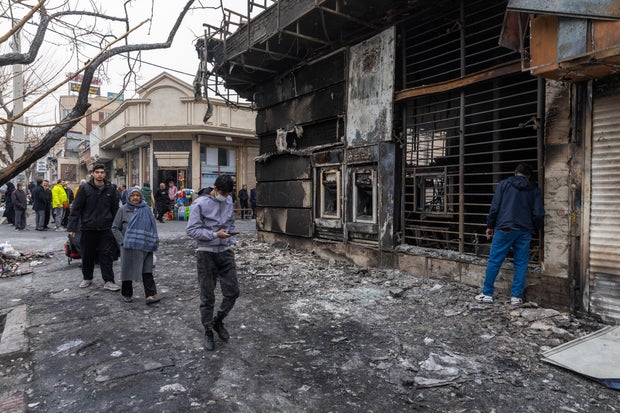
Pedestrians pass a burned-out building on Jan. 10, 2026, in Tehran, Iran, following widespread protests against the regime. Stringer/Getty
 
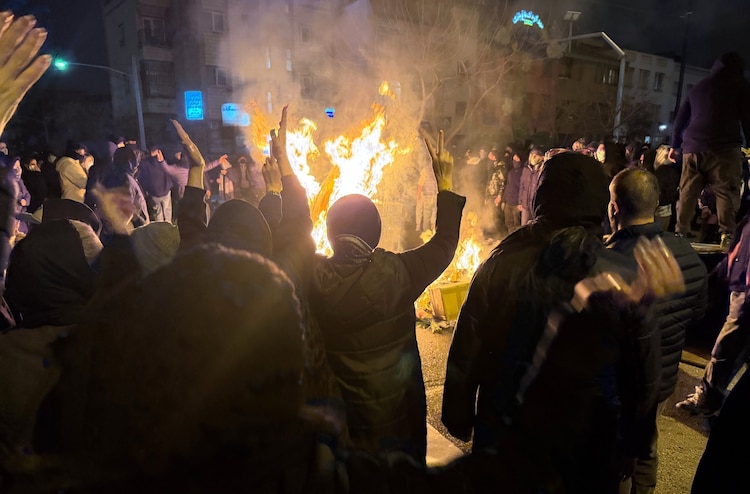
Twenty days have passed since protests first began in Iran, unremarkable at first and little-noticed outside the country, then when the protests spread from city to city, covering the entire country in hundreds of thousands, finally millions of Iranians out in the streets, damning their government, calling for its downfall, for the death of the Grand Ayatollah Khamenei, the government response changed as well, turning guns and live ammunition on those the regime called 'terrorists', inspired by foreign governments.
 
Over 3,500 civilian protesters were killed by some accounts, while other analysts claim a death toll in the tens of thousands, with greater numbers of protesters injured and hospitalized. Sparked initially by bazaaris (shopkeepers) in the main bazaar of Tehran considered the country's financial hub, demonstrations spread across major cities with demands of the protesters calling for an end to five decades of oppression under theocratic rule.
 
The price of basic food items increased in the space of three years, by 72 percent. Critical water and energy shortages compounded people's misery. Major cities ran out of electricity and gas. Iranians resented their government using billions in state funds to support their proxy militias, terrorist groups like Lebanon's Hezbollah, the Yemeni Houthis and Hamas in Gaza, while families in Iran struggled with food scarcity, a shortage of medications, cooking and heating oil.
 
https://i.abcnewsfe.com/a/771cae6a-af90-4d05-97fb-89f529973dac/iran-2-ap-gmh-260116_1768592409388_hpMain.jpg?w=750
Iranians attend an anti-government protest in Tehran, Iran, Jan. 9, 2026.   UGC via AP
 
Following days of threats to strike Iran should authorities continue killing the protesters, the issue was taken to the UN Security Council for deliberation. While urging protesters to "take over your institutions", saying that "help is on its way", the impression was left that the powerful United States of America planned to come to the aid of the protesting public. The tension of guessing what form that help might take ranged from long-distance empathy to the commitment of military strikes.
 
From Iraq to Lebanon and Yemen, the IRGC special Quds Force orchestrated funding, training and equipping Shi'ite militant groups regionally, Hamas included. This past summer, decades of shadow warfare culminated in direct conflict in a 12-day war that saw Israel strike weapons depots, IRGC command posts, government buildings and eliminate a number of senior military and government figures. The U.S. flew warplanes equipped with bunker-penetrating bombs targeting Iran's nuclear installations. Iran both regionally and domestically was left reeling and diminished.
 
Earlier conflicts by Israel with Hamas, following the 7 October 2023 Palestinian terrorist incursion into southern Israel to commit mass atrocities, and with Hezbollah which joined Hamas in sending rockets into Israel, then finding itself engaged in battle, and Yemen with its ballistic missiles supplied by Iran entering Israel airspace and attacking marine traffic linked to Israel in the Red Sea, all engaged militarily with a responding Israel military to their hapless detriment. Leaving Tehran no dedicated outside terror proxy to call upon.                 
 
President Trump's intention to intervene in the regime crackdown on the protests as well as its execution of protesters was circumvented at the behest of Saudi Arabia, Egypt, Oman and Qatar, informing  him that Iran had put a stop to the executions and the killing of protesters. The threat of U.S. intervention subsided. The regime instituted a total internet lockdown, along with a moratorium on texting, so no information came or went. And under lockdown executions continued, arrests and torture recommenced, and Iranians fled for safety to their homes.
 
The conditions for a prospective regime collapse, according to analysts, would depend largely on positions taken by the military and the national police; to ally with the protesters, or the government. Hopeful claims expressed by Iranian opposition groups in exile aside, no such scenario of police defections laying down their arms and the military supporting the protesters materialized.                                                        
"First is street protests, which we have, but the other two things we don't have."
"Second is just the crippling of the economy through strikes, most importantly, the oil sector."
"And third would be defections from the security services, and we haven't seen that either."
Kaveh Shahrooz   
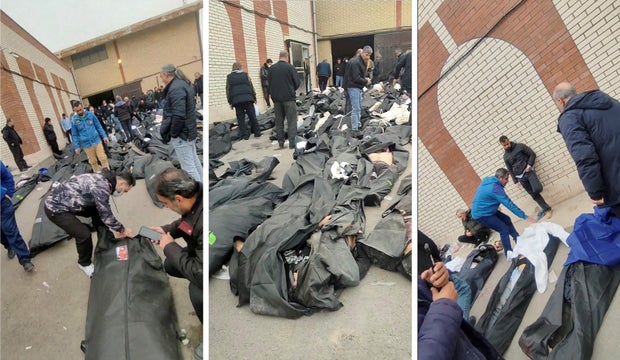
https://assets2.cbsnewsstatic.com/hub/i/r/2026/01/13/f864b885-ecda-46f1-b026-8a4596c99bd9/thumbnail/620x360/b7e182198b1ce1021bd8905f4224f8b0/iran-body-bags-reuters.jpg
Bodies lie in body bags on the ground outside Kahrizak Forensic Medical Centre in Tehran, Iran, in these images from video obtained from social media, Jan. 11, 2026.  Social Media/via REUTERS
                                        

Labels: , , , ,

Tuesday, December 13, 2022

"Waging War Against God"

Image
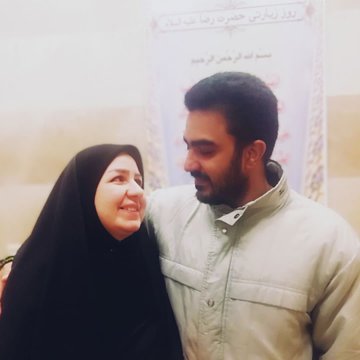
"Last night [Dec. 12] the brutes of the Islamic Republic attacked #MajidrezaRahnavard’s grandmother’s residence, arresting his uncle and brother for a few hours. They took away all the banners and flowers for the ceremony and then forcefully evicted the family from their own home."
"The Islamic Republic held #MajidReza’s “trial” 13 days ago. 3 days after conviction and sentencing by the “court” of first instance, he was executed for “Waging war against God.” Please don’t be silent."
"They allowed #MajidRezaRahnavard’s mother to visit him, and didn’t speak of execution at all. She left smiling and hoping that her son would be released soon. This morning she arrived when her son’s murderers were burying his dead body alone."
1500Ootasvir_en
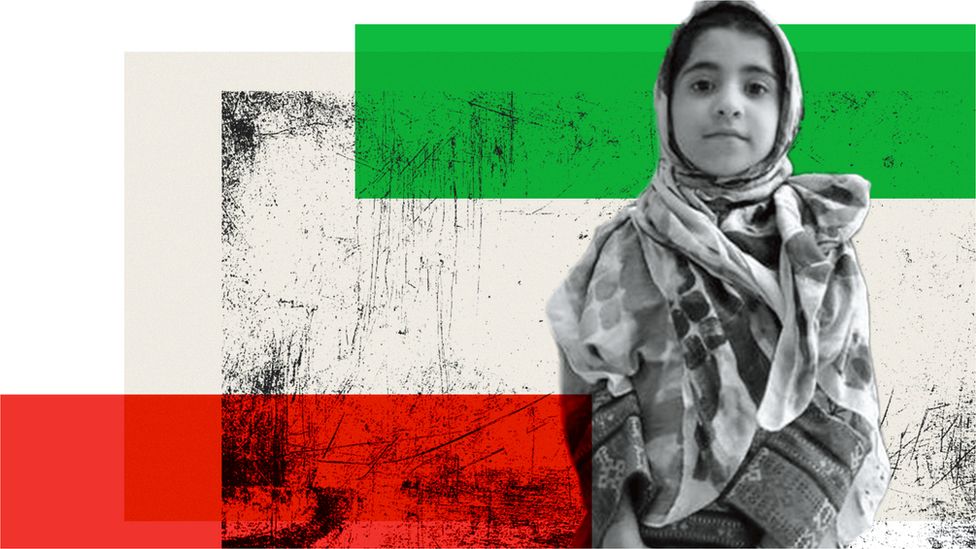
Image of 7 year-old Hasti Narouei
7-year-old Hasti Narouei was also from the Baluch community. This picture shows her wearing a traditional Baluchi dress. According to local activists, Hasti was hit on her head by a tear gas canister. She suffocated. HAALVSH
 
The public furor over the murder of a young Kurdish woman arrested by Iran's Morality Police for what they construed as a moral offence when she wore her hijab too loosely, revealing a few strands of hair, led to a courageous uprising in Iran's Kurdish geography that rapidly spread in moral indignation and numbers until every major city in the country hosted its own protests against the human rights abuses that the theocracy forced on its people in the name of the faith of Shi'ite Islam. 

In efforts to speedily put down the growing insurrection where enraged Iranians called for "Death to Khamenei" and the end of the Islamic Republic, the Basij, an arm of the Islamic Revolutionary Guard Corps was  tasked to counter the protestors using any means useful to the purpose. Predictably, this has led to unrestrained brutality on the part of the Basij, motorcycle-driving 'police', not known for gentle remonstration. Close to 500 people have been killed while protesting so far, by the Iranian Security Police.

Two days ago Iran executed a second prisoner who was convicted for crimes they claim were committed during protests challenging the theocracy. He was publicly hung from a construction crane. A grim medieval punishment meant to give warning to all other protestors that this could be their fate as well. Majidreza Rahnavard's execution followed a month after he was charged of the fatal stabbing of two members of the Basij paramilitary.
 
Speedy 'trials' followed by the death penalty obviously considered an effective method of cooling the ardour of the public in its attempts to unseat the ruling theocracy. According to Iranian activists, a dozen people, perhaps more, have already been sentenced to death at closed-door hearings. 488 people have been killed since the demonstrations broke the complacency of the Ayatollahs in mid-September. Authorioties have placed another 18,200 people in detention.

The Mizan news agency under the country's judiciary influence, published images of Rahnavard hanging from the crane, hands and feet bound, black bag covering his head. In front of concrete and metal barriers to hold back a gathered crowd, masked security force members stood guard early Monday morning in the city of Mashhad, a Shi'ite holy city located east of Tehran.

The hanged protestor, according to the newspaper, had stabbed two security force members to death in Mashhad, wounding four others. State television aired footage of a man chasing another around a street corner then standing over him and stbbing him after he fell agains a motorbike. Another video showed the same man stabbing another in quick succession with the assailant finally fleeing. State TV iterates the man with the knife was Rahnavard.

The dead men were identified in the Mizan report as "student" Basij, the paramilitary volunteers deployed in major cities, attacking and detaining protesters who have been resisting and fighting back. After Majidreza Rahnavard's execution, state television showed him in the courtroom where he declares  his hatred for the Basijis following video clips he had seen on social media of the forces beating and killing protesters.

Activists speak of Mashhad of hosting strikes, of shops closed and demonstrations that began over the death in custody on September 15 of 22-year-old Mahsa Amini. Rahnavard was convicted in Mashhad's Revolutionary Court, tribunals that have been criticized internationally for disallowing those on trial to have their own lawyers, much less see the evidence against them.  Rahnavard was convicted of 'moharebeh', meaning "waging war against God"
"[The public execution of a young man so soon after his arrest indicated] a significant escalation of the level of violence against protesters."
"Rahnavard was sentenced to death based on coerced confessions, after a grossly unfair process and a show trial.This crime must be met with serious consequences for the Islamic republic."
"[There is] a serious risk of mass execution of protesters [as thousands were in custody]."
Mahmood Amiry-Moghaddam, director, Iran Human Rights, Oslo, Norway
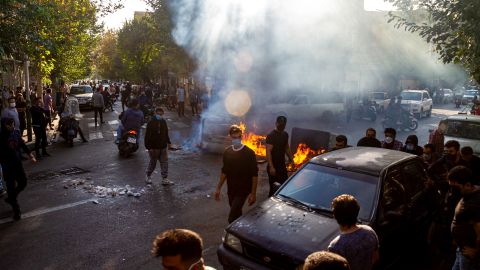
Iranians protest the death of Mahsa Amini after she was detained by the morality police last month, in Tehran, on October 27.
Iranians protest the death of Mahsa Amini after she was detained by the morality police last month, in Tehran, on October 27.  Stringer/Middle East Images/File
 

Labels: , , , ,

Friday, May 04, 2018

Befriending Iran

"Exiled Iranian human rights activists such as Toronto-based Maryam Nayeb Yazdi have pointed out that stoning is still a viable legal threat in Iran, for both men and women, and that executions in general are rising."
"Anything less than a continuing diplomatic boycott and the seizure of Iranian government assets [in Canada], as well as a ban on visits by their government officials, would be a betrayal of [Canadian] democracy and of those Iranian-Canadians who have fled that Islamic dictatorship since the revolution that brought these evil men to power in 1979. It would also be a slap in the face to the children waiting in Iran's prisons for their turn on the gallows."
Geoffey Clarfield, Toronto-based anthropologist
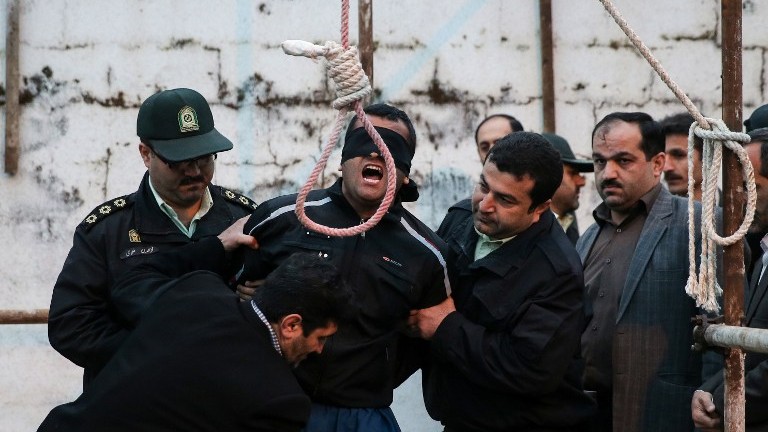
Illustrative photo of an execution in Iran. (AFP/Arash Khamooshi/ISNA)
Photo of an execution in Iran. (AFP/Arash Khamooshi/ISNA)

The Islamic Penal Code administered by mullahs in the Islamic Republic of Iran is a daunting system of enacting justice. Due process carried out in the Western world is a practise of justice unknown in the Islamic theocracy. There, people can be arrested, interrogated, even tortured even before they ever appear in a court of law and stand before a judge. Trials are short and closed. If a lawyer is hired for the defence he too is often harassed and occasionally arrested on charges of representing the interests of Europe or North America.

Human rights groups make it a point of regularly tracking in particular the war waged by the Islamic Republic against Iranian youth. When murder is committed, under the justice system practised in the West, it is considered a heinous violation of the social contract, devised to ensure security and peace among people, guaranteeing safety under the law. Murder in Iran is viewed as a private matter between families. Should a murder occur, the culprit arrested and tried, possibly condemned to death, the family of the deceased can accept blood money for the release of the murderer.

Execution by hanging is often staged in public where people are encouraged to attend; the event viewed as public entertainment as well as a warning to others. Those heading to the gallows are often first beaten and tortured, then brought out to entertain the crowd. The spectacle can include a botched  hanging where it takes ten to twenty minutes of expressed agony before death by asphyxiation is finally achieved, and justice is seen to be done. That justice is the state's response to unforgivable crimes such as:
  • Should a man or woman under the Islamic Shariah of Iran be convicted of fornication out of wedlock four times, he/she can be executed;
  • Fornication by a non-Muslim with a Muslim woman can result in execution;
  • Anal sex among adult males (over the age of 15) is justification for capital punishment;
  • Lesbians are condemned to death if they are caught in a 'criminal act' four times;
  • Possession of obscene audio-visual materials can be punished by death;
  • Caught drinking alcohol for the third time can seal one's fate in punishment by execution;
  • Thefts are punished by amputations; if four such occasions arise, the punishment is execution;
  • If one is born a Muslim then seeks to convert to another religion, it is termed apostasy, punishable by death;
  • Killing a non-Muslim by a Muslim does not automatically merit the death penalty.
Under Iran's Islamic Penal Code a female is considered a fully responsible adult at 13 years of age, while a male is considered adult at age 15. When youth under 18 are arrested, tried, condemned and set for execution they are thus considered fully adult under the law and the death penalty can be administered lawfully. Iran is responsible for 73 percent of all child executions worldwide, with a 47 percent under-18 population, ranking as the world's top child-executioner.

When Iranian children under age 18 are charged with a capital offence and sentenced to death, Iranian authorities, sensitive to world opinion, allow them to remain incarcerated awaiting their 18th birthday at which time the death sentence is carried out. In this manner the Islamic Republic lives up to the UN Convention of the Rights of the Child which states that those under 18 years of age are to be considered children.
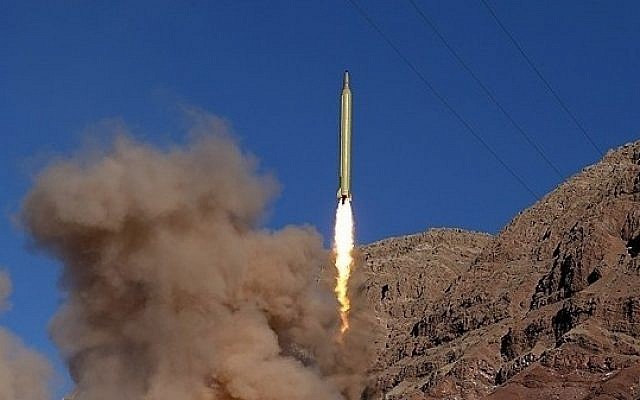
A missile launched from the Alborz mountains in Iran on March 9, 2016, reportedly inscribed in Hebrew, ‘Israel must be wiped out.’ (Fars News)
 
Infamously, Iran threatens world stability through its furtive efforts in streamlining ballistic missiles to accompany the nuclear warheads it claims it has no interest in producing. The Republic's support for terrorist groups such as its proxy militia Hezbollah in Lebanon which it dispatches on missions abroad to produce bloody carnage and which has most latterly been involved along with the Iranian Republic Guards Corps al-Quds division in Syria, is responsible for sectarian conflict in the Middle East.
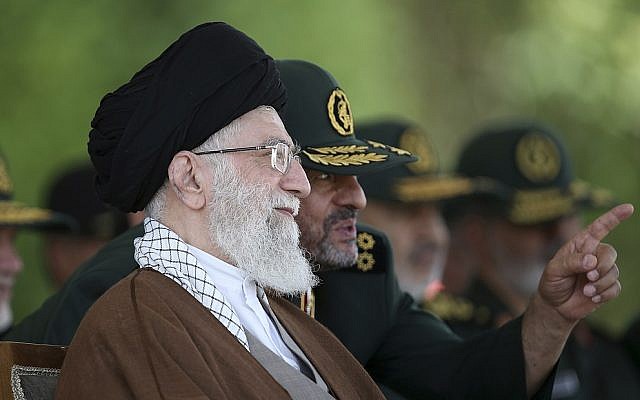
In this Wednesday, May 20, 2015 file picture released by the official website of the office of the Iranian supreme leader, Ayatollah Ali Khamenei listens to IRGC commander Mohammad Ali Jafari during a graduation ceremony of officers in Tehran, Iran. (Office of the Iranian Supreme Leader via AP, File)
In this 2015 file picture released by the official website of the office of the Iranian supreme leader, Ayatollah Ali Khamenei listens to IRGC commander Mohammad Ali Jafari during a graduation ceremony of officers in Tehran, Iran. (Office of the Iranian Supreme Leader via AP, File)

In response to Iran's reputation and its penchant for meddling in other countries' affairs to its advantage, Canada's former Conservative-led government under Prime Minister Stephen Harper cut off diplomatic relations with Iran, closing the Canadian embassy in Tehran, and inviting Iran to close its embassy in Ottawa, while taking steps to take possession of its non-diplomatic financial assets in Canada to be used in financing compensatory awards to victims of Iranian terrorism.

Unfortunately, the following Liberal-led government of Prime Minister Justin Trudeau seeks to reverse all of that under the influence of a pro-Iranian lobby urging the reopening of the embassies and re-engaging in trade with Iran through commerce with companies owned and operated by the revolutionary Islamic government's ayatollahs and their Iranian Republican Guard Corps elite commanders. Canada's Liberal government recently financed a $100-million business deal between Iran and Bombardier, Canada's aerospace conglomerate.

Labels: , , , , , , , ,

() Follow @rheytah Tweet