Deadly Russian Malice
 |
| Ukraine's President Volodymyr Zelenskyy appears on screens as he speaks via a video link at the opening session of the International Crimea Platform Parliamentary summit, organized by Ukraine and Croatia, in Zagreb, on Tuesday. (Damir Sencar/AFP/Getty Images) |
"Our countries made clear that we all reject Russia's transparently false allegations that Ukraine is preparing to use a dirty bomb on its own territory.""The world would see through any attempt to use this allegation as a pretext for escalation."France, Britain, United States joint statement"[The aim of a] dirty bomb [attack by Ukraine would be to blame the resulting radioactive contamination on Russia by accusing Moscow of detonating a low-grade nuclear weapon].""The aim of the provocation would be to accuse Russia of using a weapon of mass destruction in the Ukrainian military theatre and by that means to launch a powerful anti-Russian campaign in the world."Russian Defence Ministry
"If Russia calls and says that Ukraine is allegedly preparing something, it means one thing: Russia has already prepared all this.""So when today the Russian Minister of Defence organizes a phone carousel and calls foreign ministers with stories about the so-called 'dirty' nuclear bomb, everyone understands who is the source of everything dirty that can be imagined in this war."Ukrainian President Volodymyr Zelenskyy
 |
| Ukrainian National Guard soldiers fire at Russian positions with a mortar near Kharkiv, Ukraine, on Tuesday. (Andrii Marienko/The Associated Press) |
Ukrainian forces are advancing toward the Dnipro River, a counteroffensive to retake Kherson the province and the city, from Russian occupation. All the more disconcerting to the Kremlin in the wake of its announcement of the annexation of the area along with three other south-eastern areas of Ukraine. Following hard on claims that those four provinces are Russian territory, Moscow advised the world and Ukraine in particular, that any action taken to recover the territory would be construed as an 'act of war' against Russia.\, with predictble consequences including nuclear.
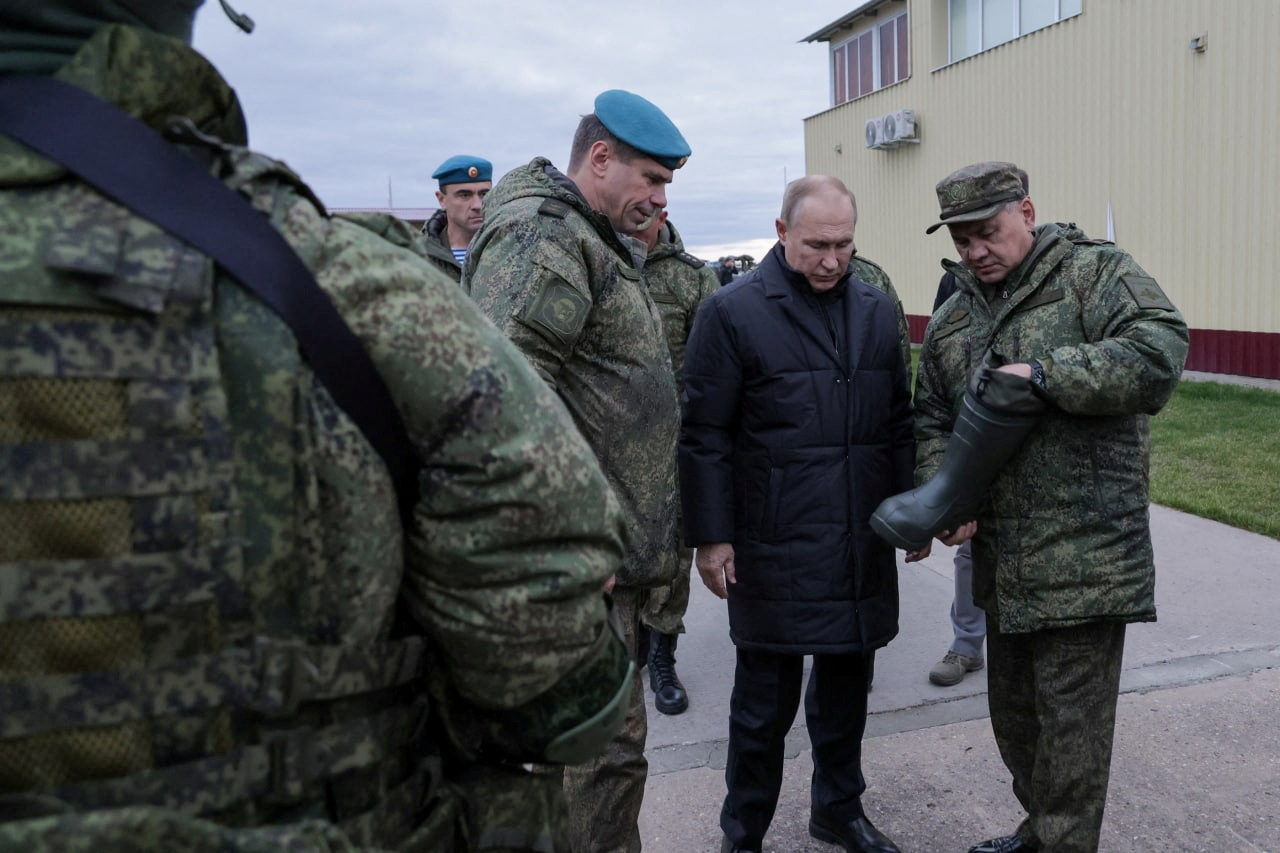
A sanctimonious charge so arse-backwardly absurd it would make a good script for a theatrical comedy lampooning Russia, if it were not so obviously the work of a land-grabbing, nation-destroying, anti-human rights national government whose invasion exploits are the stuff of nightmares. A self-righteousness so deranged that the Russian Defence Minister Sergei Shoigu had the unmitigated call to to call his counterpart ministers of France, Britain and the United States to inform them of an odious plot Ukraine was engaging in.
In fact it became almost instantly transparent that the revelation was in reverse order; that Russia is scheming to make use of a radioactive bomb of limited power and range that would be used as 'evidence' of Ukraine's willingness to begin a nuclear war between Russia and NATO, spurring Russia to self-protection, to respond in kind. Not Russia's fault, goes the plotline, if the 'neo-Nazi' government of Ukraine provoked Russia to such an extent it had little option but to reciprocate.
In a follow-up call with Russia's military Chief of General Staff Valery Gerasimov, British Chief of Defence Staff Tony Radakin made it quite clear his government rejected the Russian allegations, even while taking pains to convey the sensible message that both sides continue to maintain open channels of communication as a vital commitment.
Kremlin spokesman Dmitry Peskov, when asked to comment on Western skepticism of Russia's Ukraine accusations, responded "their disbelief doesn't mean there's no threat. The threat is evident." In ostensible response to which Moscow has ordered civilian evacuation of the territory in advance of the Ukrainian forces' advance. Should Russia suffer a defeat in Kherson it would represent a massive setback of the Russian 'special military invasion' agenda.
The west bank of the Dnipro River represents Russia's sole foothold of the area. That area where the Dnipro i\bisects Ukraine is a gateway to the Crimean peninsula, annexed by Russia in 2014.
Energoatom, Ukraine's state nuclear plant operator, said it assumes ... the Russians to be preparing a terrorist act using nuclear materials and radioactive waste stored at [the plant]. It said there were 174 containers at the plant's dry spent fuel storage facility, each of them containing 24 assemblies of spent nuclear fuel.
"Destruction of these containers as a result of explosion will lead to a radiation accident and radiation contamination of several hundred square kilometres of the adjacent territory."
 |
| People shelter inside a subway station during a Russian missile attack in Kyiv on Tuesday. (Vladyslav Musiienko/Reuters) |
Labels: Nuclear Threats, Russian Invasion of Ukraine Ukrainian Military Counteroffensive, Russian War Crimes
posted by Pieface | 9:51 PM
|
0 comments