Politic?

This is a blog dedicated to a personal interpretation of political news of the day. I attempt to be as knowledgeable as possible before commenting and committing my thoughts to a day's communication.

Sunday, April 19, 2026

Sudan : An Abandoned Crisis
https://www.rescue.org/sites/default/files/styles/super_widescreen_21x9_2058px_wide/public/2024-07/8S3A8129%E2%80%9321x9%20%281%29.jpg?itok=-uAQ5tC-
International Rescue Committee
 
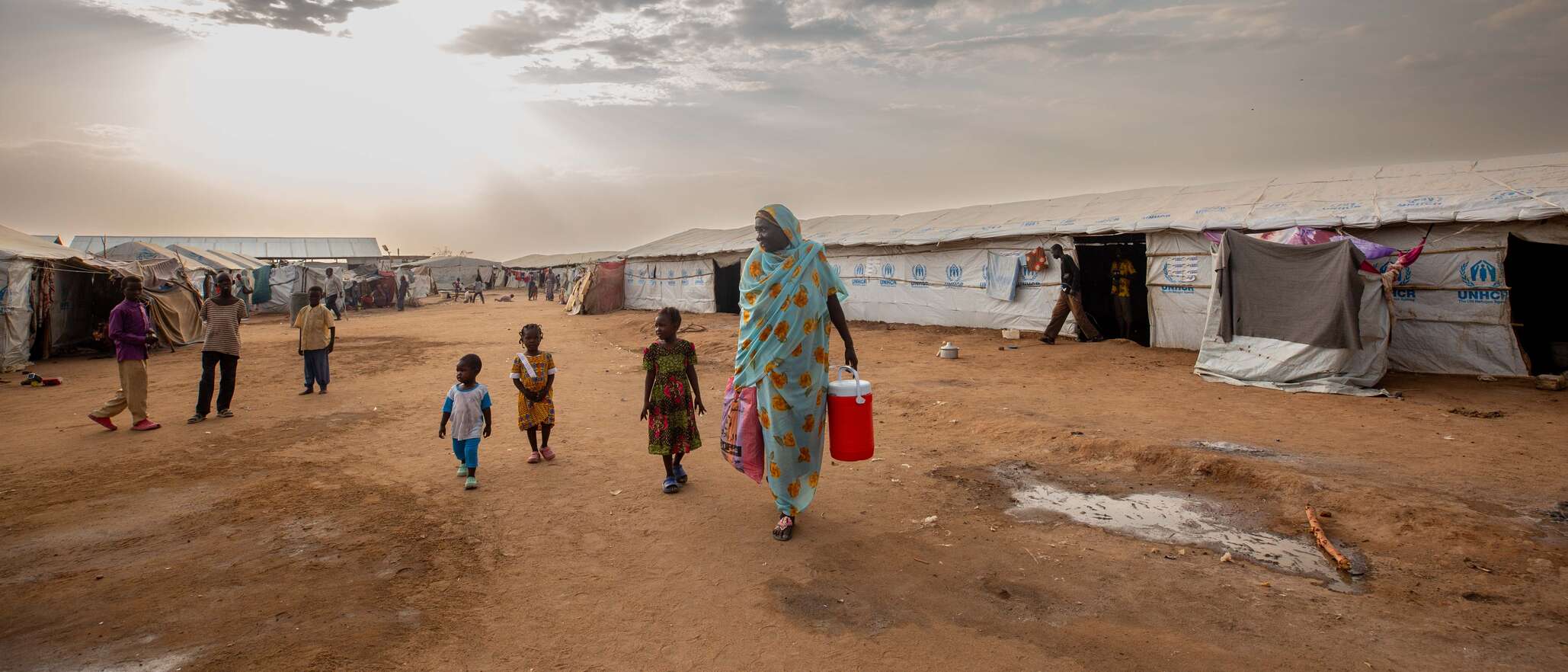
"Even before the war in Sudan erupted in April 2023, the country was already experiencing a severe humanitarian crisis that left 15.8 million people in need of aid. Now, three years of war have drastically worsened these conditions, displacing approximately 14 million people and leaving 33.7 million people—two-thirds of the population—in need of humanitarian support."
"The country’s food system has been pushed to the brink, with millions of families now surviving on just one meal a day, or less."
"Sudan is the largest humanitarian crisis in the world in terms of number of people who need humanitarian aid. It is also the largest and fastest displacement crisis."
International Rescue Committee
 
 
  • As Sudan marks three years of war, MSF teams continue to treat people whose lives have been devastated by the conflict between the Sudanese Armed Forces (SAF) and the Rapid Support Forces (RSF).
  • A lack of basic services and constrained humanitarian access are compounding people's suffering.
  • The warring parties must protect civilians and be held accountable for their violations, and the international community must use diplomatic pressure to prevent further crimes. 
  • Medicins Sans Frontieres  
    APTOPIX Sudan War
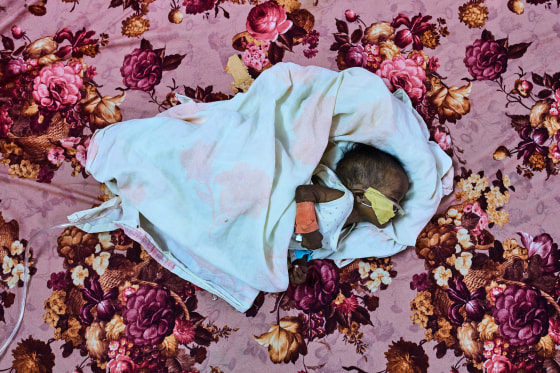
    Patient Saidal Altaher, 2 months old, being treated for malnutrition at the pediatric hospital stabilization center in Port Sudan on Wednesday.  Bernat Armangue / AP
     
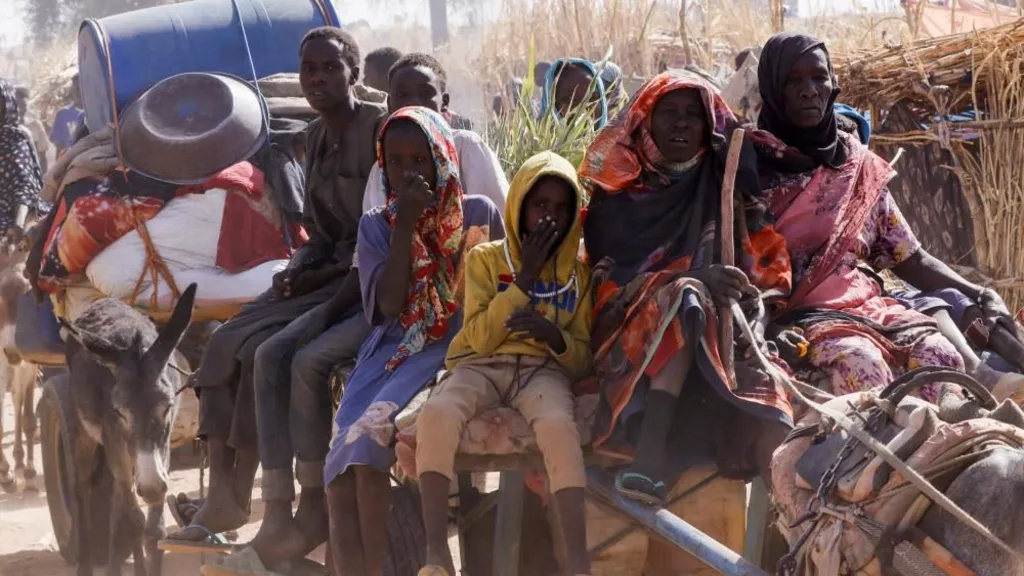
    Described as the world's largest humanitarian challenge in terms of displacement and hunger, Sudan is suffering a crisis of abandonment with the world's attention turning to the Middle East and the standoff in Iran, and its blockade of the Hormuz Strait. In Sudan, 13 million people have been forced by the threat and violence of a bloody conflict to flee their homes, becoming internally displaced. Food and medicines are scarce and diseases like cholera are running rampant. 
     
    The number of  dead from the conflict stands at 59,000 with 6,000 having perished over three days alone, as the RSF (paramilitary Rapid Support Forces) bulled their way through the Darfur outpost of el-Fasher in October, an offensive that the UN considers alike "the defining characteristics of genocide". Black Darfurians once again in the rifle sights of the horsed Arab Janjaweed as they were in the early 2000s.
     
    Severe acute malnutrition is set to afflict 800,000 people in parts of Sudan, according to the Integrated Food Security Phase Classification. Two of every three Sudanese require assistance, according to the United Nations. Health facilities have been impacted to the point where only 63 percent remain fully or partially functional to deal with the conflict's wounded and emerging disease outbreaks. 
     
    Denise Brown, the UN's top official in Sudan, criticizing the international community for its failure to press for the end to the conflict, stating: "A plea from me: Please don't call this the forgotten crisis. I'm referring to this as an abandoned crisis", she corrected. 
     
    https://ichef.bbci.co.uk/news/1024/cpsprodpb/3cf9/live/b8148000-373d-11f1-8606-05fe34b06e1b.jpg.webp
    People fleeing conflict in Sudan's Darfur risked being hit by drone strikes   Reuters
     
    Following the deposed dictator Omar al-Bashir in 2019, a power struggle emerged between the Sudanese military under General Abdel-Fattah Burhan, and RSF commander General Mohamed Hamdan Dagalo, who was initially Burhan's deputy at the ruling sovereign council of Sudan. Sudanese "have become powerless and are subjected to foreign dictates", claimed a Sudanese journalist and researcher.
     
    Germany undertook to host a  conference in Berlin, welcoming governments, UN agencies and aid groups to take part, with a goal to rally donors to assist in funding strained humanitarian responses and to "promote an immediate ceasefire", according to the German Development Ministry. For its troubles, the Khartoum government condemned the conference as an 'unacceptable' interference on Sudan's internal affairs. 
     
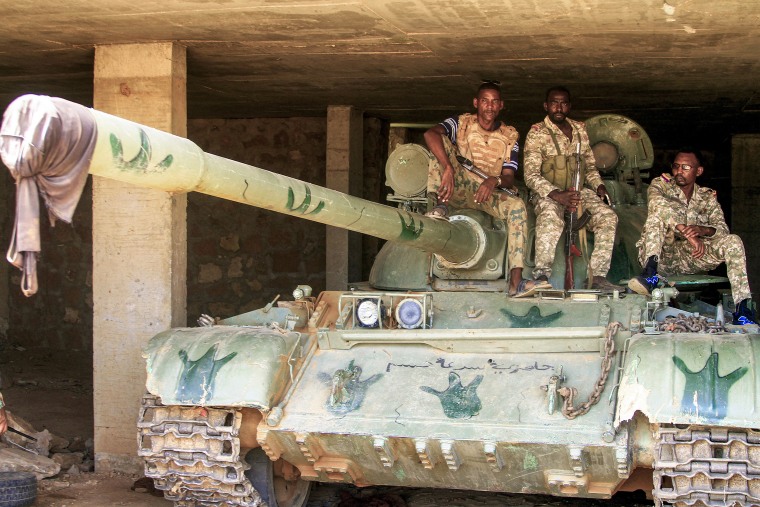
    The Sudanese military has control over the country's north, east and central regions, its oil refineries and pipelines, and Red Sea ports. The RSF and its allies control Darfur and the region at the border with South Sudan. Regions that both include oilfields and gold mines. Egypt supports the Sudan military, and the United Arab Emirates has been accused by the UN of providing arms to the RSF, which it emphatically denies. 
     
    In the three years of conflict, widespread atrocities are known to have occurred;  rampant sexual violence in gang rapes and mass killings, among them. According to the WHO, hospitals, ambulances and medical workers have been attacked, claiming over 2,000 have been killed.  Most atrocities have been placed at the feet of the RSF and the Janjaweed, notorious for atrocities committed in the early 2000s against Black Sudanese farming communities. 
     
    TOPSHOT-SUDAN-CONFLICT
    Sudanese army soldiers sitting atop a parked tank after their capture of a base used by the RSF, after the rival paramilitary group evacuated from the Salha area of Omdurman, the twin city of Sudan's capital, in May 2025.  Ebrahim Hamid / AFP via Getty Images


    Labels: , , , , , , ,

    Sunday, June 16, 2024

    Sudan in Extremis

    "[The] DNA of the conflict in Darfur of 20 years ago is still present in the fighting today, but this war is more ferocious."
    "The atrocities that were committed in this war, it is unlike anything that Sudan has seen before."
    "[The RSF has been] systematically destroying civilian dwellings [in areas that have a significant population of Zaghawa, an ethnic minority in Darfur]."
    "This represents the first specific evidence of potentially ethnically motivated alleged targeting inside El Fasher by RSF."
    "I’m sure Sudan will come out of this. I just hope that these dark days will be short, this war will end soon, and that the world will help us."
    Omer Ismail, acting foreign minister, Sudan’s transitional government before the military coup
    https://fl-i.thgim.com/public/incoming/x8wjoq/article68292893.ece/alternates/LANDSCAPE_1200/69364297_403.jpg
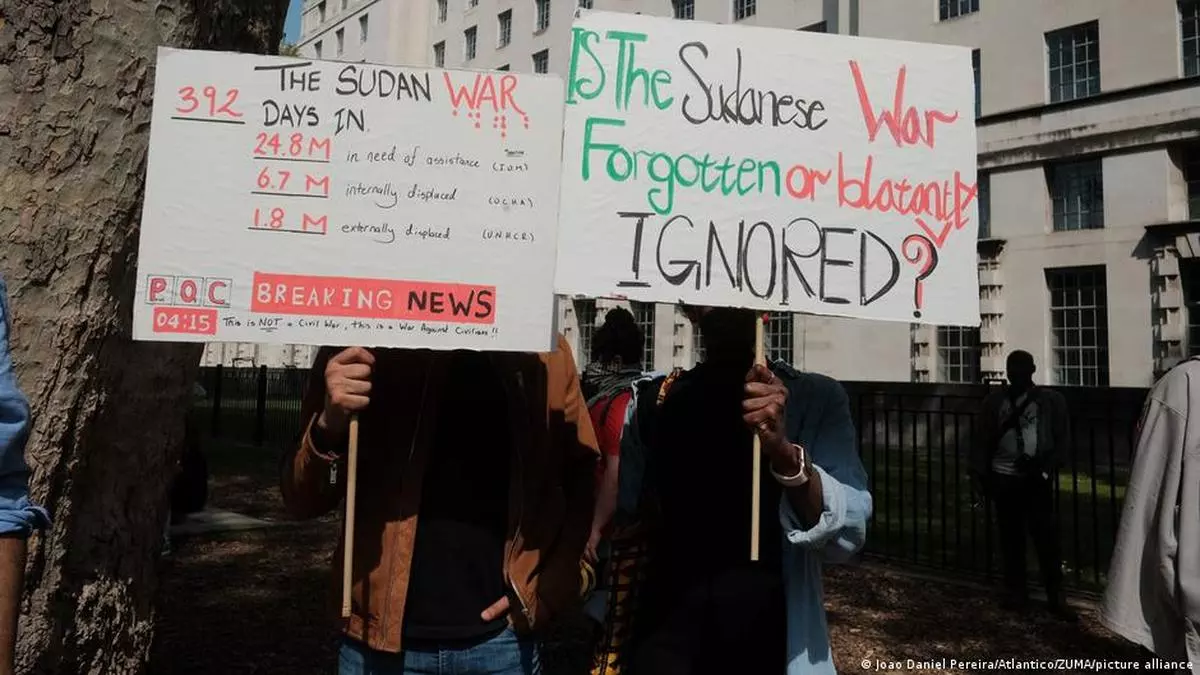
    The year-long civil war in Sudan has been overshadowed by the conflict in Gaza and the war in Ukraine. | Photo Credit: Joao Daniel Pereira/Atlantico/ZUMA/picture alliance

    "I’ve been really grappling with this question basically since I started working on Sudan issues in 1997."
    "Like so many things in life, the answer is a mix of things. One factor is the complexity of the situation, where neither side is obviously 'good or evil'. [Another may be a deeply ingrained, potentially even subconscious, racism or Eurocentrism where outsiders incorrectly perceive the fighting as somehow 'uncivilized' or 'typical'."
    Roman Deckert, Geneva-based independent expert on Sudan
     
    https://media-cldnry.s-nbcnews.com/image/upload/t_fit-560w,f_avif,q_auto:eco,dpr_2/rockcms/2023-05/230531-sudan-army-abdel-fattah-al-burhan-mn-1025-090823.jpg
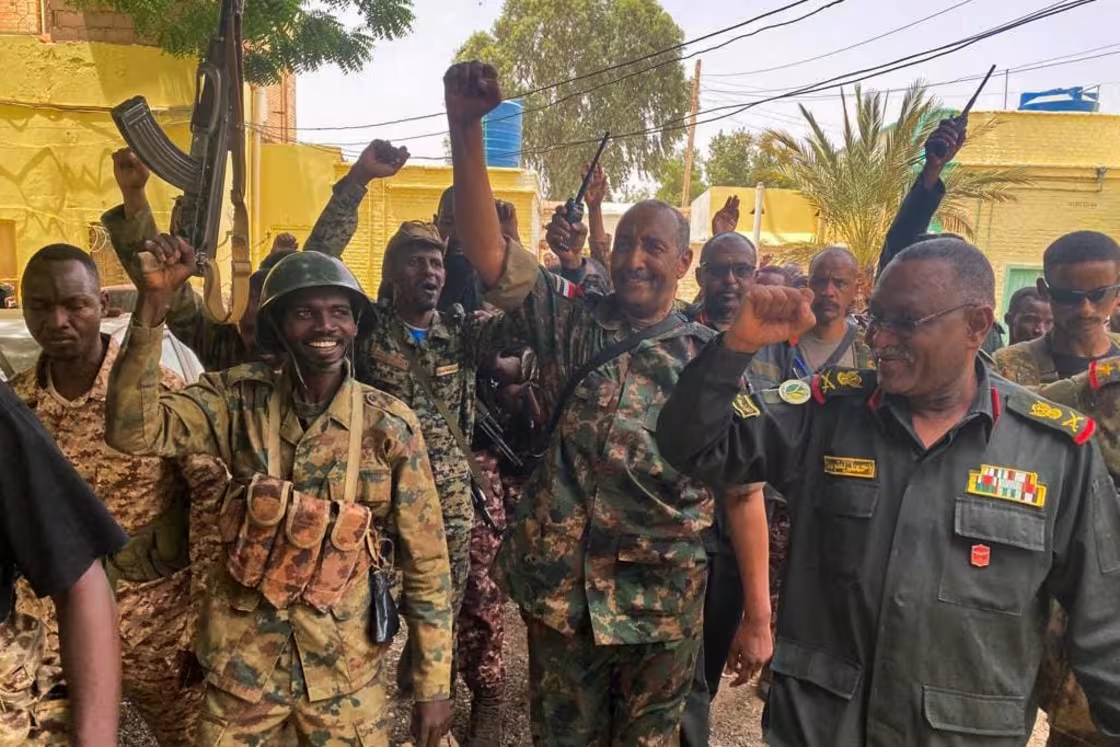
    Army chief Abdel Fattah al-Burhan cheers with soldiers in Khartoum last month. Sudan's Armed Forces via AFP - Getty Images
    The current war in Sudan began with a disagreement between the country's army chief, General Abdel Fattah al-Burhan, and Lieutenant General Mohamed Hamdan, leader of the Rapid Support Forces -- formerly the Janjaweed, armed Islamist horsemen involved with the massacre of non-Arab Darfurian farmers during the previous government of President Omar Hassan al-Bashir, condemned by the International Court of Justice for war crimes and crimes against humanity -- in a power play. Since the initial phase of the conflict, other armed forces backing the Sudanese military have joined the conflict.
     
    Now, corpses lie in the streets, and much of Khartoum, the capital, has become a rubble graveyard. Hospitals and homes have been smashed to rubble by artillery shells that soar over the Nile River. Death is so much a part of people's lives now that residents hesitate to venture too far from home -- even where security is scarce there too -- leading them to bury their dead outside the front doors of their homes. 
     
    One of the largest cities in Africa, Khartoum is now reduced to a battleground as two generals' fight for power brought the nation to civil war, and Khartoum became ground zero for a humanitarian catastrophe. An estimated 150,000 people have been killed in the space of a year. Nine million people fled their homes, comprising the globe's largest displacement crisis, (rivalling that of Syria), according to the United Nations. Officials warn an oncoming famine could kill hundreds of thousands of children in coming months.
     
    Foreign countries such as the United Arab Emirates, Iran and Russia all play a role in the chaos in a volatile mix of outside interests providing endless weapons or fighters to the conflict that began in April of 2023 with a standoff between the military and the paramilitary Rapid Support Forces when gunfire burst on the streets of the Sudanese capital. Rivals, they ruled together after seizing power in 2021 before falling out over military merging.
     
    The conflict appears stale-mated with the war metastasizing into a free-for-all that has devastated the country, with another genocide threatening Darfur after the war crimes committed two decades earlier. Disparate armed groups have entered the conflict even as the Sudanese state collapses, threatening the stability of a fragile region. Expert onlookers feel it to be a matter of time before Chad, Eritrea or South Sudan, as neighbours of Sudan, become involuntarily involved.
     
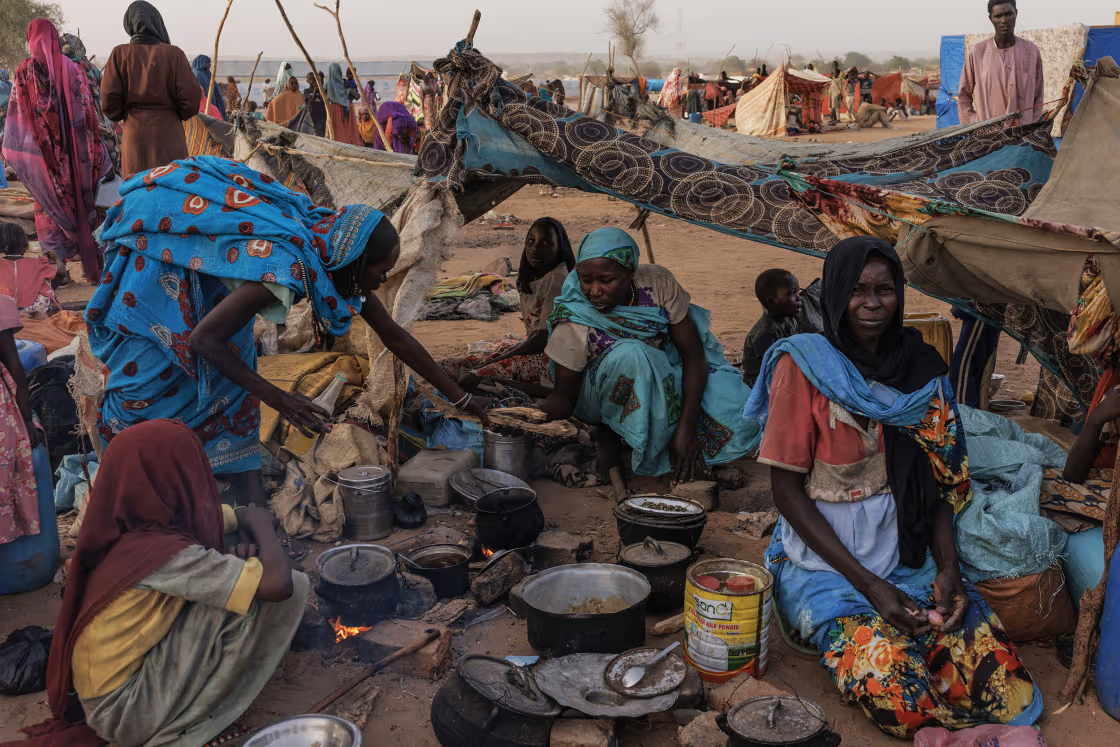
    https://media-cldnry.s-nbcnews.com/image/upload/t_fit-560w,f_avif,q_auto:eco,dpr_2/rockcms/2024-06/240613-darfur-refugees-chad-mb-1145-073fd8.jpg
    Sudanese refugees at their makeshift shelters at a relocation camp near Adre, Chad. Over 600,000 new refugees have crossed the border from Darfur into Chad. Dan Kitwood / Getty Images
    Khartoum state's nine million residents have seen half flee the conflict. Most of the capital's bank branches have been looted, thousands of vehicles have been stolen as street-by-street looting becomes commonplace, mostly committed by the R.S.F. Few hospitals are now operating; in them starving infants approach death. Famine is underway in parts of Darfur and Khartoum with over 220,000 children expected to perish in coming months in a conflict where both sides use hunger as a weapon.
     
    While Rapid Support Force fighters loot aid trucks and warehouses, the Sudanese army withholds visas, travel permits and permission to cross front lines. "One of the most horrific situations on Earth is on a trajectory to get far, far worse", commented the U.S. envoy for Sudan. Since the fall, rebels from Darfur, ethnic militias, Islamists and thousands of women and men have been recruited to join the military.
     
    While the United Arab Emirates is supplying weaponry to the R.S.F. in anticipation of building a port on the Red Sea, Egypt has backed the military. The army has turned to Iran for a supply of drones and other weapons. Russia too is involved, offering assistance to both sides. Wagner mercenaries last year supplied the R.S.F. with antiaircraft missiles. Russians trained fighters to shoot down Sudanese warplanes. More latterly Sudan prepared to allow Russian naval access to its ports in exchange for arms and ammunition.
     
    International concerns are that the war could spill beyond Sudan's borders, risking sucking in Ethiopia, the second-most populous country in Africa which Sudanese officials accuse of backing the R.S.F. Ethiopia's traditional foe, Eritrea, sides with the Sudanese military. "It's sheer madness. The people of Sudan demand it [a United Nations peacekeeping force]. Enough is enough", former economy minister Ibrahim Elbadawi, protested from Cairo.
     
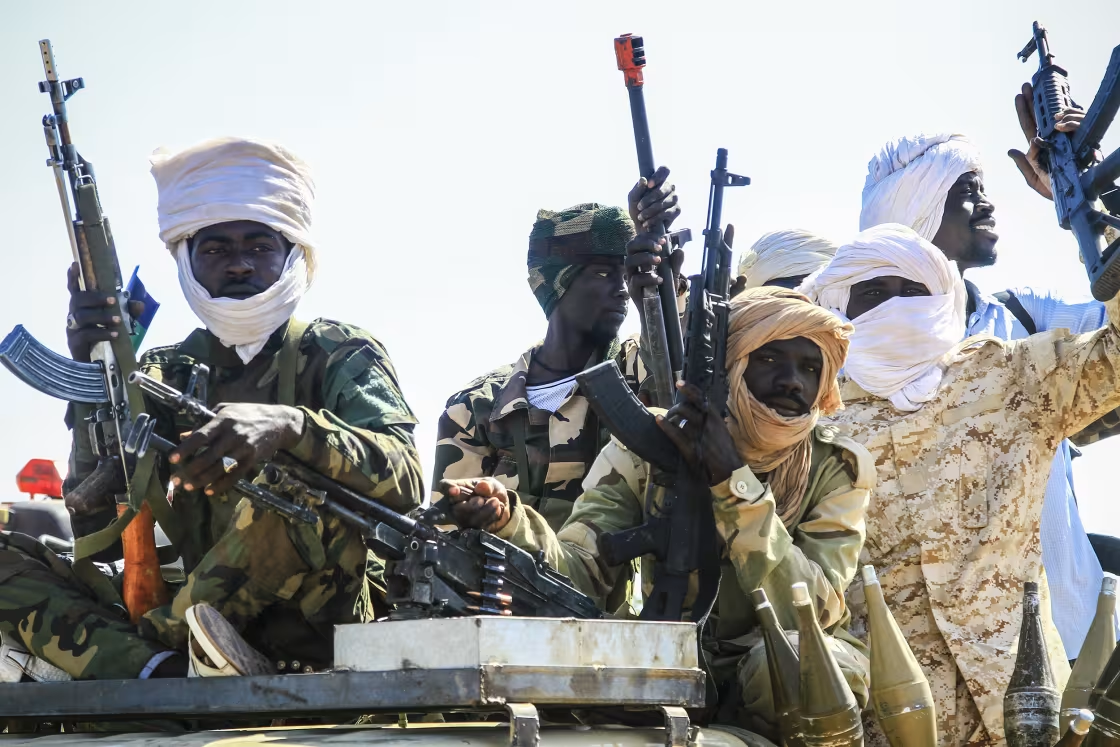
    https://media-cldnry.s-nbcnews.com/image/upload/t_fit-560w,f_avif,q_auto:eco,dpr_2/rockcms/2024-06/240613-sudan-mb-1141-f8b69c.jpg
    Fighters of the Sudan Liberation Movement, which supports army chief Abdel Fattah al-Burhan, in the southeastern Al Qadarif state in March. AFP via Getty Images

    Labels: , , , , , ,

    () Follow @rheytah Tweet