Addiction Compassion, Community Safety Disinterest
"Used needles also started popping up in the rear lanes on both sides of Heward Avenue, my street. These lanes are playgrounds for the many children who live on these streets, relatively traffic-free spaces where they can ride their bikes, play catch and shoot at basketball and hockey nets.""By 2019 there was a distinctive shift outside the South Riverdale Community Health Centre. It had, in a short amount of time, been transformed from a place of semi-discreet open use to something that bore a much closer resemblance to the open-air drug emporium that would grow over the next four years.""Drug dealing was becoming more rampant, as was open use.""Drug dealers would arrive by car across from my house most mornings, and the buyers would not-so-discreetly arrive to make purchases. There were also suddenly dealers on foot. But the most common dealers, especially of late, are ones on bikes, typically wearing backpacks."Derek Finkle, Leslieville, Toronto
 |
| A view of the South Riverdale Community Health Centre. (CBC) |
This is a description of a 'supervised consumption' site. Where the drug-addicted receive special care in an effort to keep them from being yet another statistic of a fatal overdose scenario. Fentanyl use is raging across Canada. Toronto isn't the worst Canadian city for drug overdoses, Vancouver takes that very special award. In fact, Vancouver is likely the most overdose-prone city in all of North America. The struggle by compassionate health authorities to keep people alive is commendable.
The people who live adjacent to supervised consumption sites may not consider their proximity to be much of a boon to the quality of their lives and that of their children, however. The sites are notorious for public disorder and crime; the centres' managers seem incapable of addressing these inconvenient side-issues that turn ordinary citizens' lives inside-out and upside-down. The commitment of the drug centres is to the addicted, not to people living in close proximity to their life-saving facilities.
Some of these centres hire active drug users and dealers for the success of their programming; people who have the 'lived' experiences, since who else knows as much about addiction as they do? And who would be more sympathetic to the plight of the addicted? And less affected by the crime scenarios that abound? As for example when an area resident was killed by a stray bullet near the safe injection site in the Leslieville community in July.
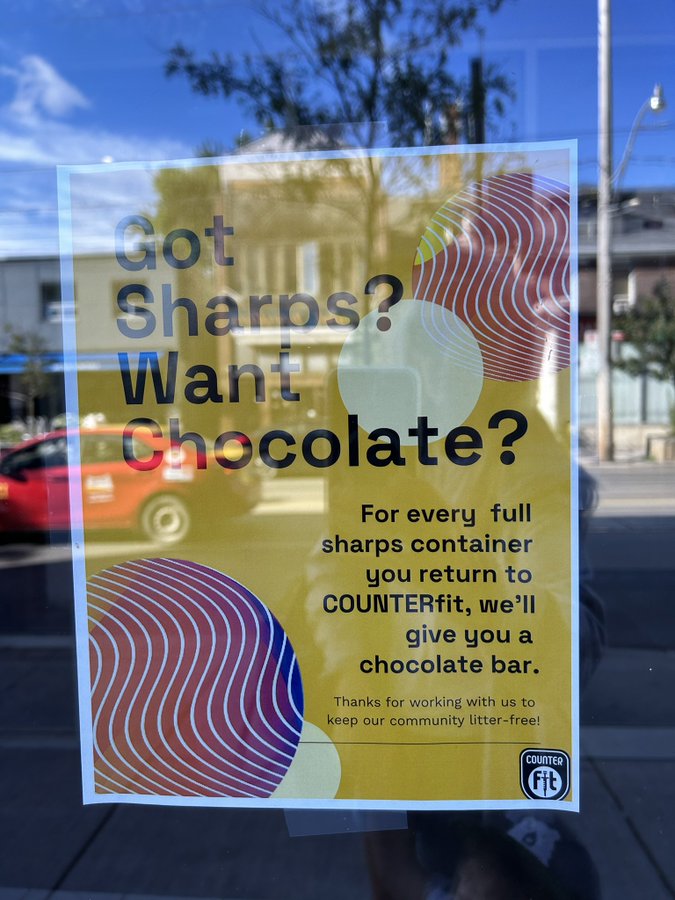 |
If you live in Leslieville and you're concerned about your kids picking up needles that surround the drug consumption site, you don't have to worry. In fact, if your kids collect enough they can trade them in for chocolate! Ginnie Roth |
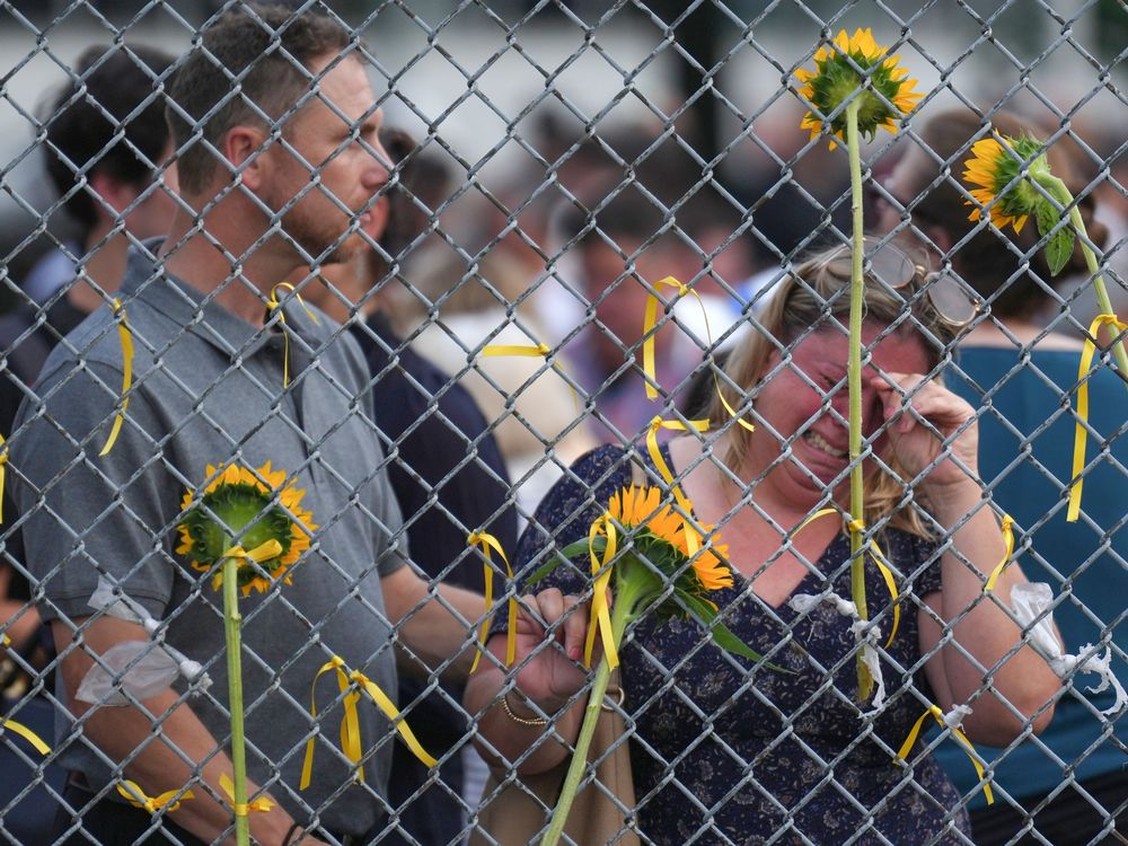
A harm reduction worker at the South Riverdale Community Health Centre, Khalila Zaa Mohammed, was arrested a month later, charged for assisting one of the shooting suspects to escape and hide from authorities. In the wake of her arrest a "critical incident review" was initiated of Ontario's consumption sites beginning with the SRCHC. The safe injection site sits within 100 metres of two schools and three daycares where used needles are ubiquitous, and a 5-year-old boy found a baggie with a chunk of orange fentanyl.
The South Riverdale Community Health Centre has initiated "Harm Reduction Satellite Sites" and there drug users are paid to operate quasi-supervised consumption sites right out of their own homes. A partner organization had an operating guide published for the edification of other service providers who might want to launch similar programs. The guiding principles of the document include building "spaces and services where repressive drug laws cannot be enforced". Service providers are encouraged to hire drug dealers to run the sites.
Trafficking is viewed as a type of expertise, and cooperation with dealers "a great way to reach people who otherwise don't typically engage with harm reduction services". Going to jail is a "part of life", the guide asserts; and satellite workers should remain on the payroll while incarcerated. It is "not appropriate to expect sobriety" from contracted drug users or dealers even while providing harm reduction services; "expectations that workers not use drugs with clients, which might be standard in other programs, should not apply to satellite workers".
The sites' existence should be hidden from landlords and other tenants to avoid eviction, service providers and satellite workers are advised by the guide that argues satellite workers can help users with information about police activity since they're within distressed communities. Citing journalist and Leslieville resident Derek Finkle, neighbours witness harm reduction workers using drugs outside the main consumption site of SRCHC, where police are "disinvited" from the property.
The situation prevails right across the country with Canadians reporting similar experiences at other consumption sites -- public drug use and trafficking, along with a crime epidemic and violent harassment. With it all a complete disinterest in how local residents are faring in this maelstrom of drugs, crime and flouting of the criminal justice system.
 |
Labels: Community Safety, Criminal Activities, Harm Reduction, Illegal Drugs, Safe Consumption Sites, Toronto
posted by Pieface | 8:50 PM
|
0 comments