Politic?

This is a blog dedicated to a personal interpretation of political news of the day. I attempt to be as knowledgeable as possible before commenting and committing my thoughts to a day's communication.

Saturday, April 18, 2026

China: Defender of Stability, Diplomacy, Open Global Economy: Yup

"Many want Beijing to play a larger role as a defender of stability diplomacy, and an open global economy."
"World leaders are heading to Beijing because they increasingly see China as a hedge against an unpredictable United States." 
Neil Thomas, fellow, Chinese Politics, Asia Society Policy Institute Center for China Analysis 
 
"Beijing also has concerns about managing its own relationship with Washington."
"More direct and active involvement in negotiations [with the Islamic Republic] could win the Trump administration's affirmation as much as earn its ire and blame."
Ja Ian Chong, associate professor of political science, National University of Singapore 
 
"It is very easy to criticize the U.S. Even America's allies are at odds with Trump and Washington these days."
"But sooner or later, China needs to go beyond the position of critic, and get some real diplomatic skin in the game."
Richard McGregor, senior fellow for East Asia, The Lowy Institute
https://static.dw.com/image/76770490_1004.webp
Spain struck a trade deal with China on Tuesday
 
China no longer viewed by the West as an economic ogre, one whose finesse at hostage diplomacy, whose penchant for cybertheft and purloining foreign industrial/commercial formulae and government secrets for its benefits; a gargantuan, omnivorous threat to the well-being of other nations' wealth and aspirations? What a swift transition. And to think that it has been occasioned by the president of the United States of America's belligerence over trade tariffs and unity in Western security over threats poised by Xi and Putin!
 
Yet in one week alone Spain's Prime Minister Pedro Sanchez, Abu Dhabi's Crown Prince Sheikh Khaled bin Mohamnmed, Vietnam's president To Lam, all came visiting one after another. Impressed, no doubt over President Xi Jinping's turning the leaf on his book of global exploits in presenting China as a source of dependable stability and (newfound) respect for international rules. As, for example in contrast to President Trump's unspeakably dire threat to bomb Iran "back to the Stone Ages", a bit of bluster to match Iran's own, that horrified Pope Leo XIV. 
 
In fact, the contrast is a deep and unfolding reality, where Trump's unchecked pronouncements on his social media site has served to further confound, affront and distance erstwhile staunch supporters in Europe, North America and Asia of U.S. policies and allied support. Italy's Giorgia Meloni, the U.K.'s Keir Starmer were this week recipients of President Trump's ire; not that it was undeserving, simply a trifle undiplomatic, as is his inimitable style. Nor did Pope Leo come away unscathed for his penchant at being "terrible for foreign policy"; that too not far from reality.   
 
Oh, and Italy's foreign minister also visited Beijing this week, coming away with a pledge that China is prepared to deepen ties with Rome. Mr. Trump's frustration with allies over their disinterest in teaming up with the U.S. military to open the Strait of Hormuz to normal shipping so that energy can continue to flow from the Persian Gulf to the people who most need and use it, including those allies, has deepened with their continued hands-off negativity.  
"Donald Trump’s second Administration is bringing about a historic reconfiguration of transatlantic relations, compelling the EU and its member states to reassess multiple dimensions of their foreign policy. In response to the deepening rift with Washington, Europe is adopting a hedging strategy by strengthening ties with other global actors, including China."
"This approach was underscored by Ursula von der Leyen at the World Economic Forum, referring to the 50th anniversary of the establishment of diplomatic relations with Beijing as ‘an opportunity to engage and deepen our relationship with China, and where possible, even to expand our trade and investment ties’. "
Mario Esteban, Elcano Royal Institute  
They've chosen instead to go-it-alone as a group, sans the U.S. and that purpose saw the U.K.'s Starmer in Paris to host a video conference alongside Emmanuel Macron, steering a coalition of some 40 countries planning to help independently restore free transit through the Strait of Hormuz, South Korea, Japan and Australia included -- all supporting a ceasefire in return for intervention. Nations in Southeast Asia have been given support in their energy crisis by a $10-billion financial package promised by Japan's Sanae Takaichi on a new "Power Asia" initiative.
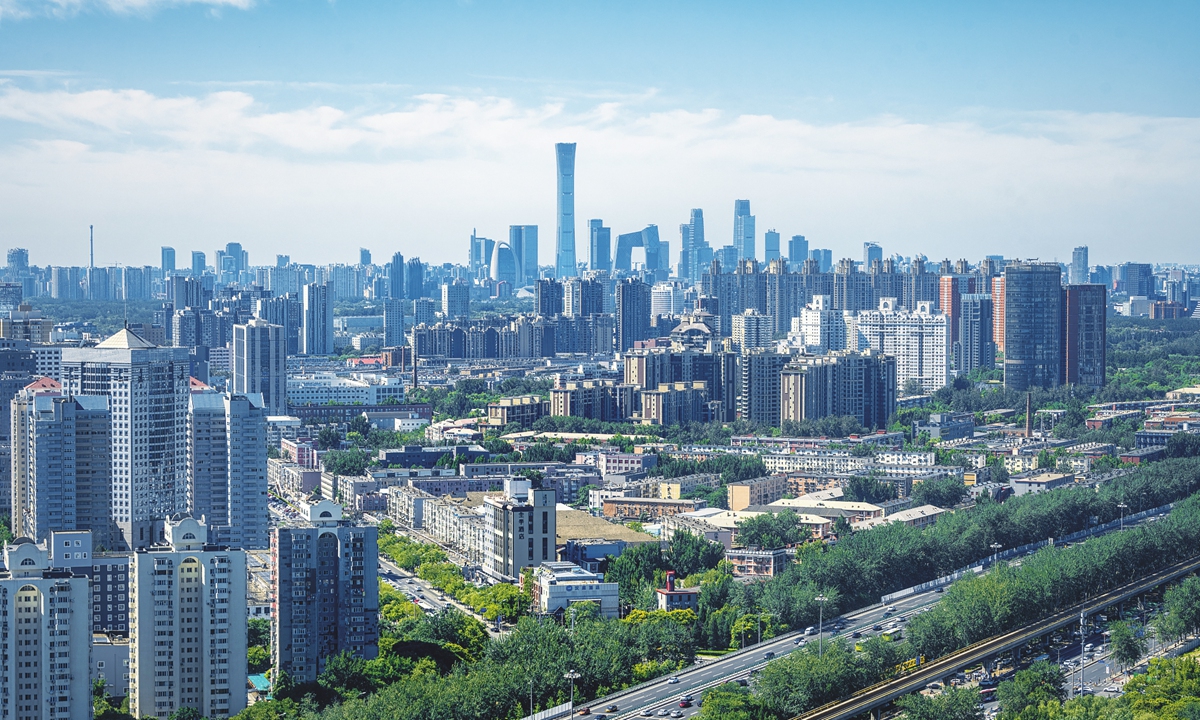
 
https://www.globaltimes.cn/Portals/0/attachment/2026/2026-04-12/e7db8f9c-f03b-4c0f-94db-ea9a1821c009.jpeg
An aerial view of the cityscape of Beijing, China Photo: VCG
 
That China stoutly maintains its support of Russia, despite its full-fledged conflict in Ukraine makes the entire scenario somewhat bizarrely Byzantine; even as European leaders, fixed in their support of Ukraine's battle to sustain its sovereignty, visit China to explore lucrative trade agreements, Xi met with Russian Foreign Minister Sergei Lavrov to pledge deeper bilateral coordination. Not to be forgotten is Russian and Chinese backing of Iran, their major oil supplier, despite global sanctions.
 
As the world's largest oil importer, China has vast commercial oil reserves to tide it conveniently over the current shortage afflicting its neighbours. China is content with taking an observer's back seat with the ongoing conflict in the Middle East. Officially it calls for restraint and de-escalation. Business as usual, for China.
 
https://cb-2022.netlify.app/images/country-guides/China-portal-add-banner-desktop.jpg
INVESTING IN CHINA
Powered by China Briefing, the experts at Dezan Shira & Associates, and their partners
 

Labels: , , , , , ,

Friday, January 23, 2026

Ukraine's Ongoing Existential Plight

"Europe looks lost. Just last year, here in Davos, I ended my speech with the words: Europe needs to know how to defend itself. A year has passed. And nothing has changed."
"We are still in a situation where I must say the same words again."
"[Ukrainians too seem caught in that reality in the war] repeating the same thing for weeks, months and, of course, for years. And yet that is exactly how we live now. It's our life."
"[Europe] still feels more like a geography, history, a tradition, not a real political force, not a great power."
Ukrainian President Volodymyr Zelenskyy 
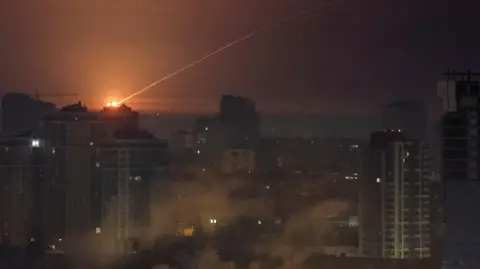
Reuters A missile is shot down over residential buildings in Kyiv
Zelensky said repelling Monday night's attack had cost Ukraine about €80m (£69m) just in terms of air defence missiles  Reuters
 
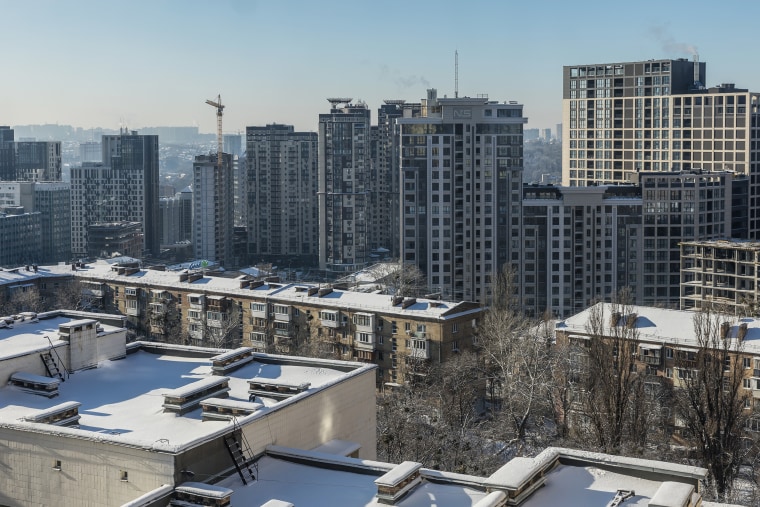
In Kyiv, close to 3,000 multi-storey residential buildings are without heat. Some 600,000 residents of Kyiv have been evacuated in the wake of Moscow's recent blitz initiated on New Year's Day. This week, roughly 60 percent of the capital city of Ukraine had no electricity during the worst winter in recent years, with temperatures hovering at -10C. Misery lives on in Ukraine. And somehow, Ukrainians muster the endurance to go on. 
 
Ukraine's allies in Europe were treated to a blistering charge of lack of adequate engagement in protecting themselves by not doing more to protect Ukraine. The slow, fragmented, inadequate response to the invasion launched by Russia four years earlier and its ongoing international aggression by daring Europe to do anything about it has finally irked a man with the weight of his responsibilities to the point of exasperation with the very allies he so much depends upon.

Heating and powercuts after the Russian strike amidst freezing temperatures.
Apartment buildings during subzero temperatures in Kyiv on Sunday. Oksana Parafeniuk for NBC News
 
Of course, Ukraine's ultimate fate also illustrates the potential of greater Europe's in the crosshairs of Vladimir Putin whose thirst for territorial gain will not be entirely quenched by an eventual success in looting territory from its neighbour. NATO and the European Union have thus far shown themselves to be less than fully engaged in rescuing one of their own -- if not in membership, then in solidarity with a sovereign nation aspiring to be one among them.
 
He had previously met once again privately with U.S. President Donald Trump in Davis. "Very good" talks, "Productive and meaningful", said Mr. Zelenskyy. And that could mean anything. It could mean that some hope still lies from that direction, and it could be a lie, to prevent his European allies from resigning themselves completely to surrendering all hope that slender threads remain before Ukraine is completely engulfed and their materiel aid has been for naught -- and  some among them are next in the lineup.
 
The financial, military and humanitarian support for Kyiv has been substantial, but against a much larger, better equipped military force, valiant Ukraine seems set for heavier territorial losses yet to come. Not all members of the 27-nation alliance are in support of Ukraine to be sure, but those that are can visualize their own sovereignty at risk, particularly those within the realm of Russia's unfortunate 'near abroad', the Baltic, Poland and the Nordic states. 
 
https://ichef.bbci.co.uk/news/1024/cpsprodpb/f517/live/ee9dc340-fe75-11ef-b50e-9d086302645f.jpg.webp
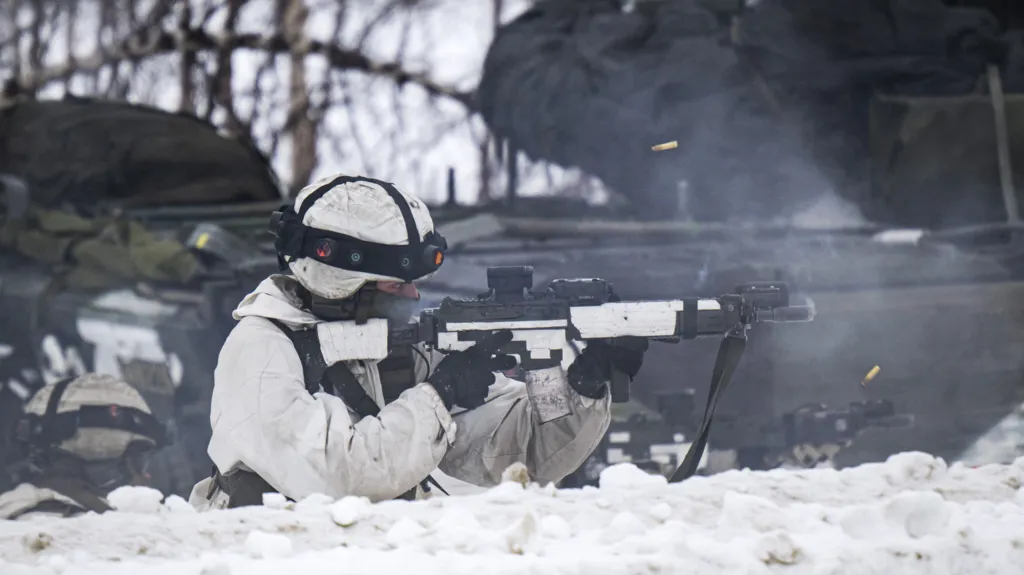
Sweden's security service said Russia's activities were mainly aimed at undermining Nato cohesion Getty Images
 
Since its February 2022 full invasion of  Ukraine, following initial kinetic hostilities in 2014, that gained Russia the annexation of Crimea, Russia has captured about 20 percent of Ukraine to the present. The 1,000-kilometre front line battles have still been an expensive gamble for the Kremlin with the Russian economy teetering under international sanctions, along with the cost of its invasion both in personnel and military hardware. 
 
Ukraine has proven adept in producing munitions of its own, in particular its drone manufacturing, but its need for financial aid from its allies is ongoing, as well as its dependence on Europe to continue providing it with the military weapons it so desperately ein need of to continue countering Russian advances; all the more so with its looming shortage of military operatives. 
 
Europe, Mr. Zelenskyy charged, has been too lax in acting on key decisions. It has spent too frugally on defence. Russia's 'shadow fleet' of oil tankers, breaking international sanctions have not been impeded as required. Worse, a consensus of agreement has not been reached for Russia's frozen assets to be used for finance Ukraine's battle for existence and eventual reconstruction. 
 
The world's attention, pivoting from Gaza and now to Iran has not been helpful in keeping Ukraine's plight under ongoing Russian attack front and centre, given a boost when President Trump began favouring Putin's war front over Ukraine's defense, which has now fizzled away, as the latest drama on the world stage continues to unfold, making Ukraine last week's news of diminished interest to a war-wearied global public. 
 
A crew member on the lookout from the bridge deck of HMS Carlskrona, a Swedish patrol ship .

Poland, Sweden and others are buying subs to protect pipelines   Getty Images

Labels: , , , , ,

Sunday, December 07, 2025

U.S. National Security Strategy (NSS)

"[European allies risk] civilizational erasure [as a result of their migration and free speech policies]."
"[Economic stagnation in Europe] is eclipsed by the real and more stark prospect of civilizational erasure."
"[Ending the war in Ukraine is a core U.S. interest to] reestablish strategic stability with Russia." 
"[Europe is enfeebled by its immigration policies, declining birthrates], censorship of free speech and suppression of political opposition [along with a] loss of national identities and self-confidence."
"Should present trends continue, the continent will be unrecognizable in 20 years or less. As such, it is far from obvious whether certain European countries will have economies and militaries strong enough to remain reliable allies. Many of these nations are currently doubling down on their present path. We want Europe to remain European, to regain its civilizational self-confidence." 
"[As for the Middle East], America's misguided experiment with hectoring [countries in the Middle East, especially monarchies in the Gulf, about their traditions and forms of government]."
"[The Arab nations are] emerging as a place of partnership, friendship, and investment. We should encourage and applaud reform when and where it emerges organically, without trying to impose it."
"[The U..S. strategy] is motivated above all by what works for America -- or, in two words, 'America First'."
U.S. National Security Strategy 
A person speaks into a microphone.
U.S. President Donald Trump speaks at an event in Washington, D.C., on Saturday. Trump's new national security strategy was welcomed by Moscow, according to a Kremlin spokesperson on Sunday. (Julia Demaree Nikhinson/The Associated Press)
 
"The adjustments that we see correspond in many ways to our vision."
"[The current U.S. administration is] fundamentally different from the previous ones." 
"President Trump is currently strong in terms of domestic political positions. And this gives him the opportunity to adjust the concept to suit his vision."  
Dmitry Peskov, Kremlin Spokesman  
A person seated leans back to speak with someone standing who bends over to listen.
Kremlin spokesperson Dmitry Peskov, left, speaks with Russian President Vladimir Putin in Moscow.(Sergei Ilnitsky/The Associated Press)
 
"This NSS is a real, painful, shocking wake-up call for Europe. It is a moment of cavernous divergence between Europe’s view of itself and Trump’s vision for Europe."
"If Europe had any doubt that the Trump administration is fully committed to a tough love strategy, it now knows for sure. The administration is asking—demanding, really—that Europe polices its own part of the world and, most importantly, pays for it itself."
"The most worrying parts of the strategy are the ones that chastise Europe for losing its European character. The sentiment behind the words seems to stoke fear of migrants and an adherence to an idealized, old-world Europe that is questionable at best. Modern Europe is vibrant, evolving, and—largely—pretty happy."
"The majority of Europe’s reaction to this NSS is likely to be the same aghast shock as met Vice President JD Vance’s Munich speech."
Center for Strategic & International Studies (CSIS) 
Released on Friday, the Trump administration's new national security strategy will give no comfort whatever to its heretofore allies in Europe, while Russia has already expressed its cautious pleasure, and China will be satisfied to an extent; Latin America has more to puzzle over, and the Middle East will feel somewhat gratified and no little relieved, for the most part. America's erstwhile partners in Europe stand to wallow in discomfort and uncertainty, not quite recognizing its place in this new America First reality imposed upon the world.
 
A disconcerting pivot from the role of controlling, stabilization empire of the globe to a new hands-off policy which allows other nations the pleasure of going it alone when it comes to stability and self-defense. With the second election/administration of Donald J. Trump to the presidency of the United States of America a new world order came into effect. On the other hand, Mr. Trump remains dedicated to 'peace' and peace-making, still counting on the Nobel Committee to come to its senses in 2026 -- which hasn't given it pause in striking 'terrorist' boats in the Caribbean Sea trafficking drugs to the U.S.
 
This is a document required by law that the administration must release; and it presents a break from former president Joe Biden's Democratic administration's course of intent which implemented a campaign to reverse Mr. Trump's first administration's trajectories. In brokering an end to the four-year-stagnant conflict in Ukraine, the first shock was the virtual abandonment of Ukraine's sovereign rights and a surprise embrace of Moscow's territorial imperative. An end to the war is not designed to liberate Ukraine but rather to consolidate a rapprochement with Russia.
 
As for America's European allies, their intransigence in supporting Ukraine and expecting the United States to continue the previous administration's commitment to that end, has left those expectations adrift and discombobulated. Trump's position in a drive to "reestablish strategic stability with Russia", when Europe's concerns are the Kremlin's yearning to restore the Soviet bloc to its former glory and NATO is stuck in a position of unease when its member-states are forced to cope with mysterious drones flying over their airports and military bases, flounders with its most powerful ally scorning its utility.
 
Jewish population of Greater New York reaches 1.4 million - JNS.org
Jewish population of greater New York reaches 1.4 million. JNS
 
The United States, of course, faces no issues of immigration/migrant/refugee instability where Congress is faced with elected Representatives from Somalia and 'Palestine' backgrounds along with other Muslim Arab-Americans whose loyalties to the United States are not always evident. The U.S. 'melting pot' has installed imams in mosques whose Friday sermons don't exactly praise democracy and love of their fellow-man. New York electing an avowed Socialist, Muslim extremist whose contempt for America's ally in the Middle East has him broadcasting his intention to 'arrest' Prime Minister Benjamin Netanyahu should he come to New York City, the major home of Jewish-Americans.
 
The world at large is extremely well aware of the presence of Donald J. Trump in the White House. It is still reeling from the economic blows of trading with the United States where former free-trade agreements have been swept into the dust heap of the past as economy-crippling tariffs have taken their place. The sovereignty of nations called into question when U.S. national security under Mr. Trump eyes Greenland and Canada as potential extensions of the United States. It's Mr. Trump's very own version of How to Win Friends and Influence People.  
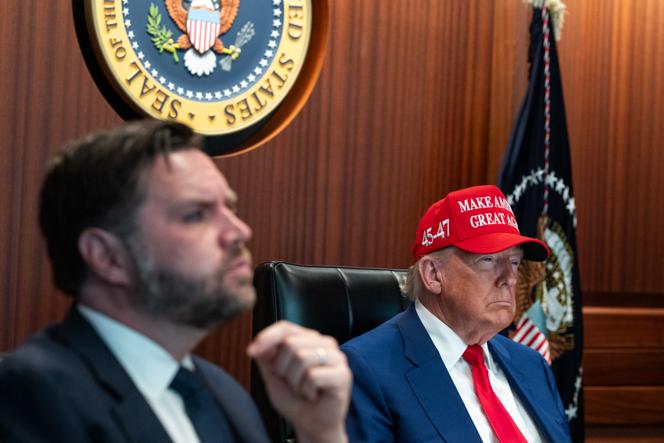
US Vice President JD Vance and Donald Trump at the White House, Washington, June 21, 2025.
J.D. Vance and Donald Trump   Getty Images
"That strategic clarity is entirely missing from the new NSS, which is more polemic than policy. The north star of great power competition with China and Russia—around which the first Trump administration built bipartisan consensus—is gone."
"Rather than describing the scope and scale of China’s systemic challenge to the United States and our allies and partners, the 2025 NSS makes clear that economics are “the ultimate stakes.” The new paramount objective of Washington’s China policy is a “mutually advantageous economic relationship with Beijing.” 
"The discussion of Russia is mealymouthed at best: The document declines to characterize the threat Moscow poses to U.S. interests. It instead opts for the bizarre formulation, “many Europeans regard Russia as an existential threat.” 
"And while the 2017 NSS highlighted Iran and North Korea as second-tier threats, the new NSS does not mention North Korea at all and downplays the danger posed by Iran after Operation Midnight Hammer."
"Vance’s speech in Munich could have been interpreted back in February as the ideological views of just the vice president and parts of the radical MAGA base. But now, these views have become the administration’s official policy, which will only accelerate Europe’s efforts to hedge against the United States and to build up its own autonomy."
Council on Foreign Relations  
https://time.com/redesign/_next/image/?url=https%3A%2F%2Fapi.time.com%2Fwp-content%2Fuploads%2F2025%2F10%2FGettyImages-2198761888.jpg%3Fquality%3D85%26w%3D1024&w=1920&q=75
 

Labels: , , , , , ,

Friday, February 14, 2025

"Everything Is On The Table"

"[The main issue is to] not allow everything to go according to Putin's plan. We cannot accept it, as an independent country, any agreements [made] without us."
"He [Trump] never mentioned in a conversation that Putin and Russia was a priority. We, today, trust these words. For us it is very important to preserve the support of the United States of America." 
"[Ukraine needs security guarantees above all] Because we are talking about security guarantees as the main point in any document on the cessation of war or the end of the war, security guarantees for Ukraine, for the whole of Europe, and Ukraine is already part of Europe and will be part of an equal European Union."  
"We need the strong support of a strong country, the United States, a strong President [Donald] Trump, we need his support and we need him to be on our side."
"It’s not two countries fighting each other, but Russia bringing war to our land and we are defending it, I think, with honour."
"A peace agreement cannot be signed in Munich, because this is Munich and the president [Donald Trump] is not here. And we remember the things that have already been signed here."
"If we talk pragmatically, not only about the defence of Europe, although I think that the defence of Europe is the priority and people are the priority, but we can also talk about it pragmatically from a financial point of view."
Ukrainian President Volodymyr Zelenskyy
 
"Just as Putin has no intention of stopping hostilities even during potential talks, we must maintain Western unity and increase support ... to Ukraine, and political and economic pressure on Russia."
"Our actions must show that we are not changing course." 
Estonian Foreign Minister Margus Tsahkna
https://i.abcnewsfe.com/a/384cfa88-e6dd-45e0-a4cf-36e67dab9e95/trump-putin-6-gty-gmh-250212_1739381669863_hpMain_16x9.jpg?w=992
Brendan Smialowski/AFP via Getty Images

Russian officials have made no secret how pleased they are with U.S. President Donald Trump's decision to depart from the previous presidency's three years of American policy over the Russia-Ukraine conflict. His announcement that he planned to meet shortly directly with Russian President Vladimir Putin for the purpose of hammering out a peace deal for Ukraine has effectively left Ukraine and European countries that have backed Ukraine following the full-scale invasion by Moscow in a quandary, i has startled both Ukraine and its European allies.
 
President Zelenskyy responded to that exclusion with the non-negotiable statement that he would not accept any negotiations relating to Ukraine's future and prospects of a peace agreement without direct involvement in any talks. At the same time, a seat at the negotiating table was also demanded by European governments that have stood steadfast with Ukraine during its ordeal with the intention of helping the beleaguered country defy the Kremlin's and its President's territorial ambition to annex Ukrainian territory.
 
According to President Trump's mindset, identifying Vladimir Putin as the sole player who can implement an end to the fighting, meant that he alone should be addressed, sidelining Mr. Zelenskyy in any peace talks, along with Ukraine's European-government-partners. That prospect, says the Ukrainian leader, is "very dangerous".
 
A major diplomatic upheaval has resulted from Trump's announcement on his negotiations decision. Following Wednesday's call between Trump and Putin during which they explored the issue for an hour and a half. Kremlin spokesman Dmitry Peskov remarked that the "position of the current (U.S.) administration is much more appealing". Dmitry Medvedev, deputy chair of Russia's National Security Council, remarked "The presidents of Russia and the U.S. have talked at last. This is very important in and of itself."
 
"The U.S. finally hurt Zelenskyy for real." Trump has found "common ground" with Putin, trumpeted Russian state news agency RIA Novosti in an opinion column. "This means that the formula ‘nothing about Ukraine without Ukraine’ — a sacred cow for Zelenskyy, the European Union and the previous U.S. administration — no longer exists. Moreover, the opinion of Kyiv and Brussels (the European Union) is of no interest to Trump at all." The Russian tabloid Komsomolskaya Pravda published a column whose headline stated "Trump signed Zelenskyy's death sentence"

 
https://www.cbs42.com/wp-content/uploads/sites/81/2025/02/67ae89538aa365.84879007.jpeg?w=876&h=493&crop=1
Volodymyr Zelenskyy, president of Ukraine speaks to the press during a media briefing on the territory of Khmelnytskyi Nuclear Power Plant, Ukraine, Thursday, Feb. 13, 2025. (AP Photo/Alex Babenko)

And from President Zelenskyy himself, came the admission that it was "not very pleasant" that the American president chose to speak first to Russian President Vladimir Putin. Some European governments expressed alarm  over Washington's new course of action, insisting they must be part of any negotiations, reflecting their fear that their countries could also be vulnerable to the Kremlin's ambitions of territorial expansion. 

"Ukraine, Europe and the United States should work on this together. TOGETHER", Poland's Prime Minister Donald Tusk wrote on social media. President Trump spoke of his lengthy telephone call with President Vladimir Putin on Wednesday, describing it as "lengthy and highly productive", indicating further negotiations would begin "immediately".
"We agreed to work together, very closely, including visiting each other’s nations."
"We have also agreed to have our respective teams start negotiations immediately, and we will begin by calling President Zelenskyy of Ukraine to inform him of the conversation, something which I will be doing right now."
U.S. President Donald J. Trump
 
"[The Americans were giving Russia] everything that they want even before the negotiations."
"[Any agreement made without the Europeans] will simply not work."
European Union foreign policy chief, Kaja Kallas
 
"There is no betrayal there], but a “recognition that the whole world and the United States is invested and interested in peace, a negotiated peace."
"Everything is on the table in his [Trump’s] conversations with Vladimir Putin and Volodymyr Zelenskyy."
U.S. Secretary of Defense Pete Hegseth
Associated Press

Labels: , , , ,

() Follow @rheytah Tweet