Politic?

This is a blog dedicated to a personal interpretation of political news of the day. I attempt to be as knowledgeable as possible before commenting and committing my thoughts to a day's communication.

Wednesday, September 03, 2025

Student Social Issues Intimidation on Canadian Campuses

"Inescapable from our study is the recognition that classroom discussions on controversial topics on university campuses fail to reflect the actual cross-section of opinions of students in the classroom."
"[Of 760 university students surveyed, 48.1 percent expressed reluctance to reveal their opinions on a] controversial political issue." 
"The data reveal that the students most comfortable sharing their views at Canadian universities identify as follows: liberal, secular, racialized, homosexual, gender-nonconforming."
"On each controversial issue, the majority of students are uncomfortable -- often very reluctant -- thinking through their views out loud." 
Researchers, Aristotle Foundation for Public Policy 
https://smartcdn.gprod.postmedia.digital/nationalpost/wp-content/uploads/2025/09/students.jpg?quality=90&strip=all&w=564&h=423&type=webp&sig=p-DVujVouK3ZaG1nIWwKwA
 
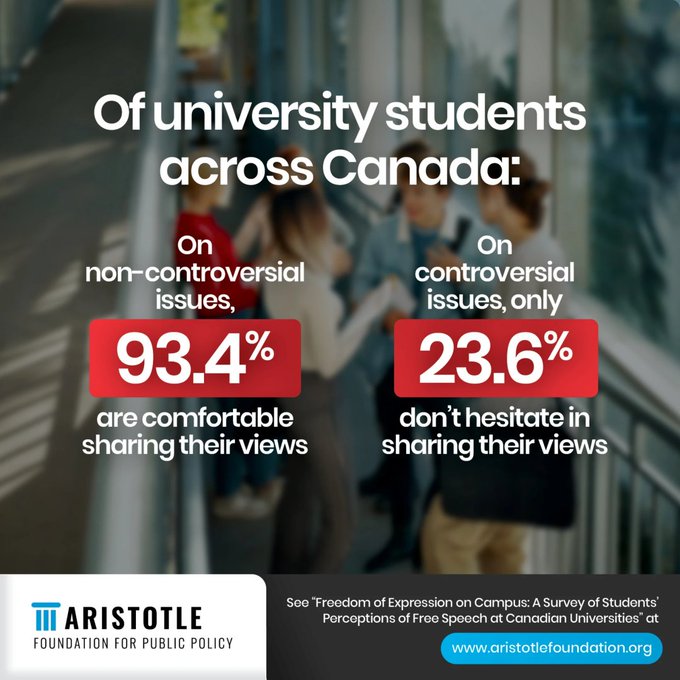
According to a comprehensive survey newly published by the Aristotle Foundation for Public Policy, close to fifty percent of all Canadian university students actively conceal their opinions with respect to controversial matters, in fear of being sanctioned or suffering mistreatment. As a result, 48.1 percent of 760 university students in the survey expressed reluctance in revealing an opinion on a "controversial political issue"; 27.5 percent were somewhat reluctant, and 20.6 percent were very reluctant. 
 
On the other hand, when respondents were asked about issuing their views on a "non-controversial" issue, 93.4 percent claimed it was not a problem. A student's identity was critical with respect to apprehensions over speaking out. Campus environments where all opinions or views could be expressed without consequence were described by some groups, while others felt campuses have become places where a lack of self-censorship risked poor grades, peer rejection and even campus authority investigation. 
 
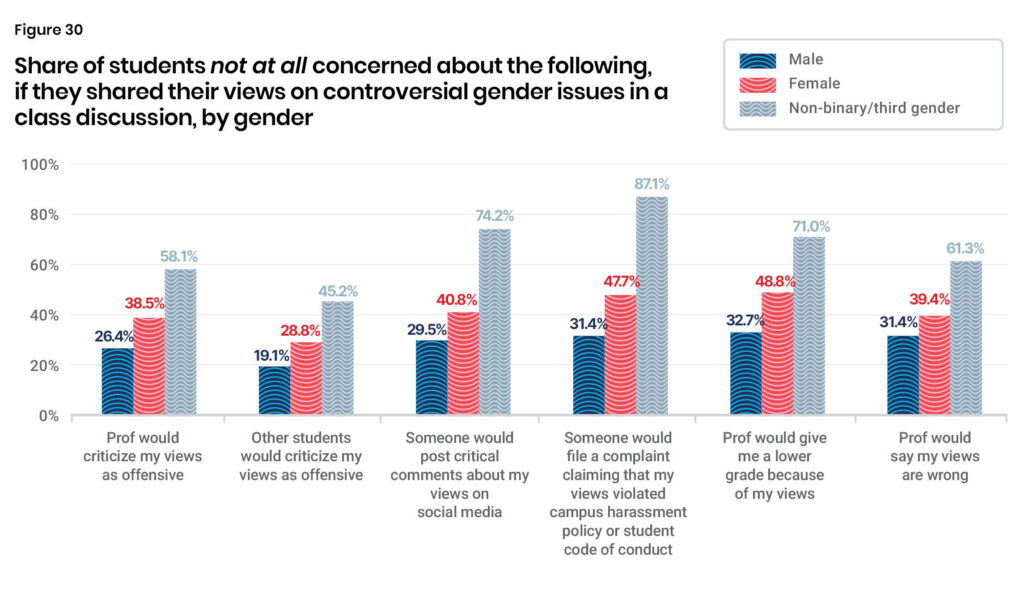
Identifying as either "non-binary" or a non-specified third gender, respondents expressed greater confidence than any other cohort airing their views without consequences. One survey question asked respondents to discuss a "controversial gender issue" in class, restraining themselves for fear of being reported to campus authorities for expressing hate or discrimination. Non-binary and third-gender respondents expressed 87.1 percent confidence this would never fall to them.
 
On the other hand, male and female respondents were guarded, with only 31.4 percent of men and 47.7 percent of women feeling they could speak candidly without risk of backlash. When respondents were questioned whether their gender opinions would result in punishment with a lower grade, 71 percent of non-binary and third-gender respondents said they had no concerns, while 32.7 percent of men and 48.8 percent of women had similar reactions.
https://pbs.twimg.com/media/Gz7ggR5XQAACmlk?format=jpg&name=small 
Of white and Hispanic students, 50 percent of Hispanic and 46 percent of white students preferred to remain out of class discussions on hot-button issues. This survey is one of several Canadian polls to recently reveal campus environments increasingly unwelcoming for Jewish students. The question, if a "controversial religious issue" was discussed in class, elicited a 69 percent Jewish response of reluctance to speak. Of Muslim students, only 36 percent would be reticent about speaking. 
 
Interestingly, the Aristotle survey concluded that moderate or conservative opinions represent at the present time, the plurality of students' political views on Canadian campuses. 38.7 percent of respondents reported "moderate", "conservative" or "libertarian" opinions, as opposed to 37 percent who reported liberal sentiments. The Aristotle survey respondents were disproportionately non-white and women, historically tending to lean left in political views. And although moderates and conservatives represent a plurality, it was they who felt most besieged for their political views.
 
46.2 percent of students were found by the survey to state they were badly treated or treated unfairly as a result of their political views, while 6.6 percent said they have become targets weekly. For this survey, the Aristotle Foundation for Public Policy touched base with 760 students from 34 Canadian universities, with the use of a questionnaire based on the Heterodox Academy's Campus Expression survey.  
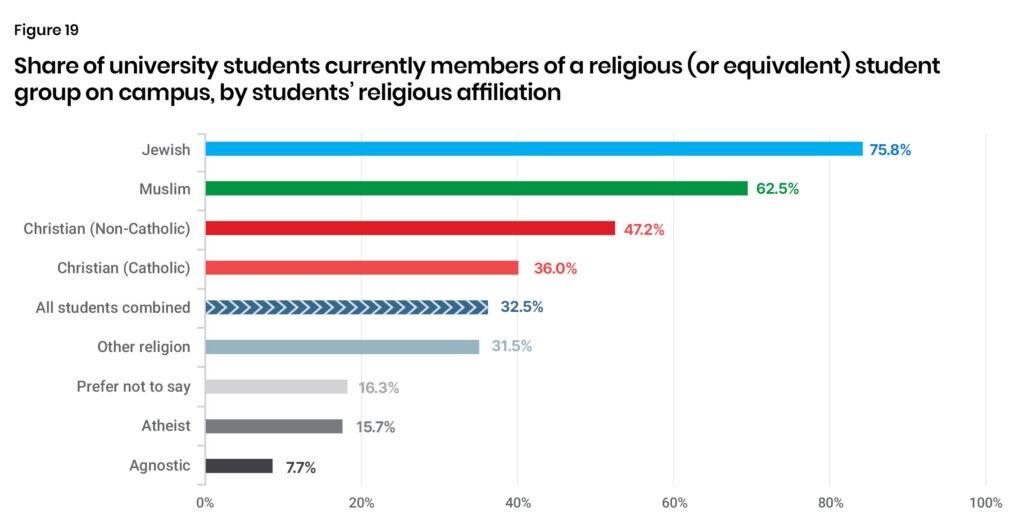
"The disparity in perceived freedom to express one’s views among students holding differing views is not limited to political views but was also observed in other areas such as religion. Despite religious students outnumbering non-religious students two to one, it is the non-religious who are considerably more comfortable in a university classroom discussing controversial issues about faith and religion. The data reveals particular concerns around the experience of Catholic, Muslim, and Jewish students, with the latter reporting considerable mistreatment in their university experience. Jewish students participating in our study are four times more likely than the average student to be “very reluctant” to speak up and share their views on religion in class discussions. This fear of expressing their viewpoints correlates to a concerning outcome in the study, whereby 15 percent of Jewish students reported experiencing daily abuse on campus for being Jewish, and 84 percent reported experiencing antisemitism at university at least once a year. By contrast, 90 percent of agnostics, 86.6 percent of atheists, and 75.5 percent of students who elected not to disclose their religious affiliation reported never being treated badly or unfairly, as a university student, because of their religious views. In other words, an agnostic or atheist student from our study population is six times more likely than a Jewish student to report never being treated badly or unfairly for their views on religion. Not a single agnostic, atheist, or “prefer not to say” participant in our study reported daily mistreatment."  
Aristotle Foundation 
 https://aristotlefoundation.org/wp-content/uploads/2025/08/Fig-19-AF-Freedom-of-Expression-on-Campus-V1-Aug-22-2025-e1756169773881-1024x526.jpg
"Gender and sexuality are the most polarizing topics. On one end, they have the largest share of respondents who expressed that they were “very comfortable” (32%) sharing their honest views on a controversial matter in class; yet, gender and sexuality also have the largest share who expressed that they were “very reluctant” (22%). Like race, the gender and sexuality findings are mixed. Those who rarely experience any mistreatment for their gender or sexual orientation—heterosexual males—are, by far, the least likely to feel at liberty to share their views on those issues. Whereas, despite experiencing more frequent mistreatment—90 percent of students who identify as gay, non-binary, or third gender reported experiencing poor or unfair treatment because of their gender at least once a year—gender-nonconforming and non-heterosexual students are the most comfortable sharing their views on controversial gender and sexuality issues in class."
Aristotle Foundation   
https://aristotlefoundation.org/wp-content/uploads/2025/08/Fig-30-AF-Freedom-of-Expression-on-Campus-V1-Aug-22-2025-e1756171187684-1024x590.jpg 

Labels: , , , , , , ,

Wednesday, February 20, 2019

What!!!! Perish the Thought ... Corruption in Canada?!

"I make sure we get a signed invoice [for bribery pay-offs]."
"And payment is always in the form of a cheque, not cash, so we can claim it on our income tax!"
Bernard Lamarre, former head of Lavlin Inc., Quebec

"Given the size of Canada's economy and its high-risk industries, the Working Group recommends Canada review its law implementing the Convention [Corruption of Foreign Public Officials Act] and its approach to enforcement to determine why it has only had one conviction [of illegal bribery of foreign officials] to date."
OECD Working Group on Bribery, 2011

"Deferred prosecution agreements [DPAs] and similar alternative-enforcement mechanisms act as powerful incentives for firms to disclose ethics breaches and co-operate with authorities -- co-operation that leads to higher levels of enforcement."
John Manley, 2015 CEO Canadian Council of Chief Executives; former Liberal deputy prime minister


In 2006 Canada had a Conservative-led government under Prime Minister Stephen Harper, a government that prosecuted companies that based their growth on bribing foreign officials to obtain contracts abroad. This was a change from former Liberal-led governments that turned a blind eye to bribes that resulted in exports being facilitated. When Canada had a Liberal government and Jean Chretien -- later a three-term majority Liberal Prime Minister: 1993 - 2003 -- was trade minister in the 1970s his attitude was that overseas sales shouldn't be held up by irrelevant details such as bribes.

It is why this well-seasoned Liberal politician took many trade missions to China during his prime ministerial years, forging contacts with influential Chinese authorities and politicians in the Communist government, eager and willing to overlook the repressive regime where corruption reigned as supreme as its human rights failures. As soon as the Liberals lost government as a popular electoral base crumbled under the weight of a vast corruption scandal, Mr. Chretien signed on as an influential senior member of a prestigious Canadian law firm to lend his practical expertise in leading trade missions to China.

Canada passed its Corruption of Foreign Public Officials Act in 1998 as it had little other choice when an Organization for Economic Co-operation and Development convention characterized bribery for what it is, an illegal, corrupt practise -- demanding all its members crack down to ensure its business interests complied with what became an OECD-wide anti-corruption cleansing initiative. As a member, Canada had little option but to join in enacting such a law, though the legislation was largely ignored in Canada.

Canada was later named and castigated as one of the developed world nations most tolerant of corruption in a 2009 Transparency International study which found that Canada undertook "little or no enforcement" of anti-bribery legislation, placing Canada on record as being similar in that regard to countries like Greece, Slovenia, South Africa and Turkey in their casual disregard for corrupt business practises.

Canada was further distinguished when a 2011 review undertaken by the OECD Working Group on Bribery faulted the lax enforcement of anti-corruption laws. When 2008 rolled around under the Conservative minority government, that oblivious attitude to internal corruption came to an abrupt halt as the RCMP created its International Anti-Corruption Unit which led to charges against SNC-Lavalin, Canada's largest engineering and construction company with worldwide holdings, and well recognized for its corrupt business practices.

Once a majority Conservative government was returned in 2011 the government increased its anti-corruption focus through its Integrity Framework, automatically barring companies convicted of criminal offences from accessing contracts with the federal government for a decade. SNC-Lavalin, the Quebec-based construction giant, now at the centre of a government scandal where the current Liberal-led government of Justin Trudeau has been accused of attempting to give it an "out of jail free" pass, heavily dependent on government contracts is a case in point.

Its corrupt practices saw its opportunities for World Bank contracts dried up for the engineering company as penalty for its corrupt practices after it was convicted of a criminal offence. The current Liberal government has invested itself in exonerating the company irrespective of its record of criminality, set on reducing the threat that the Integrated Framework represents for its future and the employment of thousands of Quebec-based employees, where the Liberal government depends on votes, alert to the potential of the October federal election becoming a Liberal=routing exercise.

To that end, they were extremely receptive to a legalized plea bargain where a company and its executives, under a DPA -- deferred prosecution agreement -- could promise not to further engage in corrupt practices, and to pay a compensatory fine, then get on with business as usual, spared a trial and a resulting criminal record that would bar them from bidding on lucrative government contracts for a ruinous ten-year period. SNC-Lavalin lobbied the government robustly to enact a DPA and succeeded, hoping to be spared an upcoming trial for bribery.

However, the federal Criminal Prosecution authority declined to offer the company a deferred prosecution agreement, leading the executive branch of government to make an effort to intervene through pressuring the Minister of Justice to overturn the decision of the Prosecution authority and it all blew up into a scandal of what can only be termed typical Liberal proportions. In fact, DPAs have the effect of decriminalizing bribery and allied corrupt practices, enabling bribes to continue to be viewed as a cost of doing business.

The previous, Conservative government refused to enact legislation for DPAs, favouring traditional prosecutorial practices to result from corporate crimes. Once the Liberals ascended to government in the 2015 federal election, two months passed and an administrative agreement permitting SNC-Lavalin to continue winning government construction contracts proceeded, despite criminal charges pending against its executives.

With a change of government, where the current Prime Minister, Justin Trudeau cheerfully pronouncing to the world at large "Canada is Back!", lobbying and political considerations in place of operations through the rule of law have taken centre stage, where the bribery of foreign officials is back on track. Business at any cost at the service of a government that touted its determination to run a transparent, unimpeachable style of government where integrity would be manifest.


Labels: , , , , ,

Wednesday, August 16, 2017

Truth and Consequences

"It pretended to be 'unite the right' but it was basically Nazis saying, 'shit or get off the pot, become a white nationalist or f---k off'. And a lot of people told them to f--k off."
"It seemed like they were drifting into the arena of the unwell. This gathering was a lie. It purported to be about statues; it purported to be about community, but it was really about polarizing the right and saying, 'You are with us or against us'. And I think they're going to find that everyone is against them. Their rhetoric got a woman killed and a boy put in prison."
"It cut the alt-right off from everyone else. [the left and the media] see us all as one dumb unified group, and we're not. And I think what we learned this weekend is, we shouldn't be."
Gavin McInnes, Vice co-founder, head, Proud Boys
Alt-right rally members on Aug. 12, 2017 in Lee Park in Charlottesville, Va. Rebel Media's reporting from the rally could spell the end for the right-wing organization, Tim Harper writes.
Alt-right rally members on Aug. 12, 2017 in Lee Park in Charlottesville, Va. Rebel Media's reporting from the rally could spell the end for the right-wing organization, Tim Harper writes.  (Go Nakamura / TNS)

Suddenly, Canada's most prominent right-wing personality and his online website The Rebel have been bathed in a very compromising and unattractive light, shading it with a link to a ideology it would vastly prefer not to be associated with. Some of Ezra Levant's most prominent contributors to The Rebel have reacted with viral distaste to any hint in the public eye of possible association however remote and however much denied with the odious alt-right which distinguished itself with brute violence in Charlottesville last weekend.

The white supremacist gathering of neo-Nazis, the KKK fascist/racist illuminati, and the alt-right that used the concept of a protest against the removal of an historical monument to General Robert E. Lee of Civil War fame, to further their agenda of racial bigotry, decrying the presence of immigrants, of Blacks and particularly of Jews in America diluting the fabric of white culture and society as an affront to the United States that must be resisted by any means -- violence if necessary, and violence is always necessary to prove they mean business -- made conservatives blanch in disgust.

"When I first heard of the alt-right a year ago, I thought it simply meant the insurgent right, the politically incorrect right, the grassroots right, the nationalistic right", wrote Ezra Levant in a 'memo' to his staff and contributors explaining his reaction and instant efforts to distance himself and The Rebel from any whiff of connection to those who distinguished themselves in Charlottesville. The situation is similar to what occurs at leftist peace gatherings protesting war, where signs accusing Israel of war-mongering held by Palestinian sympathizers are hoisted alongside the flag of Hamas.

"But the alt-right ha changed into something new, especially since Trump's election. Now the leading figure -- at least in terms of media attention -- is Richard Spencer, and other white nationalists. By that, I mean people whose central organizing political principle is race", he went on, anxious to impress his audience with the sincerity of his rejection of all that the alt-right and its pals represent.

"There were actually some Nazi swastika flags in Charlottesville. Whether or not they were being genuinely carried, or carried by agents provocateurs trying to embarrass the alt-right isn't even important. They were there -- and Spencer's torchlit walk had other Nazi symbology, including the 'Sieg Heil' arm salute, and the chant of 'blood and soil' -- which was a slogan popularized by the Nazis. Sorry, that's not conservative, that's just racist, and I think it's unpatriotic to mimic one of America's greatest historical enemies."

Up until this sordid and violent event in Charlottesville, The Rebel appeared to support the alt-right to a degree, but now that it has linked with white supremacism, backing away with haste certainly appeared the best-case scenario to assure staff and contributors that there was no support of the unsupportable from that quarter. The manslaughter charge against a 20-year-old for vehicular homicide of 32-year-old Heather Heyer has transfixed the U.S. with the horror of internecine warfare.

That it was actual internecine warfare that cost the lives of an estimated 620,000 Americans ideologically polarized over Black slavery among other issues that brought about this current atrocity makes it all the more appalling in that race and bigotry have never been very distant from the public mind. The 'boy' mentioned by McInnis has been a Nazi admirer since childhood; that he also has a medical record of psychosis he was treated for years ago, somewhat complicates the issue, but it was hate, pure and simple, that led him.
"What may have started as a concern over the [Rebel's] harsh tone taken on some subjects came to a head with this weekend's events in Charlottesville, Virginia. [The protest] was really an anti-Semitic white power rally."
"I am not comfortable being associated with a group that, rightly or wrongly, is being increasingly viewed as associated with the likes of Richard Spencer. Like many of you, I had family that fought the Nazis. I never want to be in the same room as one."
"What The Rebel suffers from is a lack of editorial and behavioural judgement that left unchecked will destroy it and those around it."
Brian Lilley, Rebel co-founder

John Robson @thejohnrobson
Parting ways with The Rebel

Labels: , , , , , , ,

() Follow @rheytah Tweet