

Student Social Issues Intimidation on Canadian Campuses
"Inescapable from our study is the recognition that classroom discussions on controversial topics on university campuses fail to reflect the actual cross-section of opinions of students in the classroom.""[Of 760 university students surveyed, 48.1 percent expressed reluctance to reveal their opinions on a] controversial political issue.""The data reveal that the students most comfortable sharing their views at Canadian universities identify as follows: liberal, secular, racialized, homosexual, gender-nonconforming.""On each controversial issue, the majority of students are uncomfortable -- often very reluctant -- thinking through their views out loud."Researchers, Aristotle Foundation for Public Policy
 |
According to a comprehensive survey newly published by the Aristotle Foundation for Public Policy, close to fifty percent of all Canadian university students actively conceal their opinions with respect to controversial matters, in fear of being sanctioned or suffering mistreatment. As a result, 48.1 percent of 760 university students in the survey expressed reluctance in revealing an opinion on a "controversial political issue"; 27.5 percent were somewhat reluctant, and 20.6 percent were very reluctant.
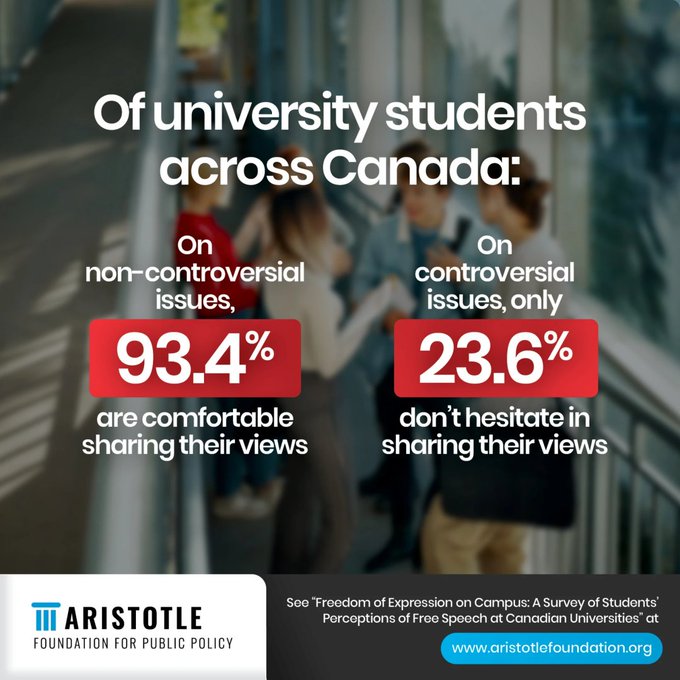
On the other hand, when respondents were asked about issuing their views on a "non-controversial" issue, 93.4 percent claimed it was not a problem. A student's identity was critical with respect to apprehensions over speaking out. Campus environments where all opinions or views could be expressed without consequence were described by some groups, while others felt campuses have become places where a lack of self-censorship risked poor grades, peer rejection and even campus authority investigation.
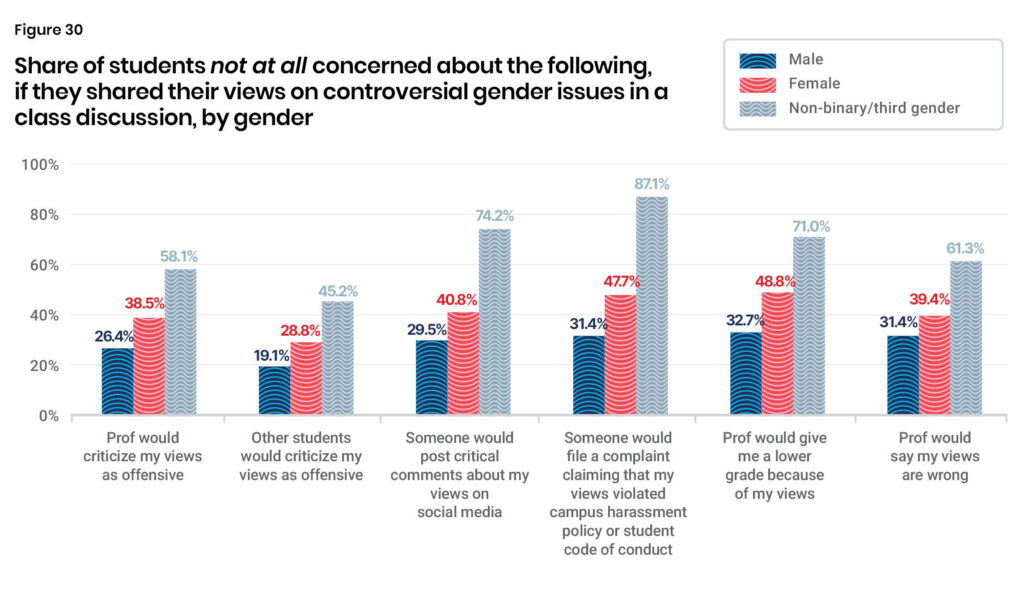
Identifying as either "non-binary" or a non-specified third gender, respondents expressed greater confidence than any other cohort airing their views without consequences. One survey question asked respondents to discuss a "controversial gender issue" in class, restraining themselves for fear of being reported to campus authorities for expressing hate or discrimination. Non-binary and third-gender respondents expressed 87.1 percent confidence this would never fall to them.
On the other hand, male and female respondents were guarded, with only 31.4 percent of men and 47.7 percent of women feeling they could speak candidly without risk of backlash. When respondents were questioned whether their gender opinions would result in punishment with a lower grade, 71 percent of non-binary and third-gender respondents said they had no concerns, while 32.7 percent of men and 48.8 percent of women had similar reactions.
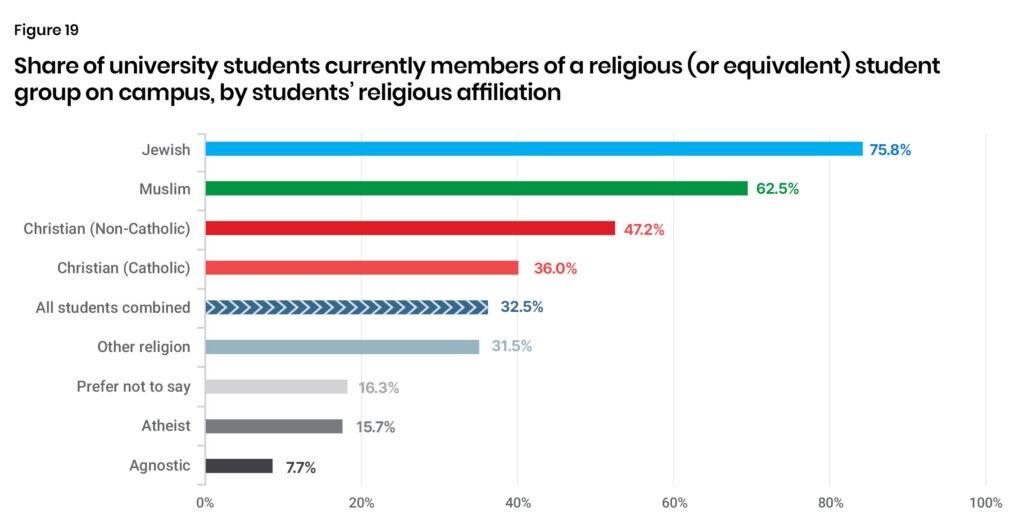
Of white and Hispanic students, 50 percent of Hispanic and 46 percent of white students preferred to remain out of class discussions on hot-button issues. This survey is one of several Canadian polls to recently reveal campus environments increasingly unwelcoming for Jewish students. The question, if a "controversial religious issue" was discussed in class, elicited a 69 percent Jewish response of reluctance to speak. Of Muslim students, only 36 percent would be reticent about speaking.
Interestingly, the Aristotle survey concluded that moderate or conservative opinions represent at the present time, the plurality of students' political views on Canadian campuses. 38.7 percent of respondents reported "moderate", "conservative" or "libertarian" opinions, as opposed to 37 percent who reported liberal sentiments. The Aristotle survey respondents were disproportionately non-white and women, historically tending to lean left in political views. And although moderates and conservatives represent a plurality, it was they who felt most besieged for their political views.
46.2 percent of students were found by the survey to state they were badly treated or treated unfairly as a result of their political views, while 6.6 percent said they have become targets weekly. For this survey, the Aristotle Foundation for Public Policy touched base with 760 students from 34 Canadian universities, with the use of a questionnaire based on the Heterodox Academy's Campus Expression survey.
"The disparity in perceived freedom to express one’s views among students holding differing views is not limited to political views but was also observed in other areas such as religion. Despite religious students outnumbering non-religious students two to one, it is the non-religious who are considerably more comfortable in a university classroom discussing controversial issues about faith and religion. The data reveals particular concerns around the experience of Catholic, Muslim, and Jewish students, with the latter reporting considerable mistreatment in their university experience. Jewish students participating in our study are four times more likely than the average student to be “very reluctant” to speak up and share their views on religion in class discussions. This fear of expressing their viewpoints correlates to a concerning outcome in the study, whereby 15 percent of Jewish students reported experiencing daily abuse on campus for being Jewish, and 84 percent reported experiencing antisemitism at university at least once a year. By contrast, 90 percent of agnostics, 86.6 percent of atheists, and 75.5 percent of students who elected not to disclose their religious affiliation reported never being treated badly or unfairly, as a university student, because of their religious views. In other words, an agnostic or atheist student from our study population is six times more likely than a Jewish student to report never being treated badly or unfairly for their views on religion. Not a single agnostic, atheist, or “prefer not to say” participant in our study reported daily mistreatment."Aristotle Foundation
"Gender and sexuality are the most polarizing topics. On one end, they have the largest share of respondents who expressed that they were “very comfortable” (32%) sharing their honest views on a controversial matter in class; yet, gender and sexuality also have the largest share who expressed that they were “very reluctant” (22%). Like race, the gender and sexuality findings are mixed. Those who rarely experience any mistreatment for their gender or sexual orientation—heterosexual males—are, by far, the least likely to feel at liberty to share their views on those issues. Whereas, despite experiencing more frequent mistreatment—90 percent of students who identify as gay, non-binary, or third gender reported experiencing poor or unfair treatment because of their gender at least once a year—gender-nonconforming and non-heterosexual students are the most comfortable sharing their views on controversial gender and sexuality issues in class."Aristotle Foundation
Labels: Antisemitism, Canadian Universities, Conservatism, Gender Identity Issues, Intimidation, Judicious Discretion, Speaking Out, Students on Campus
posted by Pieface | 8:30 PM


0 Comments:
Post a Comment
<< Home