
Politic?

This is a blog dedicated to a personal interpretation of political news of the day. I attempt to be as knowledgeable as possible before commenting and committing my thoughts to a day's communication.

Thursday, December 16, 2021

Eliminaing Russian Nuisances

"State organs of the government of the Russian Federation took the decision to liquidate Tornike Khangoshvili in Berlin."
"Khangashvili had given up the fight against the Russian Federation years before. He had not held a weapon in his hands since 2008."
"This was not an act of self-defence by Russia. This was and is nothing other than state terrorism."
Judge Olaf Arnoldi, Berlin court 

"This murder, ordered by a state, is a serious violation of German law and Germany's sovereignty."
"Acts like the murder in [Berlin's] Tiergarten park seriously burden relations between our countries."
German Foreign Minister Annalena Baerbock
Russian President Putin | German Chancellor Olaf Scholz Photograph:( AFP )
 
Germany summoned the Russian ambassador to Germany, to inform him that two of the embassy's 101 diplomatic staff were to be expelled, following the trial and ruling by Justice Arnoldi when he sentenced Vadim Krasikov for the "especially serious" crime of murder of a former Chechen militant. The Russian agent dispatched to do the work of assassinating a man that President Vladimir Putin spoke of as a "bloody terrorist" was sentenced to life imprisonment for the 2019 act of "state terrorism".

The verdict, in the opinion of the Russian Embassy was "not objective and politically motivated". In 2019, Russian President Putin accused the murdered man of involvement in crimes that included the 2004 bombing if the Moscow metro, when ten people were killed. Georgian citizen Tornike Khangoshvili died of three shots from a Block pistol in August of 2019 in evident retaliation for his role fighting for Chechen separatists against Moscow in the 2000s.

Russia had supplied their hit man with false papers to use when travelling toward his destined target. His assignment began when Krasikov flew to Paris equipped with a false passport and from there journeyed on to Berlin In  his possession was thousands of euros in cash to enable his swift departure once his assignment had been completed.

As Khangoshvili cycled through the famed Berlin park on a beautiful sunny August day, Krasikov lethally shot his target, then hid behind shrubbery where he removed his clothing and his cap, replaced them with an innocuous tourist-type outfit, trimmed his beard, and prepared to saunter out and make good his escape from the scene. Unfortunately for his well-laid plans, there were witnesses.
 
The murderer's plan of escape was rent asunder when armed police within minutes surrounded him and others retrieved the discarded clothing, the murder weapon and brought Khangoshvili's bicycle out of the river. The arrested man now claims he is not Krasikov, but a construction engineer from St.Petersburg with the name of Vadim Sokolov. The lawyer for the arrested, tried and sentenced man claims the case against his client was built on conjecture, not proof. 

Russian assassins have a long history of murder by grotesque means of one kind or another to rid the nation's powerful and popular leader of irritating critics, of embarrassing turncoats, of those possessing state-incriminating evidence of more than nuisance value. From the use of military-grade chemical weapons to radioactive poisons, they leave their trademark, clumsy clues used to identify the perpetrators, linking them directly to the state apparatus assigned to eliminate state opponents.
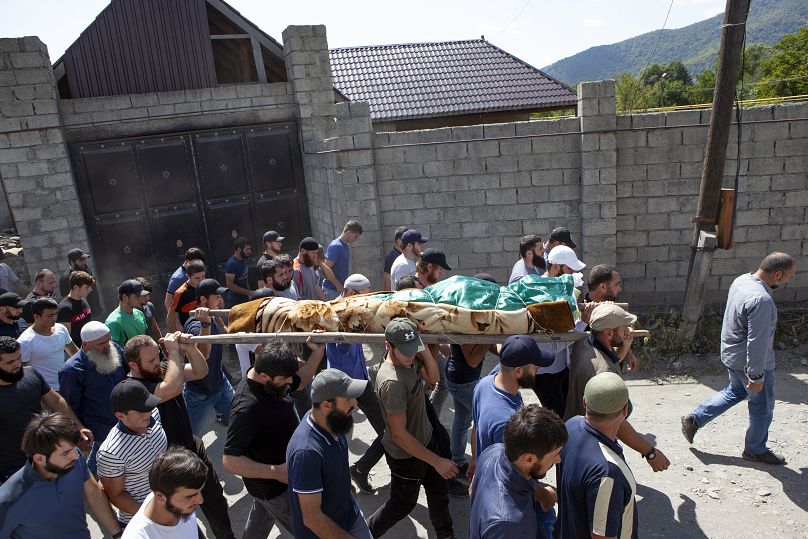
FILE - AP Photo/Zurab Tsertsvadze - August 2019
Zelimkhan Khangoshvili's body was carried during his funeral in Duisi village in the Pankisi Gorge valley. - AP Photo/Zurab Tsertsvadze - August 2019

Labels: , , , , , ,

Sunday, April 10, 2016

Unforgivingly Ruthless -- But Does It Work?

"Yes, they detained my relatives. But they were guilty. Do you understand? Because they were my relatives."
"If I'm a bandit, then they're bandits, too."
Magomed Khambiyev, Chechen rebel defense minister

"There can be short-term results, but I wouldn't call it success."
"You can prevent some episodes of violence at the moment, but you are radicalizing whole communities."
Ekaterina Sokirianskaia, analyst, International Crisis Group
Russian soldiers patrolling a Chechen village in December 2000. Russia found that abductions of militants’ family members were effective in unwinding the rebel leadership in Chechnya. Credit Agence France-Presse
Well, shades of Israeli policies in persuasion. While the Palestinian Authority lionizes the violence perpetrated by Palestinians whom the PA has incited to "resist", by naming squares and streets after the blessed martyrs, Israel responds by informing the families of the bombers that their homes will be destroyed. What could be dearer to anyone's heart than the possession of a home of their own? What could be more catastrophic personally than losing that home, other than the death of a family member deliberately seeking martyrdom?

Oh yes, of course, that deliberate launch of a martyrdom action, in the process taking the lives of as many other people as possible, giving purpose and meaning to jihad, is an honourable pursuit making a hero of the jihadist, so their life lost is no loss, but an honour bestowed upon the family. The family member who has made that sacrifice to bring honour to his family is placed on a devoted pedestal; the state which has lost citizens to unspeakable violence is the criminal for destroying a home.

Does it work to restrain other suicide bombers from embarking on their own honourable mission? (Israel suspended the practise for awhile, then reinstated it with the stabbing intifada.) Perhaps not, but Russia, it appears, seems to believe otherwise. Moscow has engaged in counterterrorism strategies including targeting families of jihadists aimed at smashing the Caucasus Muslim separatist rebellion. Is a separatist rebellion in the same category as that of plotting to destroy a state?

Police in Brussels disclosed that two suicide bombers were brothers; Ibrahim and Khalid el-Bakraoui. Not unusual, it seems, with analysts in intelligence concluding that a third of the terrorist participants are related to another attacker. The Chechnya conflict that metastacized into a greater Caucasus regional organized Islamic rebellion saw Russian security services arrest, torture and kill relatives, according to human rights groups.

Abductions of family members produced the ultimate effect of stifling the Chechnya rebel leadership. Russian security services routinely burn or demolish homes of people suspected of being insurgents or terrorists, in Chechnya and Dagestan. In the process, family members are rounded up and held, awaiting release when the militant surrenders himself, or is alternately killed.

During Russia's Chechnya conflict, Vladimir Putin saw to it that relatives of the separatist fighters were used in captivity to lure militants toward capture. If the ruse failed to succeed, the family member simply somehow 'disappeared'. This is what is called incentive to at to prevent such a disappearance. There were roughly 3,000 to 5,000 unresolved disappearances in the five-year conflict.

In 2004, Russian security services detained dozens of members of the extended family of the Chechen rebel defense minister, Magomed Khambiyev. A 19-year-old cousin was infamously abducted from a university he attended, beaten semiconscious and symbolically and brutally shoved out of a car in the home village of the rebel leader. And in the end Mr. Khambiyev responded by surrendering to save the lives of his relatives.

Labels: , ,

Thursday, July 03, 2014

Grant Them Martyrdom, Please, and Swiftly

"Our aim is clear and everyone knows why we are fighting. Our path is toward the caliphate. We will bring back the caliphate, and if God does not make it our fate to restore the caliphate, then we ask him to grant us martyrdom."
Chechen Tarkhan Batirashvili, aka Omar Al-Shishani
Omar al-Shishani
This image made from undated video posted during the weekend of June 28, 2014 on a social media account frequently used for communications by the Islamic State of Iraq and the Levant (ISIL), which has been verified and is consistent with other AP reporting, shows Omar al-Shishani standing next to the group's spokesman among a group of fighters as they declare the elimination of the border between Iraq and Syria. Al-Shishani, one of hundreds of Chechens who have been among the toughest jihadi fighters in Syria, has emerged as the face of the Islamic State of Iraq and the Levant, appearing frequently in its online videos — in contrast to the group's Iraqi leader, Abu Bakr al-Baghdadi, who remains deep in hiding and has hardly ever been photographed. (AP Photo/militant social media account via AP video)
"A Chechen comes and has no idea about anything [in the country] and does whatever his leader tells him. Even if his emir tells him to kill a child, he would do it."
Hussein Nasser, spokesman, Islamic Front coalition, Syrian rebels

The Chechens are fierce fighters, that much is well acknowledged. Ask Russia about the Chechens.
They have had ample experience with them over the years. Chechen fighters have been able to mount explosive atrocities within Russia in an expression of their hatred for Russian domination of Chechnya. In 2002 a group of over 40 Chechens held more than 700 hostages at a Moscow theatre, the terrorists demanding an end to Russian presence in Chechnya and full independence.

They threatened to execute all their hostages. Russian troops stormed the building after detonating explosive devices within the theatre. Many of the hostages were casualties of the ending of that siege three days after it began partly due to the deadly gas that was used with the explosives. The failure of Russian authorities to take minimal precautions was cited as the main reason so many hostage casualties ensued with the liberation of the theatre.

Two years later 32 heavily armed, masked men seized Middle School No.One and over one thousand hostages in Beslan, North Ossetia.Most of the hostages represented children from six to sixteen years of age. A two-day standoff replete with gunfire and explosions took place until Russian soldiers raided the building. After a two-hour gunfight 331 civilians, eleven commandos and 31 hostage-takers died. Chechen terrorists like these spectacular types of mass atrocities.

Three Chechens hijacked a Russian aircraft with 174 people on board in 2001 lifting off from Turkey, forcing it to land in Medina, Saudi Arabia. It was left to Saudi commandos to free over 100 hostages. The leader of the hijackers, according to a Russian diplomat posted to Saudi Arabia, was a "highly-trained military officer who appears to know what he is doing." A month later again in Turkey 100 hostages at a luxury hotel were seized by Chechen gunmen in Istanbul.

The Boston bombers were two young Chechen brothers who had immigrated with their family as refugees to the United States and seemingly integrated into the American way of life, attending university in the U.S. Except that in reality, brothers Dzhokhar and Tamerlan Tsarnaev repudiated the American way of life, and they did that by cooking up explosives in pressure cookers and detonating them during the Boston Marathon. 1st Boston Marathon blast seen from 2nd floor and a half block away.jpg
Area of the first blast a few minutes after explosion
 
Chechen fighters have been fighting alongside ethnic Russian-speakers in Ukraine, in a secessionist conflict that has been well primed by the Kremlin. The Chechen fighters migrated to Ukraine to fight as Islamists, their presence having little to do with the Russian Federation in the sense of fighting on behalf of Russia. Russian atrocities against Chechens returned brutality for brutality during the second Chechen war in 2000 when up to 50,000 civilians died and Russia claimed 11,000 casualty figures of their own.Chechnya9268.jpg
Russian artillery shells militant positions near the village of Duba-Yurt in January 2000
 
Now, Omar Al-Shishani which is the Arabic nom de guerre of Tarkhan Batirashvili, meaning "Omar the Chechen", appears at the young age of 29, to have been named overall military commander of the Islamic State serving his master, Caliph Abu Bakr Al-Baghdadi, an Iraqi who assumed control of the Islamic State of Iraq and Al-Sham at the death of the Iraqi terrorist who once was its leader, Abu Abdul-Rahman Al-Bilawi Al-Anbari, killed in early June in Mosul.
 
ISIL has most recently declared the border between Syria and Iraq open; the vast geography in the Sunni-majority area of Iraq is now joined with that of Syria in representing the fledgling State of Islam, the caliphate for which Islamists, most notably al-Qaeda has long yearned for. Only in this instance, ISIS, the upstart terrorist Islamist group has upstaged al-Qaeda, which not so long ago disowned it, favouring instead the Nusra Front as its affiliate fighting in Syria.
 
And now that the Islamic State has been established, young Muslims are flocking to it, responding to the invitation to join, to do their divine duty as devout Muslims, to Allah who bids them through his new emissary, the caliph, to join jihad and distinguish themselves as martyrs for the cause. Acting as ISIS's military commander in Syria, Mr. Shishani evidently is prepared to lead the Islamic State on to a much broader portion of Middle East territory.
 
According to Alexei Malashenko, with the Carnegie Endowment's Moscow office, as an expert in jihadi terrorism, ethnicity is not a major factor in jihadi movements; rather dedication to jihad is. And Chechens have proven themselves immensely dedicated to jihad. Mr. Shishani, he states, "is a fanatic of Islam with war experience, and he obviously has had a strong track record [among fellow fighters]", he concludes.
 
He leads the al-Qaeda-inspired group "The Army of Emigrants and Partisans", inclusive of a large number of fighters from the former Soviet Union. Mr. Shishani was honoured to pledge his loyalty to Mr. Baghdadi during a meeting organized for that purpose, as reported to Lebanon's Al-Akhbar newspaper. What's next on their immediate agenda? A bloody confrontation between the Islamic State and Al Nusra, for starters, then conflict between it and al-Qaeda before moving forward in their Middle East conquest on their way to conquering the world.

Labels: , , , ,

() Follow @rheytah Tweet