Politic?

This is a blog dedicated to a personal interpretation of political news of the day. I attempt to be as knowledgeable as possible before commenting and committing my thoughts to a day's communication.

Tuesday, February 10, 2026

A Guatemalan Tragedy of Unspeakable Proportions

"All of the villagers in the well were ultimately killed ... I find those killings were done under the watch and orders of Mr. Sosa."
"When the well was being covered up, screams and cries of victims could still be heard. They were left to die a horrible death."
"Members of the patrol unit laughed, as if nothing had happened."
"Mr. Sosa denies that he was present at Las Dos Erres when the massacre took place; however, I place no credence in anything he says."
"Indeed, I consider Mr. Sosa to be a consummate liar."
Federal Court Justice Roger Lafreniere  
https://nsarchive2.gwu.edu/NSAEBB/NSAEBB316/photo1_400.jpg
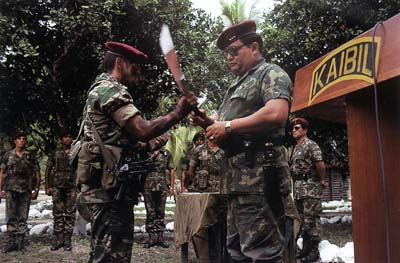
Graduation ceremony at the Kaibil, counterinsurgency unit 
"On January 18, 2011, Jorge Vinicio Sosa Orantes was arrested in Alberta, Canada on charges of naturalization fraud in the United States."
"Sosa Orantes, 52, is a former commanding officer of the Guatemalan Special Forces, or Kaibil unit, which brutally murdered more than 250 men, women and children during the 1982 massacre."
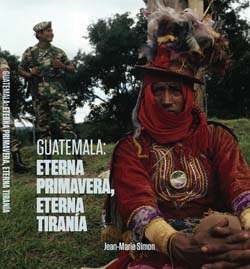
"The massacre was part of the Guatemalan military's "scorched earth campaign" and was carried out by the Kaibiles ranger unit. The Kaibiles were specially trained soldiers who became notorious for their use of torture and brutal killing tactics. "
"According to witness testimony, and corroborated through U.S. declassified archives, the Kaibiles entered the town of Dos Erres on the morning of December 6, 1982, and separated the men from women and children. They started torturing the men and raping the women and by the afternoon they had killed almost the entire community, including the children."
"Nearly the entire town was murdered, their bodies thrown into a well and left in nearby fields. The U.S. documents reveal that American officials deliberated over theories of how an entire town could just "disappear," and concluded that the Army was the only force capable of such an organized atrocity. More than 250 people are believed to have died in the massacre."
U.S. National Security Archive 
Harrowing testimony of 'extreme cruelty' perpetrated by unit commanders like Sosa, who ordered the entire village be slaughtered detailed the horror of that fateful day in extinguishing an entire village. The government military force called the Kaibiles had entered the village of Las Dos Erres, in 1982, home to 200 people, searching for weapons said to have been stolen by guerilla forces from the military, and hidden at the village, during the decades-long Guatemalan civil war. No weapons were found, but the order to butcher the entire population of the village commenced over an agonizing period of hours.
 
https://nsarchive2.gwu.edu/NSAEBB/NSAEBB316/photo3_250.jpg

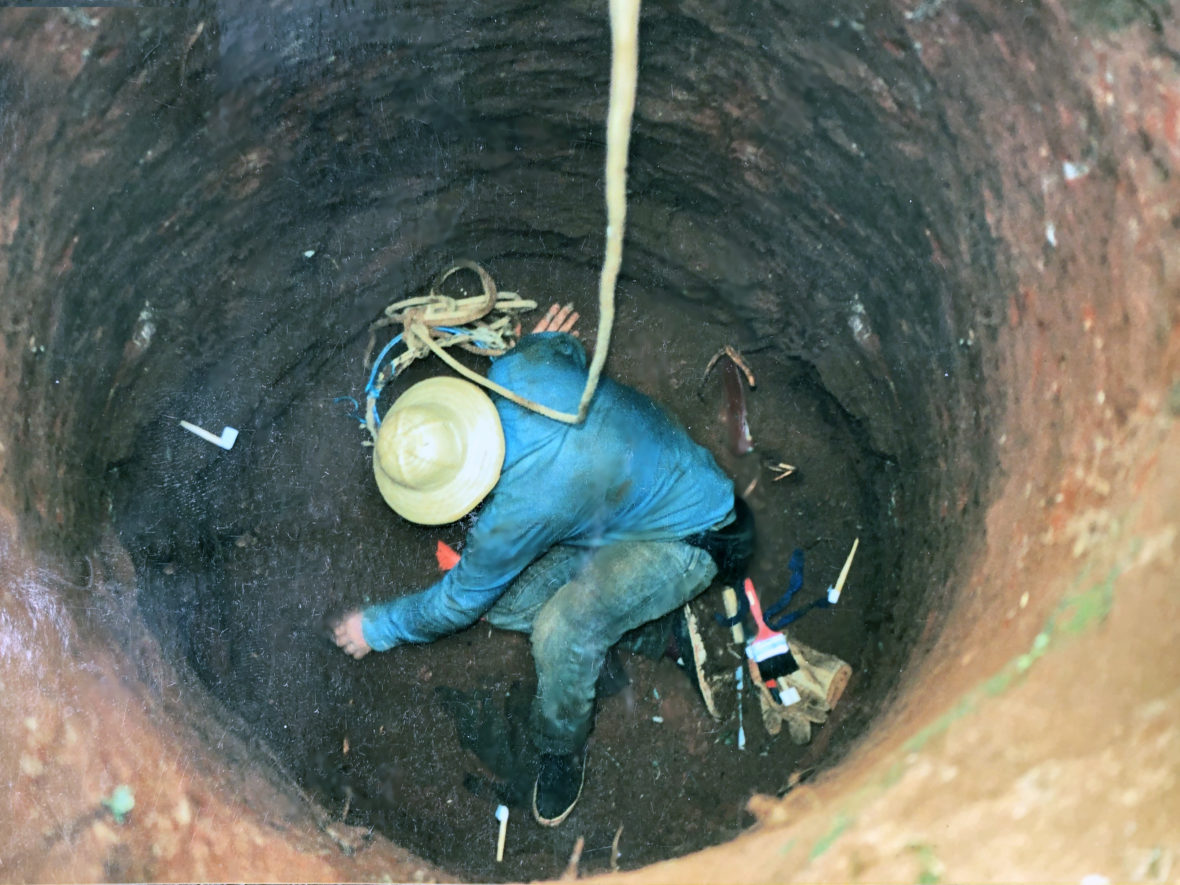
A baby was thrown into a well to drown, children were smashed against trees, and countless other members of the community were flung into that well, some alive, many dead, their skulls crushed or shot. Women were raped and murdered in front of their children. Sosa, in charge, shot a man and threw a grenade into the well to still the wailing cries of people in their death throes. Ten years after the atrocity investigators exhuming the remains found 'a minimum' of 162 had died in the well; the first victims lying at the bottom were children under age 12, and women.
 
Jorge Vinicio Sosa Orantes was fourth in command of the unit at the time, known to have personally committed murder at the time, and who had also ordered the slaughter of civilians. Testimony from one of Sosa's former military colleagues spoke of his having taught his special military unit techniques of torture on live victims at a zone set aside for practise; the "zombie area".
 
He has been living in Canada for 34 years. Guatemalan authorities, after a prolonged investigation, had issued an arrest warrant against the man in 2000, long after he had left the country. Sosa had moved to the United States where he applied for asylum, in 1985. His claim was denied and he turned to Canada in 1987, applying for asylum at the San Francisco-based Canadian consulate. He withheld the vital information from immigration officials that he had served in the Guatemalan military. Granted refugee status, he achieved citizenship in Canada in 1992.
 
Sosa married an American citizen, then applied and received U.S. citizenship in 1997. U.S. officials became aware of his subterfuge of withholding critical background information in his refugee claims --leading to his extradition from Canada to the U.S. where he was sentenced to ten years in an American prison for immigration fraud, in 2014. Canadian immigration officials three years later initiated a legal process asking a court to revoke Sosa's citizenship, declaring him inadmissible to Canada. 
 
https://newsinteractives.cbc.ca/craft-assets/images/_large/School-children-of-Dos-Erres-group-photo-courtesy-Sara-Romero.jpg
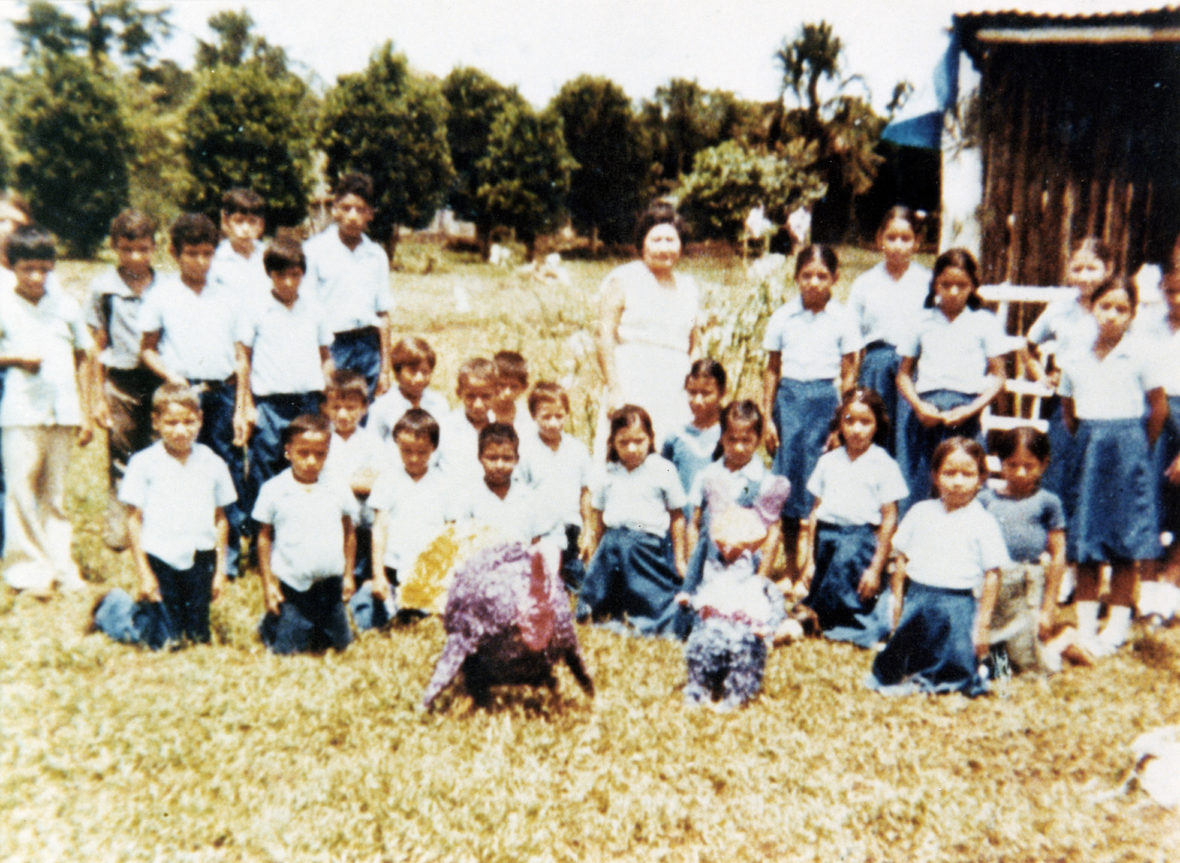
Schoolchildren gather in Dos Erres for an Independence Day celebration on Sept. 15, 1982. (Submitted by Sara Romero)
 
Finally, Canadian citizenship was revoked on the basis of Jorge Vinicio Sosa Orantes having committed unspeakable crimes in Guatemala forty years ago. Federal Court Justice Roger Lafreniere revoked that 34-year-old citizenship, declaring the man inadmissible to the country. Sosa was ordered to pay close to $250,000 to cover costs for the trial expended by the federal government. Costs related to arranging testimony of one of two massacre survivors, of two of Sosa's former military colleagues present at the bloodbath, and eight expert witnesses including Canadian immigration officials.
 
https://newsinteractives.cbc.ca/craft-assets/images/_large/IMG_0159-well-inside-courtesy-FAMDEGUA.jpg
The well in Dos Erres was examined during a dig by forensic anthropologists that was organized by Aura Elana Farfan. (Submitted by FAMDEGUA)
 

Labels: , , , , ,

Monday, May 15, 2023

Another Blighted Rescue of Quasi-Canadians

"There has been a loss of integrity in the Canadian immigration process."
"Most of these people have been living in Sudan for years."
"Sometimes they never really lived in Canada and don't speak English or French."
Unidentified insider source asking for anonymity 

"[Statistics  on the phenomenon known as] Canadians of convenience [during the Lebanon evacuation are not readily available."
"I don't know how common it is, but it's likely not negligible. We only tend to get a sense in cases like Lebanon and now Sudan."
Andrew Griffith, former director general, Immigration, Refugee and Citizenship Canada
Signs of a ceasefire in Sudan are scarce as the two warring factions have returned to fighting that has temporarily derailed rescue attempts for Canadians still trapped in the country.  CBC

Thousands of Lebanese-Canadian citizens were evacuated at Canadian government expense in 2006 during the war in Lebanon, to bring them back to safety in Canada. Most of whom, after the fact, turned out to be citizens in name only, who had acquired and maintained citizenship as a type of 'insurance' in case of emergencies. In this realm of convenience citizenship, Chinese Hong-Kongers represent another group from abroad who famously went to great lengths to acquire Canadian citizenship as a future haven should their lives in Hong Kong suddenly become 'complicated'.
 
For the Lebanese emergency, it cost $94 million for Canada to evacuate some 14,000 Canadians from Lebanon at war. Half that number returned to Lebanon when hostilities ceased. Now, in Africa there are sources suggesting there may be a repeat of this 'rescue' operation of 'citizens of convenience' in Sudan where a civil war has been unfolding. According to government figures, 550 people were flown out of Sudan to Kenya on Canadian evacuation flights.
 
Of that total, 175 were Canadian citizens or permanent residents. On flights organized earlier by other countries, another 210 Canadian citizens left. According to an individual familiar with the situation, it has emerged while the evacuees were being processed that as many as half of the 175 Canadian citizens and permanent residents happen to be refugees granted status in Canada who returned to Sudan, some continuing to claim welfare and child benefits.
 
Smoke rises from a stack atop a large multi-storey ship packed with people, under a pale blue sky.
A ferry transports some 1,900 evacuees across the Red Sea from Port Sudan to the Saudi King Faisal navy base in Jeddah, Saudi Arabia.  (Fayez Nureldine/AFP/Getty Images)

Some are refugees who are in the process of becoming Canadians, which means they should not have left the country to return to Sudan while the process has not yet been completed. All of the evacuees in Kenya were accommodated and cared for in hotels at Canada's expense. In the past five years, Canada accepted 2,120 refugee claims from Sudan; individuals who are accepted are given protection in Canada. If they return to their country of origin, however, they effectively relinquish refugee status.
 
Immigration, Refugees and Citizenship Canada had "no response to offer" when a spokesperson was approached for clarification on the matter. Nor could the government provide cost estimates of an operation involving the Canadian High Commissioner in Nairobi, the embassy in Cairo, Egypt, the embassy in Amman, Jordan, the consulate in Djibouti and 200 Canadian Forces on the ground in the region helping to expedite the 'rescue'. 
 
The Canadian portion of the relief effort has been described as "chaos" by sources in Africa. A C-130J Hercules transport aircraft left Jordan to head to Port Sudan on the Red Sea on a mission to retrieve stranded Canadians after the Wadi Seidna Air Base north of Khartoum was seen as too dangerous. According to a Forces spokesperson, Sudanese authorities reused to permit personnel to disembark, and the flight was forced to return to Jordan empty following a "diplomatic credentials mix-up".

After the fiasco in Lebanon, the-then Conservative government in Canada, instituted limitations on citizenship by descent, limiting it to one generation born outside Canada, revoking citizenship of thousands of Lebanese who obtained status through fraudulent means. Should it be established that some Sudanese evacuated to Nairobi have similarly cheated the system, they should have their citizenship invalidated.

Status can be revoked under the Canadian Citizenship Act, if it becomes clear that the person involved obtained citizenship by "false representation, fraud or knowingly concealing material circumstances". In Canada, refugee claimants must establish they have a subjective fear of persecution should they return to their home country. Those people who obtained Canadian citizenship for the purpose of escaping persecution in Sudan should not be in Sudan.

Canada has suspended its evacuation operation at a Khartoum airfield after a ceasefire unravelled and violence escalated, but Canadians are still stranded in Sudan and escape options are limited.   CBC

Labels: , , , , ,

() Follow @rheytah Tweet