This is a blog dedicated to a personal interpretation of political news of the day. I attempt to be as knowledgeable as possible before commenting and committing my thoughts to a day's communication.
China's Political Subversion Agenda : A Real and Present Danger
"Secret [for] Canadian Eyes Only."
"Triads [covers the activities of Chinese organized crime groups including within Canada]."
"Intelligence Services of the People's Republic of China [details the methodology of Beijing's agents and their infiltration activities in Canada; and] The PRCIS and the Triads [analyzes the connection between the People's Republic of China's Intelligence Service and organized crime]."
RCMP/CSIS Joint investigation report
An
early draft of this report had been leaked before now but was
controversially discredited by Canada’s Security Intelligence Review
Committee.Photo by Government of Canada
Evidence was found by Canada's domestic spy agency CSIS (Canadian Security Intelligence Service) and its federal police force, the RCMP (Royal Canadian Mounted Police), and spelled out in detail in a secret report both agencies contributed to, of foreign agents infiltrating Canada to "influence ... important leaders" and "neutralize" any criticism of China. This is a report, recently surrendered for public scrutiny after many redactions, that had been composed a quarter-century ago.
The report had been finalized in 1998 and is now partially declassified; a report resulting from a joint RCMP-CSIS investigation called 'Project Sidewinder' that set out to examine links between the Chinese government intelligence agencies and Chinese organized crime groups. While an early draft of the report had been leaked at one time it had been discredited by Canada's Security Intelligence Review Committee.
"They [Chinese agents] attempt to secure access to, influence with, and the support of important leaders, officials and sectors of the population, particularly with the Chinese communities."
"The PRCIS also seeks to mute criticism of the Chinese government in Canada and to identify and neutralize political forces in Canada opposed to Beijing's policies."
"Canada is seen as an excellent source of indigenous and foreign advanced technology both open and restricted [ie. proprietary, classified or embargoed], with which to expedite the modernization of China's economy."
RCMP/CSIS Joint investigation report
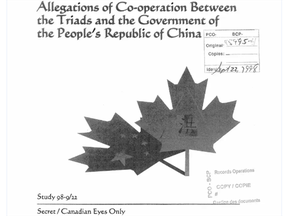
The report, entitled "Allegations of Co-operation Between the Triads and the Government of the People's Republic of China", describes concerns relating to Chinese political interference in Canada, concerns that have re-emerged recently through intelligence leaks alerting the public. Accusations that the current Liberal government of Justin Trudeau continued to ignore such warnings in its zeal to sign a free trade agreement with China, led finally to the launch of a public inquiry as a result of pressure exerted on the government by parliamentary opposition critics.
In the late 1990s, relations between Canada and the Chinese government
were warm. Here, Prime Minister Justin Trudeau is seen with
China's Xi Jinping during a G20 summit in Bali last year. (Sean Kilpatrick/The Canadian Press)
The report is 26 detailed pages in length, incorporating three main sections. Issues of concern were possible cooperation between Chinese criminal groups and the Chinese government; Chinese political interference in Canada; and China's intelligence services activities. The final conclusion reached by the report was that Chinese intelligence services actively attempted to recruit business and political leaders in Canada to influence Canada's political activities dating from the 1990s.
"PRCIS front companies and Canadian companies have been used to slip PRCIS [People's Republic of China Intelligence Services] personnel into Canada in delegations."
"The thousands of Chinese students and delegates who come to Canada each year and are hampered by few restrictions in moving about the country, pose the greatest Chinese intelligence threat."
RCMP/CSIS Joint investigation report
There was also the highlighted issue of China's intelligence services actively seeking Canadian intellectual property to be handed over to Chinese organizations. Noted in the report as well was China's use of "mass line" intelligence gathering with the use of a network of informed Chinese nationals tasked to travel abroad for the express purpose of gathering useful intelligence information.
Old intelligence reports accused Beijing of using criminal triads to do
their dirty work outside mainland China. In one recent example, criminal
groups are suspected of beating pro-democracy protesters in Hong Kong,
seen here in 2019. (Ming Ko/AP)
Former national security analyst Stephanie Carvin commented on China's pursuit of a similar agenda in 1999, similar to what it is pursuing at present, irrespective of different leaders of the Chinese Communist Government in the last 25 years. When the report was submitted to government 25 years ago, then-Liberal prime minister Jean Chretien dismissed allegations of political interference. It would, if given credence, interfere with his personal plans to do business in China which his series of trade missions had set the groundwork for.
In addition, the Project Sidewinder report confirmed that Chinese criminal organizations were actively working in Canada. "this country is an excellent place for them to invest in companies, launder profits derived from criminal activities, secure a portion of their assets outside Hong Kong and obtain a Canadian passport".
Media reports earlier in 2023 informed by intelligence source leaks speak of widespread efforts by the Chinese government to interfere in recent 2019 and 2021 elections in Canada. Underhanded work such as misleading social media to reflect a Chinese agenda, and WeChat posts in Chinese aimed at influencing Canada's huge Chinese diaspora communities, in a deliberate mission to have the Liberals returned to government while demonizing their opposition Conservatives.
Former Conservative MP Kenny Chiu says he was targeted for attacks by
the Chinese government in the 2021 election after he proposed creating a
registry of foreign agents, like some other countries have. (Adrian Wyld/The Canadian Press)
"I would say what's different now is scale."
"The other thing that's really coming in since 1999, I would say is the cyber angle [China's online disinformation and computerized intelligence-gathering]."
"I don't think this was ever forgotten [keeping an intelligence services eye on China in the 1990s of subversive activities]."
"I'm just not sure the extent people were paying attention until recently."
Stephanie Carvin, associate professor, Carleton University, former national security analyst
A Chinese man cycles past a billboard in front of Beijing's Forbidden
City before a 2001 visit by then-Canadian prime minister Jean Chretien.
At the time, concerned U.S. officials were secretly probing Chinese
operations in Canada. (Reuters)
Canada's Security Intelligence Agencies vs Canada's Activist Courts
"What I'm kind of starting to notice is that ... whether it's explicit or not, they can be politically motivated. There might be a trend here. It may be too early to tell, but that's ... something that I've noticed and something that I've heard."
"Our client was fortunate enough that he had the resources and the means to hire a lawyer to assist him [in] this process, but if you weren't so fortunate, I mean, he might be facing a lifetime ban."
"It is next to impossible to challenge the advice that security intelligence agents offer to the department."
"It's really about how we interpret what constitutes a risk, and what sort of association actually renders someone inadmissible."
"[Many people are screened out based on secret evidence that can't be reviewed, which] often leads to egregious injustices."
"What I would say is that in the immigration domain, it is pretty much a Wild West."
Sharry Aiken, professor of law, Queen's University
A recent Federal Court decision suggests the Canada Border Services
Agency relied on unreliable intelligence when it chose to deny permanent
residency to Liping Geng. (Darryl Dyck/The Canadian Press)
In Canada, a controversial discussion continues to rage around foreign interference, efforts by foreign entities in service to their governments to disrupt Canadian elections. At the same time two arms of the federal government routinely deport people suspected of engaging in espionage or terrorism. Or, they are barred from entry to Canada. Lawyers working within the immigration system anticipate a ramping up of these efforts by security officials, as a reflection of the heightened attention on the internal meddling by other countries in strictly Canadian affairs.
But then, it is not the work of immigration lawyers to be aware of potential disruptions allied with the entry to Canada of foreign elements tasked with infiltrating Canadian academia, society, corporations and governments at all levels; their bread-and-butter is successful representation of the clients in whose service their professional credentials earn them both reputation and financial security. Their very business model is based on representing clients, not the security and welfare of Canada.
In the security screening process which determines who may enter Canada and which visa applicants may not, the Canadian Security Intelligence Service, Canada Border Services Agency and the Immigration Department are all involved. Officials are tasked with barring permanent residents or foreign nationals from entry to Canada through the Immigratuon and Refugee Protection Act, should they be engaged in terrorism or in espionage injurious to Canada's interests.
The Immigration and Refugee Board of Canada acts as the independent administrative tribunal hearing applications. Should there be red flags when people submit applications for visas, they become subject to background and security checks; CSIS and CBSA produce reports to the board, and how to manage an application then is up to the discretion of the Immigration and Refugee Board. Those applicants deemed inadmissible through this process have the right to appeal to the Federal Court.
A former Canadian citizen who had been denied permanent residence, deemed inadmissible on the basis that he taught English to Chinese spies and might be involved in espionage himself, was represented by immigration lawyer Athena Portokalidis. Liping Geng, a 68-year-old Chinese citizen's case was set out in a report prepared by the National Security Screen Division of CBSA, citing information from a CSIS report. Double-screening, in other words by two separate, but cooperative intelligence agencies.
According to court records, Geng was a member of China's People's Liberation Army as a young man. He worked as an English teacher after completing school, at an army-operated department training students in foreign languages. Everyone who attended the school was "in or was linked to Chinese military intelligence", Canadian officials stated; the teachers were actively engaged in espionage. Later, Geng spent nine years completing master's and doctoral degrees at University of Toronto.
From there he went on to teach, and his family was approved for permanent residence status in Canada, becoming citizens in 1995. Geng returned to China in 2007, choosing to renounce his Canadian citizenship, since China will not recognize dual citizenship. He continued to regularly visit his family in Canada in following years, then chose to return permanently to Canada after retirement, in 2019.
Security officials were criticized for taking their evidence from newspapers and other open sources to build their case to exclude the man, instead of acquiring hard evidence, leading Federal Court Justice Richard Mosley on appeal to find that CSIS and CBSA reports accusing Geng of espionage "drove the decision-making process". The justice then wrote a ruling that quashed the Immigration and Refugee Board's decision; that the security assessments amounted to an "overzealous effort" to establish Geng as a member of the Chinese military.
Federal Court Justice Richard Mosley found the the consequences of the
decision to deny Liping Geng admission were 'particularly harsh.' (Sean Kilpatrick/Canadian Press)
But failing to take into account that China enacted a law calling on all its expatriate citizens wherever in the world they live, to be loyal to China and follow the Chinese Communist Party rules of engagement. Espionage, both commercial/scientific and military/government, along with academic, is a Chinese strategy long recognized to have robbed Western countries of trade and military secrets. Moreover, Chinese law empowers Beijing to hold Chinese who are citizens of other countries liable to China for maligning the CCP, or refusing to act on Beijing's behest.
"[A CBSA security assessment in April 2021 cited the CSIS report and
other documents found on the internet to conclude that the language
school falls within the organizational structure of the Chinese signals
spy agency] and that many graduates are assigned to 3/PLA monitoring and
control stations, including those targeting the United States and
Canada."
"As a result of his
employment as a lecturer with the LFLI, there are reasonable grounds to
believe that the applicant is a member of an organization, the 3/PLA,
that has engaged in acts of espionage that are against Canada and
contrary to Canada's interests."
"There are also reasonable grounds to believe that the applicant himself has engaged in espionage."
CBSA report
"[The language institute where Geng taught] is a military training institute
where officers and foreign affairs officials receive language training,
including for the purpose of being assigned to listening posts."
CSIS report
People walk across a street near a large screen promoting the Chinese People's Liberation Army in Beijing.Andy Wong/The Associated Press
"In the aftermath of Sepember 11, 2001, Slahi was again arrested in Mauritania at the behest of the United States."
"He was kidnapped and transported against his will on a CIA-orchestrated rendition plane to Jordan, where he was interrogated and tortured for eight months, before being rendered to Bagram Airfield in Afghanistan and then onwards to Guantanamo Bay."
$35-Million lawsuit Statement of Claim
"Canadians need to understand this is a Canadian story."
"Without Canada I'd never have been kidnapped. Without Canada I'd never have [been] tortured."
Mohamedou Ould Slahi, Mauritanian
"You provide information, which results in someone's detention."
"And then even though you're not the party detaining them -- you're not the one waterboarding them -- when you receive that information back from torture and you act on it, you're justifying it."
Jody Brown, lawyer represent Slahi
Mohamedou Ould Slahi, a former Guantanamo Bay prisoner who wrote a
best-selling book about his experiences in the U.S. military prison, is
shown in October 2016, after he was reunited with his family in his
native Mauritania. He was detained for 14 years and is now suing the
Canadian government for its alleged role in his detention. (AFP/Getty Images)
That the United States has enemies is indisputable. The sole global power that is the United States of America, for good or for ill, involves itself in foreign conflicts, has collegial relations with some, and is clearly antagonistic toward others. At a time when radical Islam became a threat to be reckoned with, rising in Saudi Arabia among Wahhabist extremists and military arms of the Muslim Brotherhood, as well as terrorist groups fostered by the Islamic Republic of Iran, all of which considered the West and the U.S. in particular, enemies of Islam, it isn't surprising that symbolic structures of that global power were targeted for destruction and thousands of innocent lives were lost.
The al-Qaeda-originated plan to attack the World Trade Centers in New York and the Pentagon, along with a failed passenger flight meant for Washington but ending up in a Pennsylvania field, was a product of Saudi Arabia. Where the official Islamist sect of Wahhabism gave impetus to Osama bin Laden's terror group that carried out the surprise attacks of 9/11. An event that saw great celebration in parts of the Islamic world, and brought shock and horror to the world of the West. Little wonder that horror of vibrant, hateful terrorism made the world take notice of violent, deadly Islamist terrorism.
There can have been little surprise anywhere that the U.S. set out on a mission to stop further atrocities being committed by al-Qaeda, and in the process sought those who might have been involved in the attacks, along with others who took inspiration from it, and went on to commit other, similar mass murders. Suspicion under such circumstances would naturally fall on all young Muslim men in the freshness of the horrifying deaths of almost three thousand innocent people who happened to be working in the targeted buildings.
In the past, Canada agreed to settle lawsuits brought by Muslim men held under suspicion and incarcerated and tortured because of perceived links to Islamist terrorist groups. The lawsuits contended that Canadian investigative authorities had erred in collaborating with their Intelligence partners in other countries, most notably the United States at a time when it was locating men suspected of links with terror, rounding them up and incarcerating them under special emergency provisions beyond normal law and justice.
Now, a man who had lived in Montreal for close to two months has filed a $35-million lawsuit against the government of Canada for its part in the alleged claim of responsibility for his incarceration for 14 years in Guantanamo prison. That it was Canada's 'contribution' to intelligence-gathering that implicated him as a possible terrorist leading to his imprisonment and torture. National security and intelligence agencies have the responsibility to investigate potential threats and identify them for the purpose of thwarting attacks.
In so doing, exchanging information with a collegial power, an action considered normal cooperation by those agencies with the responsibility to be alert and prevent violent attacks that had become increasingly common throughout Europe and North America, by Islamists dedicated to wreaking havoc, destruction and death purportedly doing the will of Islam where the Koran identifies non-Muslim countries as countries of 'war', considering Islamic nations to be countries of 'peace'. An inversion in fact, which justifies Islamic nations warring on non-Muslim countries to bring 'peace'; aka Islam to them.
Authorities with the Canadian Security Intelligence Service and the Royal Canadian Mounted Police began questioning Sllahi about ties to Ahmed Ressam, the millennium bomber who had planned an attack on Los Angeles airport. The link between the two was superficial; attendance at the same Montreal mosque. The Federal Court of Canada ruled that Slahi was not entitled to intelligence documents as being neither a citizen nor subject to legal proceedings in Canada.
Because of the surveillance he was under in Canada, he decided to return to West Africa where he was arrested in Senegal and interrogated there by American officials. When he was released from prison in 2015 he was ordered restricted to movement within Mauritania. It was not until 2020 he was able to leave the country. Guantanamo filings for his interrogation were based on a telephone conversation thought to be coded. According to Mostafa Farooq of the National Council of Canadian Muslims, the perceived Canadian complicity in Slahi's detainment and torture was a result of Islamophobia,
Given the circumstances, the horrendous events of 9/11, the terrorist attacks in the U.K., in Spain, in France and elsewhere, it is little wonder that young Muslim men were viewed with suspicion. All the more so that many young Muslim men living in Europe and North America saw fit to answer the call to Islamist jihad, travelling to the Middle East to join terrorist groups fighting against the West. The cautionary principle to know your enemy does lead to stereotyping inevitably. On the other hand, some of Islam's faithful distinguished themselves as jihadists; little wonder they were singled out for special attention; the circumstances and the times demanded it.
This Nov. 30, 2017 photo
shows former Guantanamo Bay prisoner Mohamedou Ould Slahi speaking
about his experiences under CIA interrogation via video from his home in
Mauritania to an anti-torture group in Raleigh, NC. (AP Photo/Emery
Dalesio)
"How do you make that important transition from intelligence information to prosecutorial evidence? All of that is part of what we will be examining." Public Safety Minister, Ralph Goodale, Ottawa
"All
of them could potentially be a threat, definitely We have
no information of an imminent attack, but we have to remain vigilant,
the threat is real."
"These individuals posing a threat to our security at home have violated
Canadian law. The RCMP is investigating these individuals
and will seek to put them behind bars, where they belong."
CSIS director Michel Coulombe
That assurance was issued to the public by Mr. Coulombe in 2014. Two years later, little has been accomplished in isolating, charging and arresting Muslim Canadians who have returned from the fields of conflict in the Middle East and Africa. News that 60 individuals have returned to Canada from fighting in the ranks of the Islamic State, al-Qaeda and assorted terrorist groups of which there is no lack in the aforementioned geographies has once again surfaced.
And none of them has been charged. In 2013 Parliament took steps in the creation of four criminal laws to make it illegal and a criminal act to leave the country or to attempt to leave for the purpose of taking part in terrorist actions. The Canadian Security Intelligence Service (CSIS) has a figure of 180 from Canada currently aiding extremist movements abroad. Most of these jihadis will eventually plan to return to Canada, walk the streets of its cities, and muse about their talents, how best they can be put to use in universal jihad.
CSIS Director Michel Coulombe once again testified before the Senate's committee on national security explaining the concern that among those who survive the conflicts they take part in and return to Canada, their combat skills could prove downright handy in launching terrorist attacks here. Their experience abroad gives them a certain cachet among the admirers of Islamist terror, aspiring themselves to become jihadis and perhaps even martyrs.
Those with the experience are well versed in what can be found abroad relating to those opportunities. Their experience gives them credibility and respect, and if they decide to become recruiters to terror, to raise funds for the cause, and organize domestic cells, they have all the requisite credentials to impress followers anxious to be as they are.
As an explanation for the lack of charges and arrests, both the Commissioner and the Minister pointed to Canadian law requiring more than merely incriminating intelligence, but hard evidence being required to pass as sufficient to convict someone for crimes as outlined in those 2013 laws; guilt must be established beyond a reasonable doubt, and since investigators are not known to be welcome in the confines of jihadi strongholds to witness what they theorize first-hand, evidence is hard to come by.
CSIS itself is an national intelligence investigating body, with no law enforcement capacity so that terrorism-related criminal charges must be the work of the RCMP. Policing agents have turned to the use of surveillance, immigration law, detention, peace bonds and tactics meant to disrupt, to watch, to remove and to thwart activities of those who have returned from conflict zones. This is time- and labour-consuming, taking up the attention of officers far in excess of the number of returnees being watched.
The benefit of the doubt, in other words, is scrupulously maintained by Canada's justice system, in view of the Charter of Rights and Freedoms. Even for those 'citizens' who subscribe to terrorism as a priority plank in the religion built on a platform of conquest, violence, assassinations, riven with sectarian hatreds and tribal animosities complicating the focus on the infidels and the Jews who will have their turn once Islamists have vented their acidic spleen in mutual slaughter.