

Transwomen and Correctional Service Canada's Decision-Making
"[There is recognition that the placement of gender-diverse offenders in its institutions] is a complex and evolving area of operations.""[Correctional Service Canada] continues to adapt its practices and respond to emerging issues.""[Each transfer request is] assessed on a case-by-case basis.""[We consider risks to other offenders and staff] particularly in relation to a history of gender-based violence or sexual violence [and] risks to the offender's personal safety.""CSC has the authority to transfer an offender to a more suitable institution at any point, if deemed necessary.""[Involuntary transfer decisions] are not automatic and are not based on gender identity."Correctional Service Canada"It's not transphobic to speak about reality and women deserve to be protected. And it's also not transphobic to say, 'Hey, this isn't working'.""You have two groups of people who have competing rights here, and it's women that are being harmed.""I felt very violated, and I also felt that it's the duty of the correctional system to provide safety for us, because we are locked in an institution where we cannot leave and we have no recourse to protect ourselves."Heather Mason, non-trans woman, in and out of prison on drug-related offences"I think this speaks to the question of the policy on paper versus the policy in reality.""Women who are trans or Two Spirit or gender non-conforming in another way, who feel that an institution for women best aligns with their gender, are being prevented from having that placement."Nicole Kief, executive director, Prisoners' Legal Services, British Columbia
 |
| The Investigative Journalism Bureau, University of Toronto |
Amanda Joy Cooper who as a biological male threatened a girl roller-skating by issuing to her a threat that "I'll rape you". He attacked a young woman at the same parking lot a day later, and two days following that he assaulted a 19-year-old woman at a bus shelter. Even before these incidents he had been convicted of multiple sexual assaults. In federal custody in 1985, he sexually touched female prison staff and then sexually assaulted a female parole officer. Designated a dangerous offender in 2001, he now identifies as a woman.
While in prison, gender-affirming surgery described by the Canadian Society of Plastic Surgeons as surgery to help a person "physically actualize their internal sense of self", was carried out. Now, he wants to be transferred from Ontario's Millhaven Institution's maximum security prison for men, to the Fraser Valley Institute for Women, in British Columbia.
His and other similar cases are set to be reviewed on June 15, by a Federal Court judge, part of a growing debate over handling inmates requesting prison placement based not on anatomy, but on gender identity. A debate that pits transgender women's wishes to be placed in an institution that their gender identity matches with, against, on the other hand, the security and privacy concerns of natal women housed in those institutions. In 2017 Correctional Service Canada instituted a policy change to align with federal legislation prohibiting discrimination based on gender identity.
The rate of transfer approvals, according to data obtained by the Investigative Journalism Bureau and written about by journalist Courtney Greenberg, is now 23 percent. There were 57 transwomen from 2017 to 2025 making 129 requests to transfer to a women's prison, 35 of which were approved. Over 70 requests were denied during that time frame. As of October 2025, 90 transgender women were housed in federal prisons, 73 of them placed in men's prisons, 17 in women's prisons. Eight of the 17 have undergone gender-affirming surgery.
 |
| Fallon Aubee, a former inmate, was the first trans woman to be transferred to a women’s prison. Photo by Nick Procaylo /Postmedia |
Of those 17 transgender women, criminal offences include murder, assault with a weapon, manslaughter, arson, forcible confinement, sexual interference of minors, and printing or publishing child pornography --according to the Correctional Service of Canada records. Of the 17, two transwomen are documented as dangerous offenders; they were convicted of a serious violent or sexual crime, and consequently may pose a threat to others.
Transwomen were found to make up 80 percent of gender-diverse offenders with sexual offence histories, according to a CSC 2022 study. For the most part, such offences occurred while offenders were "living as their biological sex"; most of their victims were children and women. Whereas most female offenders stand accused of nonviolent crimes; property crimes making up the largest proportion, followed by drug offences, according to a Statistics Canada report dated 2018.
The Investigative Journalism Bureau found that Michelle Autumn, a transwoman, was removed from a federal women's prison following transfer. A life sentence in 2007 was given for first-degree murder where Michelle Autumn at age 17 and living as a male, lured a 13-year-old Edmonton girl to a golf course where he and a group of others sexually assaulted and murdered the girl. In early March of 2025 Autumn was transferred to Grand Valley Institution for Women where, during a strip search, Autumn "exhibited highly inappropriate behaviour", playing with her genitalia "in a sexually suggestive manner". Four days later, she was transferred back to a men's prison.
 |
| Macdonald Laurier Institute |
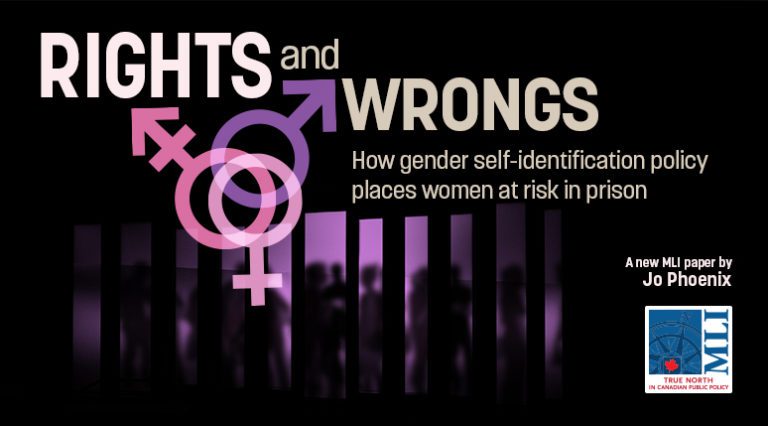
"There is no substantial evidence to support a prison placement policy that permits transgender prisoners to choose the prison in which they will serve their time.""But we do have a mounting number of specific instances where women have been directly harmed as a result of such policies.""Women prisoners who are retraumatized by the presence of male bodied individuals – especially in rehabilitation programs that may well be discussing male violence – cannot simply leave and find another group to attend.""To ask an already marginalized demographic to bear the burden of risk, the possibility of retraumatization, and the loss of dignity and privacy in order to validate the sense of identity and subjectivity of a relatively small number of individuals is, perhaps, the wrong balance of competing rights."Jo Phoenix, Professor of Criminology, Open University, London
Labels: Ensuring Security of Female Prisoners, Gender-Sensitive Correctional Service, Transwomen in Women's Prisons, Transwomen Prisoners
posted by Pieface | 9:16 PM


0 Comments:
Post a Comment
<< Home