

The New-Old Iranian At-War Governing Council
"We had prepared for such moments and have plans in place for all scenarios, even for the time after the martyrdom of revered Imam Khamenei.""You'll see that after the leadership council is formed, the power and integrity of officials, defensive forces and the people will be beyond imagination."Mohammad Bagher Galibaf, parliamentary speaker, Iran"We are ready in our country.""We are not looking for war, and we won't start the war. But if they force it on us, we will respond."Ali Larijani, 67, head, Iranian Supreme National Security Council
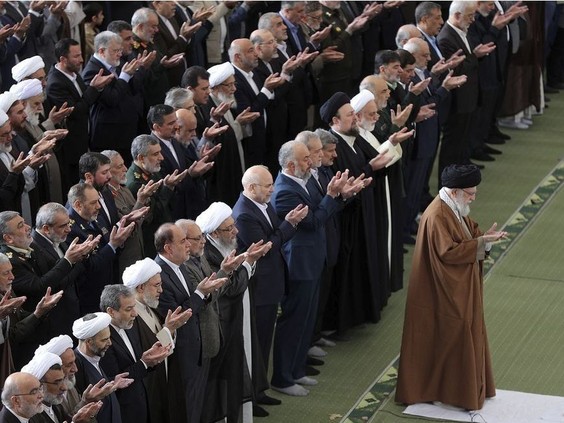 |
| In this photo released by the official website of the office of the Iranian supreme leader, Supreme Leader Ayatollah Ali Khamenei leads an Eid al-Fitr prayer marking the end of the Muslim holy fasting month of Ramadan at the Imam Khomeini Grand Mosque in Tehran, Iran, Monday, March 31, 2025. Photo by Uncredited /AP |
Well, 'they' did proceed to 'force it' on the Islamic Republic of Iran. The United States and Israel in a tandem of determination, after failed nuclear talks and in the wake of massive, prolonged popular protests by Iranians fed up with the economic plight they found themselves in as a result of sanctions imposed on Iran for its intransigence over international demands that it forego its nuclear programs, where the regime's brutal crackdown on protesters led to thousands killed, tens of thousands injured and arrested, the decision was finally made to attack the regime's nuclear development sites, its IRGC weapons depots, ballistic missile launchers and leading government figures.
Ayatollah Ali Khamenei is dead, as are many of the leading military and security figures of the Islamic Republic. Before his death, the Grand Ayatollah left instructions with trusted aids how they must proceed in a continuation of the Islamic Republic after his death. The Muslim holy month of Ramadan 2026 saw the aerial invasion of Iran by American and Israeli fighter jets targeting the regime's infrastructure, its military, its government figures, after a massive buildup of American military assets at sea and in the air. A joint, well-planned agreement between Israel, whom Iran has repeatedly threatened to destroy and the U.S., whose military assets Iran has repeatedly targeted with its proxy terrorists.
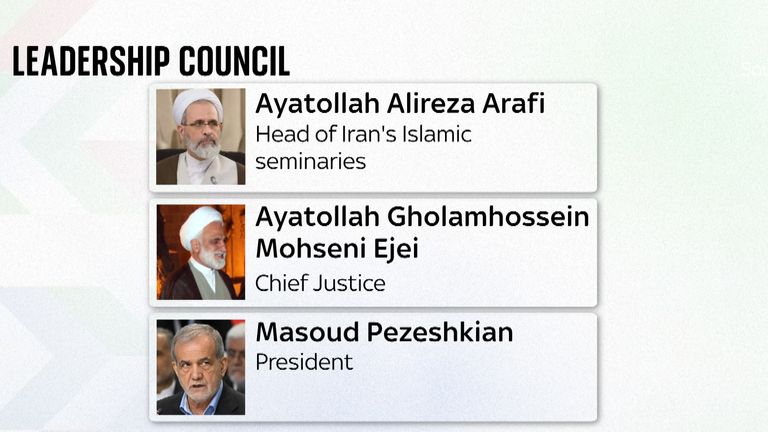 |
| Provisional Leadership Council, Sky News |
Mr. Larijani had been tasked with crushing the January protests throughout the country that demanded the ouster of the regime and the end of Islamic rule. The lethal force that was unleashed under his command was in fact a reflection of the government itself, prepared to kill as many protesters as was deemed necessary to convince Iranians that the government was unmoved by the passion of their protests other than to continue the regime's resolve to crush dissent.
It has been Mr. Larijani who has been front and central in liaising with Russia, Qatar and Oman while supervising the nuclear negotiations underway with Washington. He has been at the helm of planning Iran's response to the expected strike by the United States in view of the American forces being amassed in the region. Alongside Larijani, a handful of other close political and military associates of Ayatollah Khamenei were tasked to ensure that the Islamic Republic would survive any assassination attempts on the regime's leadership including that of the Ayatollah himself.
Four layers of succession were assigned by Ayatollah Khamenei for each of the military command and government roles of critical importance to the longevity of the regime. All those named to leadership roles were themselves in turn to name up to an additional four replacements with responsibilities delegated to a circle of confidants for decision-making, in the event that communications were disrupted or the death of the Ayatollah. All of the country's armed forces were placed on the highest state of alert in preparation for fierce resistance.
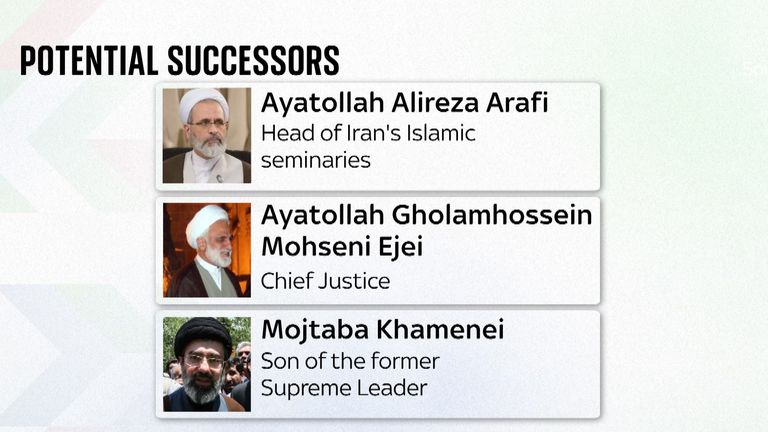 |
| Sky News |
A three-person temporary leadership council has been formed to govern
the country and temporarily assume the duties of supreme leader, in line
with Islamic Republic law. Mr. Larijani tops the list to manage the country, followed by Brigadier General Mohammad Bagher Ghalibaf, a former Guards commander and current speaker of Parliament, designated as the de facto deputy to Khamenei, to command the armed forces during conflict. President Pezeshkian has been sidelined.
None of the men in this tight little circle of command and control would be considered with any favour by the angry people of Iran, given their accusations of financial corruption, and complicity in violations of human rights, inclusive of the recent slaughter of thousands of unarmed protesters over a three-day period in early January.
Labels: Ayatollah Ali Khamenei, Islamic Republic Continuation, Popular Iranian Protests, U.S.-Israeli Aerial Bombing of Iran
posted by Pieface | 9:19 PM


0 Comments:
Post a Comment
<< Home