

DeLiberation Day in the United States of America
"Their decision is incorrect. But it doesn't matter because we have very powerful alternatives.""Today, I will sign an order to impose a 10 percent global tariff under Section 122, over and above our normal tariffs already being charged.""And we're also initiating several section 301, and other investigations to protect our country from unfair trading practices of other countries and companies.""I am absolutely ashamed [of some judges who ruled against me]; disloyal to our Constitution. Lapdogs."U.S. President Donald J. Trump"The Government reads IEEPA [International Emergency Economic Powers Act] to give the President power to unilaterally impose unbounded tariffs. On this reading, moreover, the President is unconstrained by the significant procedural limitations in other tariff statutes and free to issue a dizzying array of modifications at will.""All it takes to unlock that extraordinary power is a Presidential declaration of emergency which the Government asserts is unreviewable.""IEEPA's grant of authority to 'regulate ... importation' falls short. IEEPA contains no reference to tariffs or duties. The Government points to no statute in which Congress used the word 'regulate' to authorize taxation .. we hold that IEEPA does not authorize the President to impose tariffs."United States Chief Justice John Roberts"The Trump tariffs amount to an average tax increase per U.S. household of $1,000 in 2025 and $1,300 in 2025.""The Trump tariffs are the largest U.S. tax increase as a percent of GDP [0.54 [percent for 2026] since 1993."Tax Foundation
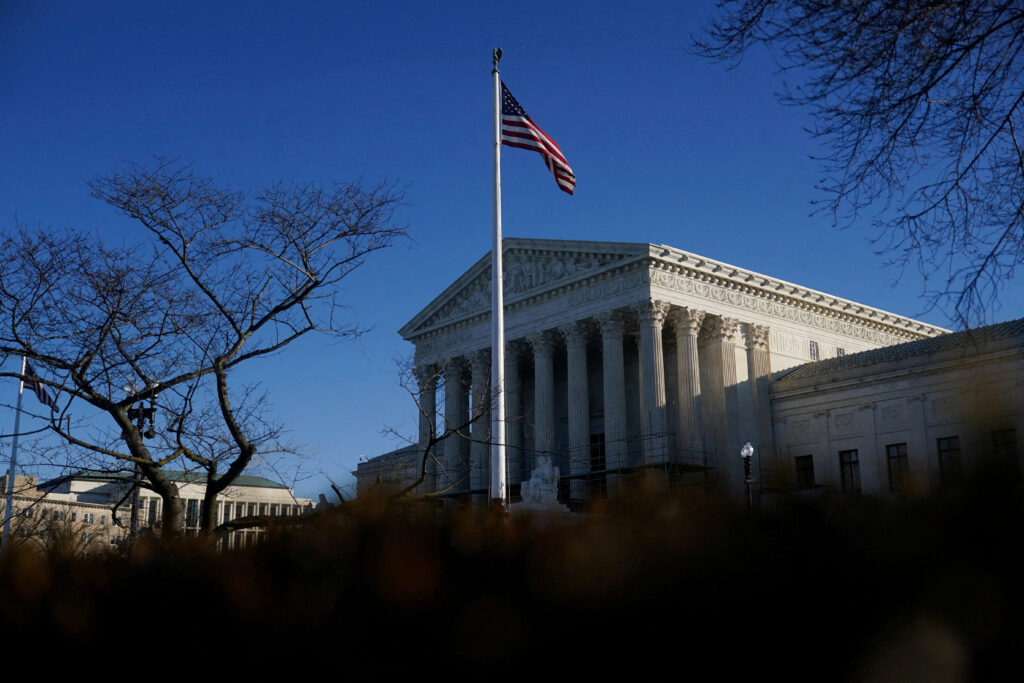 |
| Supreme Court of the United States of America Call it DeLiberation Day. On Friday, the US Supreme Court ruled in a 6-3 decision that the US president does not have the power to unilaterally impose tariffs under the International Emergency Economic Powers Act (IEEPA) Atlantic Council |
When
Donald Trump took office in his first term at the 2017 White House he
made it clear as a business real estate tycoon that the 'art of the
deal' was his forte. His America First agenda and antagonism to world
bodies, including those that regulate economics, international
cooperation, Western alliances in defence sent a cautionary message
abroad. However, it wasn't until his second term at the helm of the
most powerful nation on Earth that the quakes of his decision-making
rumbled through the international community.
Declaring
that the United States of America had too long propped up foreign
nations, in a leadership role that had for too long been taken for
granted by other nations who favoured riding on America's coattails,
while failing to fairly contributing their share, the world was put on
notice that the trust and reliance they had placed for the past 80 years
on the leadership of the United States was at a troubling crossroad.
Then came the hammerblow of Mr. Trump's rejection of global trade and
investment that he felt favoured other countries over the well-being of
the United States.
To
correct that monumental assault on American economic sensibilities in
trade imbalances, the surprising issue of sudden steep tariff
announcements roiled the global financial world as friend and foe alike
were placed on notice that the U.S. was no longer content to be the
international community's rescuer in shoring up the economies of other
countries that preyed on that of the United States. And to 'legalize'
that impulsive decision to make enemies of friends and friends of
enemies, Mr. Trump called upon the authority of a putative national
emergency law.
Free
trade suddenly became a dirty word in the United States along with free
markets. The very drivers of enormous poverty reduction that rescued
2.3 billion people globally living below the poverty line in 1990,
reducing that figure in 2025 to 831 million, even taking into account
population increase."The
proponents of quotas say 'Free trade is fine in theory but it must be
reciprocal. We cannot open our markets to foreign products if foreigners
close their markets to us"; a concept that the indomitable Milton Friedman responded to with: "The
arguments sound reasonable. It is, in fact, utter nonsense. Exports are
the cost of trade, imports the return from trade, not the other way
around".
 |
| Containers are stacked at the Port of Long Beach in California on Friday, the day the U.S. Supreme Court struck down President Donald Trump's tariffs. The refunds that do get issued as a result of the decision will take 12 to 18 months to roll out, experts estimate. (Damian Dovarganes/The Associated Press) |
"The court's decision is welcome news for American importers, the United States economy, and the rule of law, but there's much more work to be done.""Most immediately, the federal government must refund the tens of billions of dollars in customs duties that it illegally collected from American companies pursuant to an 'IEEPA tariff authority' it never actually had."Scott Lincicome, Cato Institute
Labels: Global Financial Impact, IEEPA, Runaway Tariffs, Supreme Court of the United States of America, U.S. President Donald Trump
posted by Pieface | 9:24 PM


0 Comments:
Post a Comment
<< Home