Politic?

This is a blog dedicated to a personal interpretation of political news of the day. I attempt to be as knowledgeable as possible before commenting and committing my thoughts to a day's communication.

Saturday, March 21, 2026

"The fight with Iran is militarily WON"

"[An intervention by the North Atlantic Treaty Organization to open Hormuz -- a choke point for about one-fifth of global oil and liquefied natural gas flows -- would be] easy for them to do, with so little risk."
"[Those members of NATO are] COWARDS."
"[The fight with Iran is] militarily WON."
"If we stay longer, they'll never rebuild." 
U.S. President Donald Trump, Truth Social 
https://i.cbc.ca/ais/57061a9f-22ed-406d-9e43-001db1b75420,1773968420197/full/max/0/default.jpg?im=Crop%2Crect%3D%280%2C0%2C1920%2C1080%29%3BResize%3D620
Democrats and some Republicans are alarmed by the Trump administration's pursuit of another $200 billion for the war against Iran, with some saying it signals a dangerous escalation of the conflict and highlights a lack of coherent strategy. Still from video
 
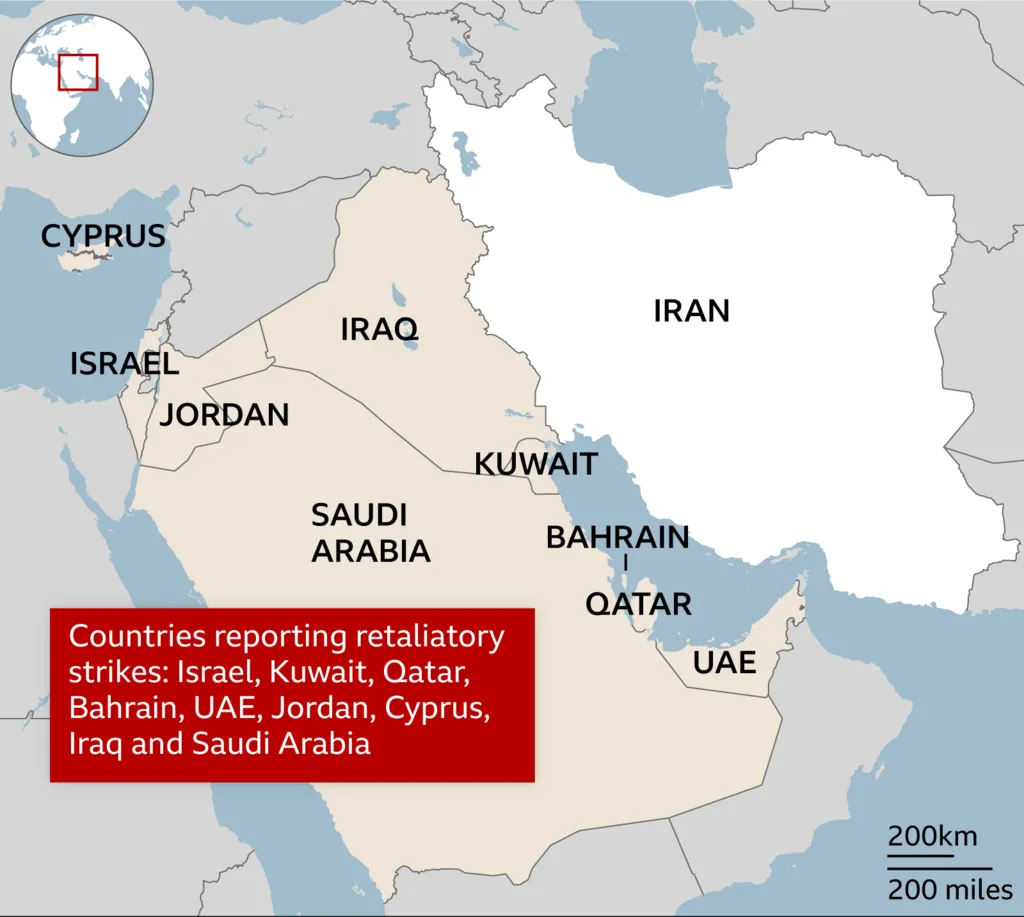
In urging NATO-member countries, ostensibly allies of the United States, to become involved in helping to keep the global-shipping-critical Strait open to marine traffic and finding little response, President Trump's optimism took a frustrated turn, while the Islamic Republic of Iran, under constant fire in the three-week-old onslaught by combined U.S.-Israel warplanes continued its attacks on Gulf States' energy assets.
 
The United Kingdom, France, Germany, Italy, the Netherlands, Japan and Canada issued a joint statement on the blockage by Iran of the Strait of Hormuz expressing their "readiness to contribute to appropriate efforts to ensure safe passage through the Strait"; unsaid was their qualifying previous cautionary appendage: 'when active combat ends'. 
 
There is an undercurrent of these not-eager-to-assist countries extending the courtesy of aid to their oil-rich allies in the Gulf, not necessarily the United States per se. When they speak of consultation with partners and allies, it is all-inclusive of Saudi Arabia, United Arab Emirates, Qatar and Kuwait, and likely NATO-member Turkey. 
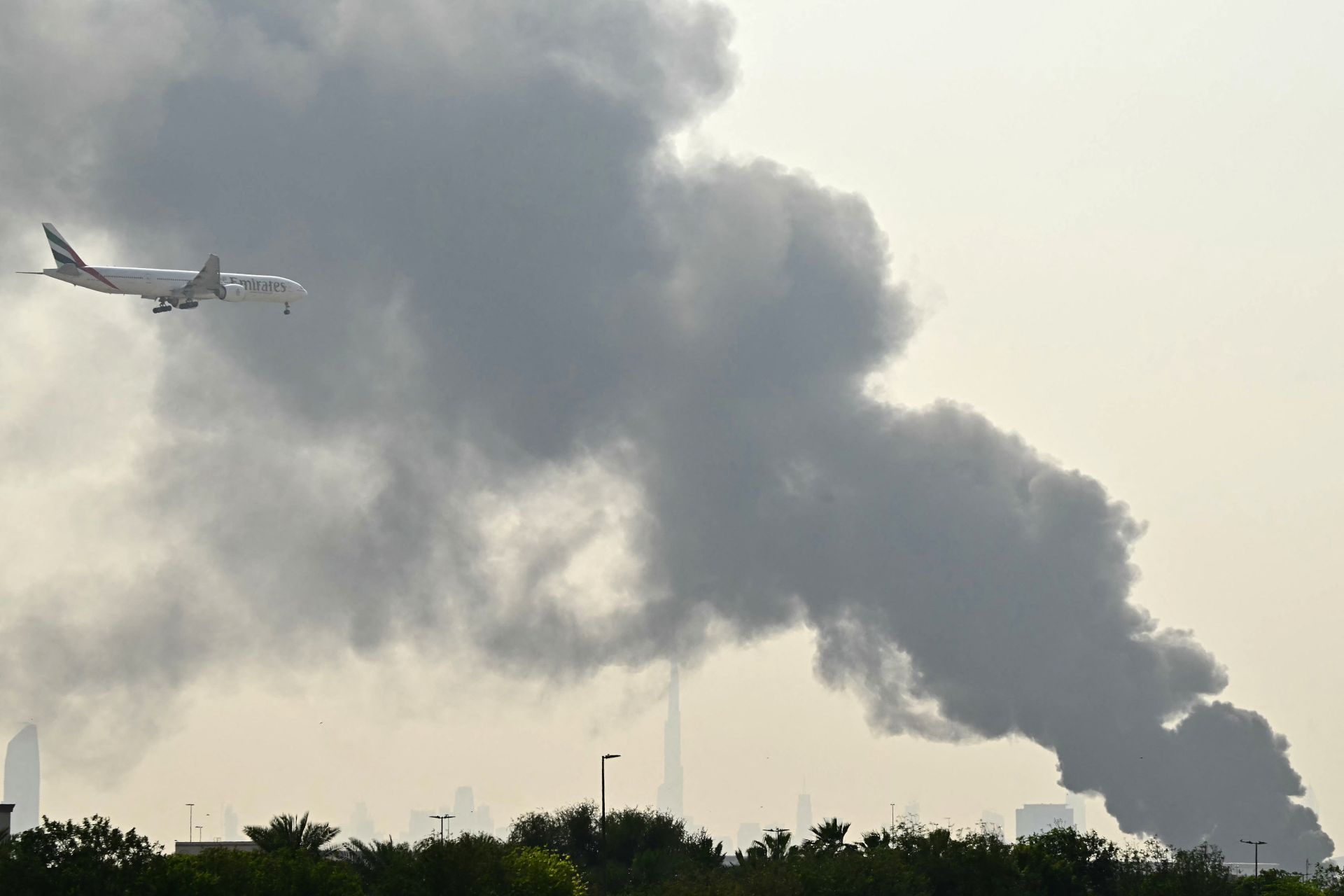
 
Iran’s Attacks on the Gulf Are Leaving Scars That Won’t Fade
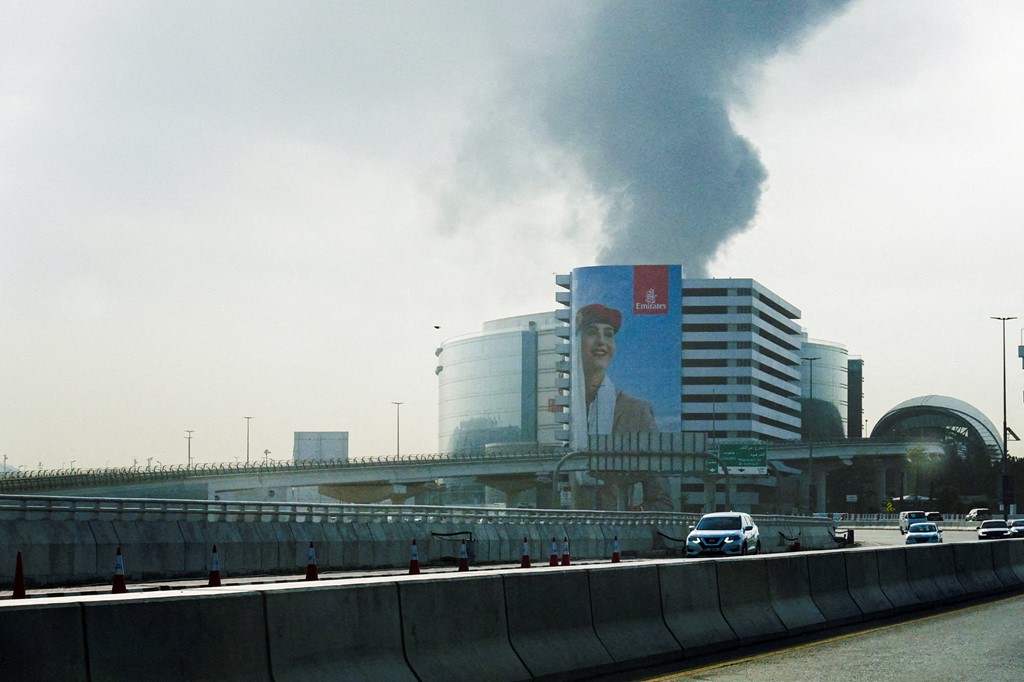
An Emirates aircraft flies past plumes of smoke from an ongoing fire near Dubai International Airport on March 16, 2026. (AFP via Getty Images)
 
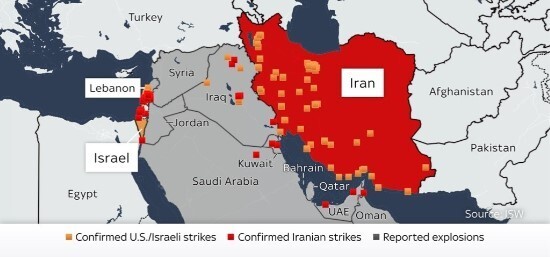
Since the early days of the war, the Strait of Hormuz remains effectively closed, a blockage that has caused a surge in oil and gas prices worldwide. Even after Israel signalled its willingness to stop targeting Iran's energy infrastructure following an earlier strike on Iran's giant South Pars gas field, Iran pressed forward with its attacks nonetheless on Gulf Arab states in retaliation for their friendly relations with the United States and their agreements to house U.S. military bases.
 
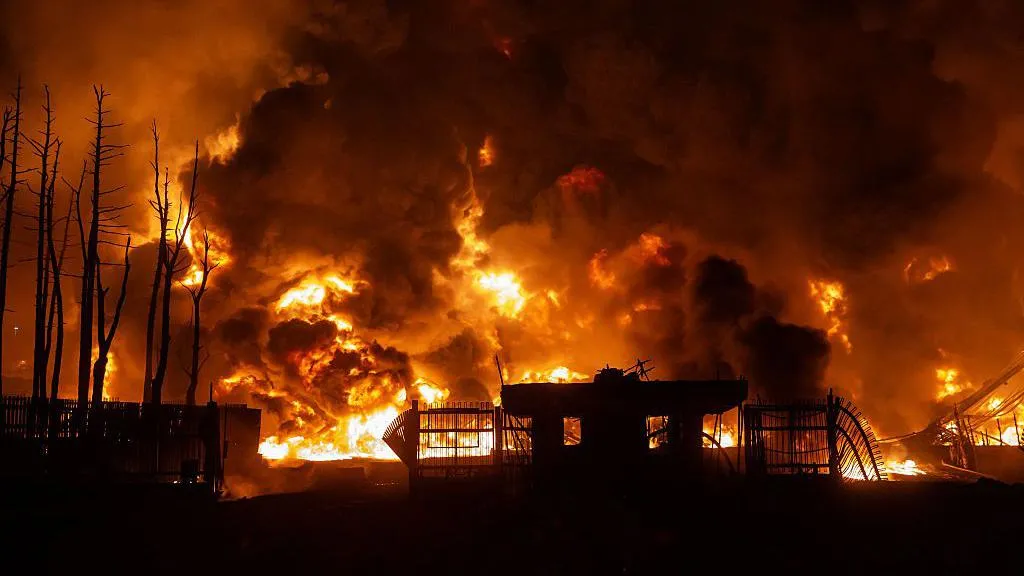
Missiles were intercepted by the United Arab Emirates and Saudi Arabia, along with Iranian Shahed drones; Bahrain reporting a fire at a warehouse and Kuwait was forced to close several units of its Al Ahmadi refinery following multiple strikes by Iran.
 
Three additional American warships and thousands more Marines are scheduled to arrive in the Middle East, according to reportage by the Wall Street Journal, despite that President Trump has consistently stated there are no plans for the U.S. to send ground troops into Iranian territory. Clearly, the American President hasn't entirely ruled out that potential. 
 
Over 4,200 people have died since the war began, across the region, the vast aggregate in Iran. Hezbollah, which chose to attack Israel from Lebanon when the February 28 conflict began with the death of the Supreme Leader Ali Khamenei, is now in a full-scale war with Israel, alongside the conflict in Iran. In Lebanon, an estimated thousand people have died in the parallel war linked to Tehran.
 
https://i.cbc.ca/ais/9856128b-2d86-452c-8201-b305a8367c52,1774043163837/full/max/0/default.jpg?im=Crop%2Crect%3D%280%2C0%2C8362%2C4703%29%3BResize%3D860
A cleric beats his chest as he mourns during the funeral procession of Iran's intelligence minister, Esmail Khatib, in Tehran on Friday. Israel's military said on Wednesday that it would not stop its 'series of eliminations' of senior Iranian officials after announcing it had killed Khatib. (Vahid Salemi/The Associated Press)
 
Qatar has revealed that close to a fifth of its LNG production has been put out of commission for up to five years; QatarEnergy stating the attacks would cost about US$20 billion a year in lost revenue. There is high risk of lasting damage to energy supplies resulting from the war, even if events come to a swift end to stop the fighting. The war's fallout has a global spread, with fuel, shipping, fertilizer and household costs steeply rising.
 
Iran's major oil-export site, Kharg Island, is now under consideration by the U..S. for a takeover operation to impress on Iran that the Strait of Hormuz must be opened, according to Axios. That decision remains in a potential state, after the U.S. strike of military sites last weekend on Kharg, stopping short of targeting oil infrastructure. President Trump retains all options of actions to bring the war to an end and with it the urgency of critical shipping cleared through the Strait.
 
From their March 1st peak, Iran's average missile and drone launches have been diminished about 84 percent, according to a Bloomberg Intelligence analysis. The brunt of Iranian attacks have been borne by Gulf states, led by the United Arab Emirates. Tehran, warned Iranian Foreign Minister Abbas Araghchi, would show "ZERO restraint", should its oil and gas infrastructure be hit again.  
 
https://i.cbc.ca/ais/8818df98-a6ef-4131-90b7-5ee81591fa73,1774008354001/full/max/0/default.jpg?im=Crop%2Crect%3D%280%2C107%2C2039%2C1146%29%3BResize%3D620
Qatar says an Iranian strike on Ras Laffan, the world's largest liquified natural gas plant, has taken out 17 per cent of its export capacity. Persian Gulf states are also major producers of fertilizer, and concerns are mounting over what may happen to global food prices should that supply chain be disrupted. Still from video


Labels: , , , ,

Monday, March 16, 2026

Islamic Republic of Iran Strategy for Survival

"Tehran's bet appears to rest on a familiar asymmetry; its conviction that it can absorb more pain, for longer than the U.S. and its partners are willing to tolerate."
"The leadership likely calculates that sustained economic pressure, finite munitions stockpiles, and the political cost of mounting casualties will narrow Washington's and Israel's appetite for a protracted confrontation."
"Time, in this view, is not neutral -- it's a battleground."
"If Iran calibrates its retaliation carefully, and if it can maintain elite cohesion at home, it may be able to outlast the immediate storm."
"Survival, not victory, is the strategic objective." 
Ali Vaez, director, Iran Project, International Crisis Group, Washington 
 
"They thought Iran was weak and they're realizing that although Iran is weaker than two years ago, the country still has thousands of ballistic missiles and drones."
"Iran has no other option than to resist and sooner or later they will realize that they made a mistake."
Foad Izadi, professor of world studies, University of Tehran
 
"My sense is that the Islamic regime's bench is deeper than the White House or the Israelis may be assuming."
"If the regime has lost legitimacy in the eyes of the majority of its people, we haven't seen defections, we haven't seen signs there is a splintering inside the regime."
"There is sufficient cohesion in the clerical-judicial authorities that even with the taking out of the Supreme Leader and the armed-forces commander, it doesn't mean we are going to see a collapse of the regime."
Jeffrey Feltman, former UN undersecretary general for  political affairs
https://ichef.bbci.co.uk/news/1024/cpsprodpb/2c18/live/532019d0-1630-11f1-801d-ed3cff6bf876.png.webp 
 
With the air attacks launched by the U.S. and Israel on 28 February leading to the death on that first day, of Supreme Leader Ali Khamenei, at minimum an estimated 1,100 people had perished in the space of the first four days of attacks. Large numbers of government and military buildings were destroyed both in Tehran and around the country. In a strategic bid for survival the Islamic Republic counts itself prepared to absorb and withstand great pain, more, it estimates, than the U.S., Israel and Gulf states combined could absorb.
 
With that in mind the strategy was developed to overwhelm the Persian Gulf with drones and missiles for the explicit purpose of exacting maximum chaos, exhaust the defensive capabilities of the region along with its political will, while disrupting global energy markets in the hope that this can all be achieved before Iran exhausts its massive store of projectiles. Weakened before the onslaught both by an earlier June 2025 wave of attacks, as well as a nation-wide series of massive protests against the regime, a depleted leadership is left to fight a war despite its polarized population.
 
"Iran, unlike the United States, has prepared itself for a long war", stated Ari Larijani, secretary of Iran's Supreme National Security Council, reflecting his crucial role in Iran's process of decision making. President Masoud Pezeshkian, judiciary chief Gholam Hossein Mohseni-Ejei, senior cleric Ayatollah Alireza Arafi and Ari Larijani represent the makeup of an interim council. After the decision was made to elevate the deceased Grand Ayatollah's son, Mojtaba Khamenei, and the revelation that he was seriously wounded at the time his father was killed, it is now believed that the Islamic Revolutionary Guard Corps has assumed the power of control in Iran.
 
https://liveblog.digitalimages.sky/lc-images-sky/lcimg-773daaae-03d3-4d2c-a6ee-f28906e07146.jpeg
 
Iranian leadership had determined to institute centralization plans for decision-making called the 'mosaic' defence strategy which includes giving military commanders the power to independently reach decisions reflective of any given situation they encounter. It was undoubtedly they who adopted the strategy of attacking Gulf Arab countries that are allies of the United States who also depend on the U.S. for their own defence, alongside trade and financial agreements.
 
Iran was estimated to have roughly 2,000 ballistic missiles left in its arsenal following last year's joint assault by the U.S. and Israel. A much larger number of Shahed drones formed an additional portion of their stock of weaponry, and a steady stream of additional drones is being handed over to Iran by its ally Russia, who is also producing them, modified and based on the Iranian design. Russia, according to an analysis through Bloomberg Economics produces the drones at a  rate of several hundred daily.
 
https://liveblog.digitalimages.sky/lc-images-sky/lcimg-d156d6f9-4465-4c67-8c55-2808b0460e42.jpeg
 
"Over recent days we're seeing operations against the launchers, on the one hand, and strikes to cork up the tunnels out of which those launders and missiles are meant to emerge", explained Israel's security cabinet minister Eli Cohen through Israel Army Radio. The U.S. strikes have hit thousands of targets across Iran, while Iran responded with hundreds of ballistic missiles and thousands of drones. 
 
No sign of anti-government protests have re-emerged internally in the country to date, with Iranian civilians likely hoping that foreign outside intervention may succeed where their January mass protests failed, at a steep cost in lives when the regime cracked down with deadly fire, killing tens of thousands of protesters.  
 
https://ichef.bbci.co.uk/news/1024/cpsprodpb/bc9c/live/e6859790-1ba3-11f1-9f65-e32170917420.jpg.webp
Conflict across the Middle East continues to rage after the US and Israel launched wide-ranging strikes on Iran, killing the country's supreme leader on 28 February.  Anadolu via Getty Images
"For the Islamic Republic as an entity, it's vital to project the uninterrupted functioning of the system."
"Decentralization is critical for Tehran. It ensures that in the absence of communication with the central government, the country can continue to function for security political and administrative purposes."
"After the June war, Iran made considerable efforts to expand its launcher capabilities. It's unclear how successful they have been. [The entrances and exits of these facilities -- underground] missile cities -- [are also vulnerable to attack]."
"Although Iranian teams have reportedly worked around the clock to reopen damaged gateways, such efforts require resources that may eventually be depleted. If I had to offer an estimate, I would say Iran may be capable of sustaining the current tempo of attacks for at least another three to four weeks."
Arman Mahmoudian, research fellow, Global and National Security Institute, University of South Florida 

Labels: , , ,

Saturday, March 14, 2026

Striking Tehran for Al Quds Day

"These attacks are out of fear, out of desperation. One who is strong wouldn't bomb demonstrations at all. It's clear that it has failed."
"[The American leader underestimated Iran’s resolve.] He doesn't understand that the Iranian people are a brave nation, a strong nation, a determined nation."
"The more he presses, the stronger the nation's determination will become."
Ali Larijani, secretary of the Supreme National Security Council 
 
"The optics are devastating."
"Israel just bombed a Ramadan gathering dedicated to Jerusalem. Every government in the Muslim world will face domestic pressure to respond."
Gulf-based anonymous diplomat  
Blasts strike Tehran’s Al-Quds day rally amid escalating US-Israeli strikes
Blasts strike Tehran’s Al-Quds day rally amid escalating US-Israeli strikes   Daily Jang
 
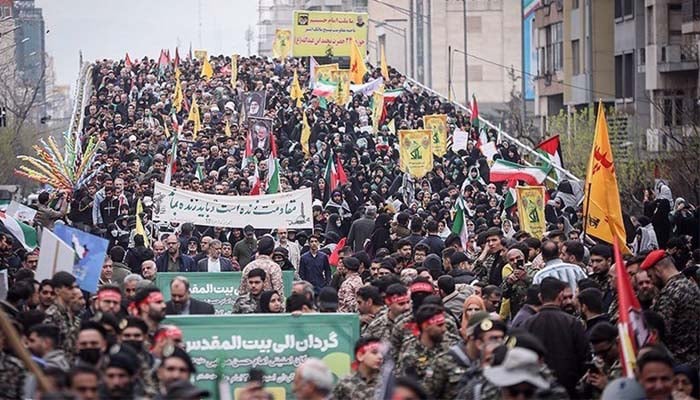
Israel issued a warning to Iranians on a Farsi-language X account. That warning was clear; that people should not attend the annual Al Quds Day rally to which the Iranian regime had urged all Iranians to turn out to demonstrate their loyalty to the Republic and its aims, even and most particularly during a time of great tension and danger, with air strikes over Iran and Tehran's military and weapons-storage and nuclear plants struck by the U.S. and Israel on a daily basis. The warning urged Iranians to clear the area, shortly before a planned attack on Tehran's central square.
 
It is doubtful that many Iranians received the message, since the regime had shut down all internet communications. Iran's President Masoud Pezeshkian in a social media post urged Iranian citizens to "disappoint Iran's enemies by taking to the streets in greater numbers than ever before". When Iranians in January 'took to the streets' all across the nation, they numbered in the tens of thousands in city after city, and not at the behest of their government. Their impetus to rally and demonstrate, despite the inherent dangers was to protest against the government.
 
The risks they took, in a regime known to be dismissive of human rights and which had in the past attacked its own people when they peacefully assembled to protest against the anti-human rights excesses of the  regime, was not unknown to the courageous civilians who faced off against the Basij police who used live ammunition to fire on protesters. An estimated 30,000 of whom were killed, many tens of thousands wounded and countless others arrested and tortured as opponents of the regime.  
 
'Death To Israel, US' Chants At Al-Quds Demonstrations In Tehran
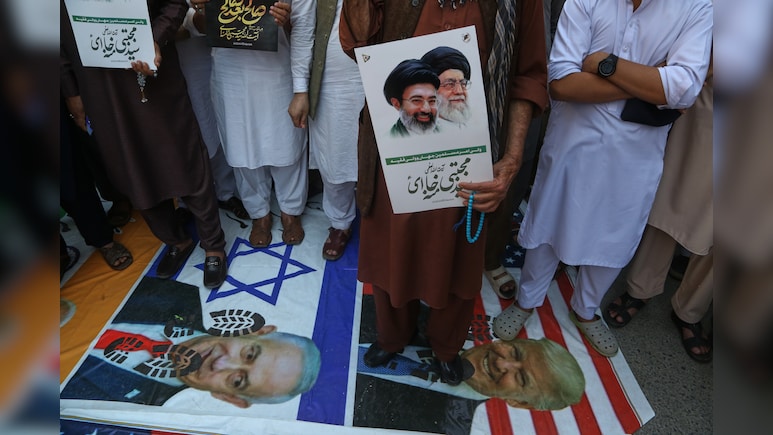
Shiite Muslims stand over the representation of US and Israeli flags with pictures of Donald Trump and Benjamin Netanyahu during an annual Al-Quds Day rally in Peshawar, Pakistan, on March 13. NDTV
 
Gathered on Friday, ostensibly to support Palestinian claims to statehood on ancient Judean ancestral land, and to chant calls for the destruction of Israel, Iranians faithful to the regime gathered in Ferdowski Square in Tehran for the annual state-organized rally. The yearly rally, meant to take place on the last Friday of Ramadan, takes place when Iran loyalists globally remain faithful to the call, and arrange for similar ceremonial al-Quds rallies to take place throughout Europe and North America.
 
This year Israel targeted the area, as warned, but that warning did nothing to stop the mass demonstration, attended by a smattering of senor government officials. The bombing of the square is part and parcel of Israel's decision to destroy the infrastructure and leadership of the Iranian theocratic regime. Despite the combined daily aerial bombardment of both Israel and the United States -- and in fact, because of it -- Iran has responded by launching widespread missile and drone attacks not only on Israel, but at neighbouring Gulf states. 
Smoke rises following an explosion during a protest marking the annual al-Quds Day (Jerusalem Day) on the last Friday of t...
PBS News
 
The midday explosion that rocked the Ferdowski Square area where crowds chanted "Death to Israel", "Death to America", sent crowds scrambling. No reports of casualties were immediately given. Following the strike, footage from the scene saw people chanting "God is greatest" in the fervour of divine belief, even as smoke billowed high in the area. 
 
A second message was posted in Farsi by the Israeli military criticizing Iran for blocking people from seeing their pre-strike warning. Gholamhossein Mohseni Ejei who leads the Iranian judiciary, was giving an interview on state television while at the demonstration, as the strike took place. He stated that Iran, "under this rain [of] missiles will never withdraw", as his bodyguards protectively surrounded him. 
 
Black smoke rises ahead as hundreds of people walk in a rally.
Black smoke rises following an explosion in Tehran, as Iranians take part in the Al-Quds Day rally, a commemoration in support of the Palestinian people held on the last Friday of the Islamic holy month of Ramadan. (Elaheh Asiabi/Fars News Agency/AFP/Getty)


Labels: , , , ,

() Follow @rheytah Tweet