This is a blog dedicated to a personal interpretation of political news of the day. I attempt to be as knowledgeable as possible before commenting and committing my thoughts to a day's communication.
"Planes, shore-to-vessel missiles, personnel armoured vehicles, heavy air-defence systems [these are our indispensable needs]."
"Either you help us now -- and I'm speaking about days not weeks -- or your help will come too late and many people will die."
"[I have no doubt Ukraine will receive the arms needed, but] the question is the timeline."
Ukraine's Foreign Minister Drnytro Kuleba
"To enable this transfer and ensure the continued security of Slovakia, the United States will reposition a U.S. Patriot missile system to Slovakia. Now is no time for complacency."
"As the Russian military repositions for the next phase of this war, I have directed my administration to continue to spare no effort to identify and provide to the Ukrainian military the advanced weapons capabilities it needs to defend its country."
U.S. President Joe Biden
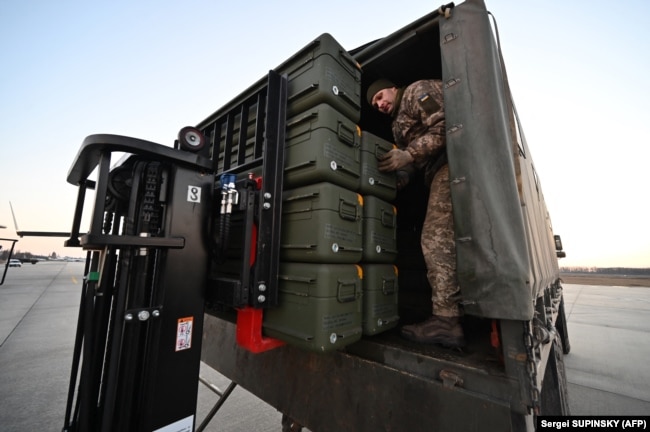
Ukrainian soldiers unload U.S. made Stinger
missiles and the other military assistance shipped from Lithuania to
Boryspil Airport in Kyiv before the Russian invasion.
Dmytro Kuleba predicted speaking after a meeting with NATO counterparts in Brussels, that the coming battle for Ukraine's eastern regions would resemble battles of the Second World War with large-scale operations, thousands of tanks and artillery pieces. And Ukraine needed whatever it could get, and more, more heavier, deadlier equipment to meet the challenge of the much larger, better equipped, (but poorly trained) Russian military. In entering a new phase, the need for military equipment to meet the Russians at their own game was paramount.
Ukraine, he pointed out, has mere weeks to receive and prepare the use of newly-received weapons, the length of time it will take Russia to reconstitute units in preparation for a major assault in the Donbas and beyond where large areas remain in Ukrainian possession. "Allies should do more and are ready to do more to provide more equipment, and they realize and recognize the urgency. This war may last for weeks, but also months and possibly also for years", commented NATO Secretary-General Jens Stoltenberg.
The U.S., U.K. and European Union have been galvanized anew by fresh exposure of Russian war crimes against civilians in reclaimed towns surrounding Kyiv. Leading the EU to agree to ban imports of Russian coal, and discussions to ensue of potential oil and natural gas embargoes that may follow. Since economic and isolation sanctions have produced no discernible impact to date, the focus on weapons capable of advantaging Ukraine as it faces "this next phase of the conflict" is in the balance, in the words of U.K.Armed Forces Minister James Heappey.
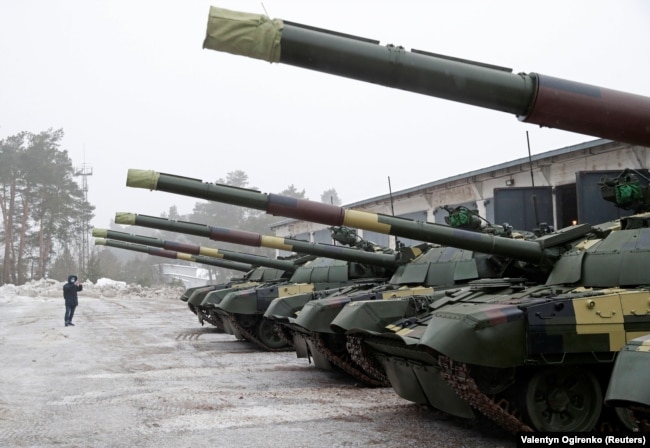
Modernized T-72 battle tanks at the Kyiv Armored
Plant before a handing-over ceremony to the Ukrainian Armed Forces in
Kyiv in February 2021.
A group of senior Ukrainian officers were hosted by Minister Heappey, demonstrating "a range of equipment and options for further military support, including defensive missile systems and protected mobility vehicles" in introducing them to Ukrainian Deputy Defence Minister Volodymyr Havrylov, heading the Ukrainian group. The initial NATO reluctance to supply large offensive weaponry to Ukraine is being relaxed. Germany offered 100 Marder tanks that have been out in rain so long months of repair would be required for them to be operational. "While Berlin has time, Kyiv doesn't", commented Foreign Minister Kuleba.
When G7 foreign ministers met, the U.K. pointed out the time was right to surrender to Ukraine whatever level of equipment it wishes to receive; the U.S. stating it was prepared to help with tanks and longer range anti-aircraft systems. The U.K.'s Starstreak anti-aircraft system is being prepared, along with 3,615 light anti-tank weapons (NLAWs) sent to Kyiv. Australia is prepared to deliver 30 of its Bushmaster armoured personnel carriers and the provision of anti-armour weapons and ammunition.
Such equipment as Switchblade armed drones, Javelin anti-tank missiles and ammunition is consumed quickly in high-intensity conflict. And some of the equipment requires months of training to operate. A matter of time that Ukraine hasn't the leisure to expend as a prelude to countering the Russian advance on the east. "Donbas will be a battle of attrition", remarked Mark Hertling, a former commander of the U.S. Army in Europe.
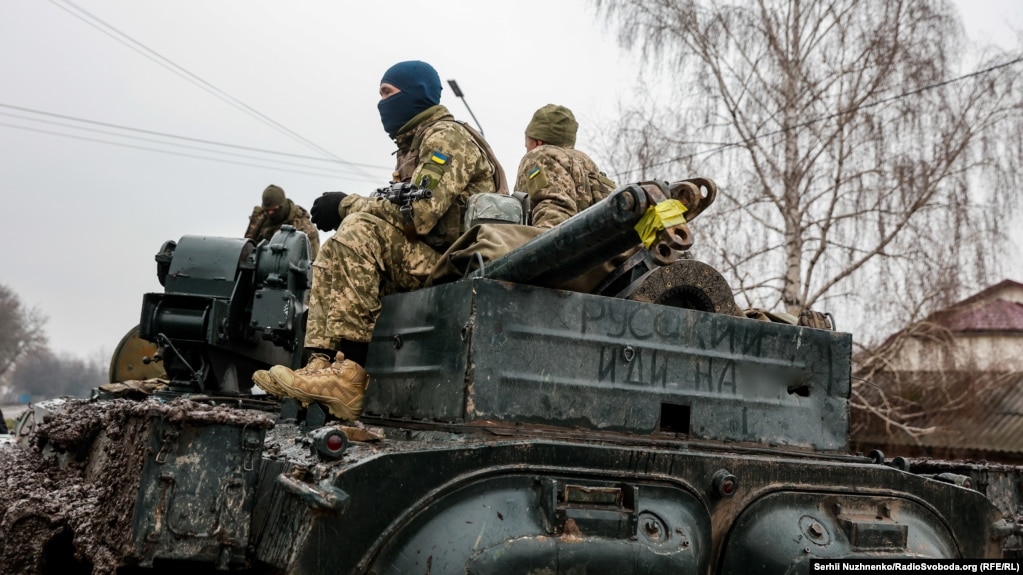
Members of the Ukrainian military advance near Nova Basan in the Chernihiv region earlier this month.
"APT 40 almost certainly consists of elements of the Hainan State Security Department's regional MSS office."
"This group's cyber activities targeted critical research in Canada's defence, ocean technologies and biopharmaceutical sectors in separate malicious cyber campaigns in 2017 and 2018."
Global Affairs Canada
"Responsible states do not indiscriminately compromise global network security nor knowingly harbour cyber criminals -- let alone sponsor or collaborate with them."
U.S. Secretary of State Antony Blinken
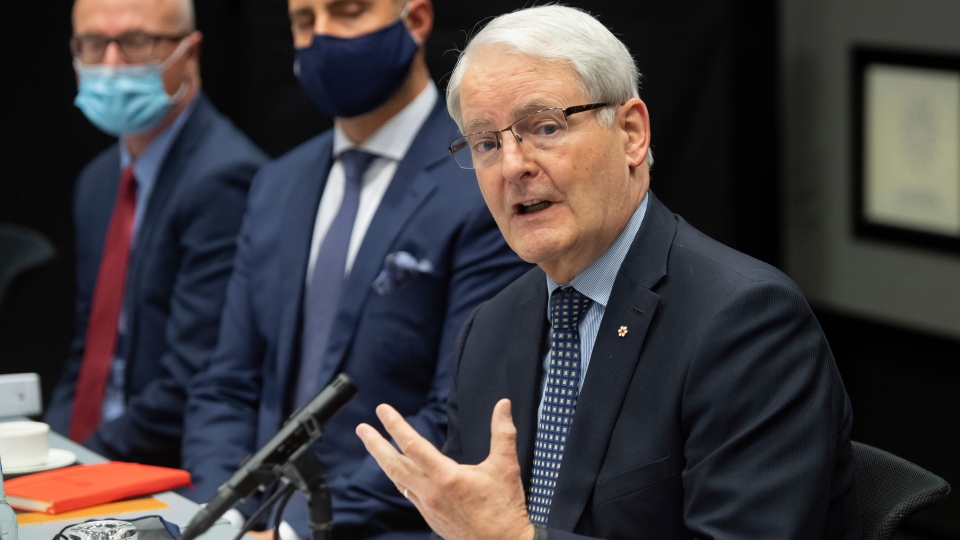
Canadian Foreign Minister Marc Garneau, speaks during a meeting with US
Secretary of State Antony Blinken, at the Harpa Concert Hall in
Reykjavik, Iceland, Wednesday, May 19, 2021, on the sidelines of the
Arctic Council Ministerial summit. (Saul Loeb/Pool Photo via AP)
Global Affairs Canada (Department of Foreign Affairs) has finally, publicly, named China's Ministry of State Security as the state actor responsible for organizing and orchestrating an extensive hack on Microsoft email software earlier in the year. Canada, its allies and their intelligence agencies have a high degree of confidence in charging the state intelligence agency of involvement in the attack. Canada also linked a regional office within the Ministry of State Security which had targeted Canada's defence, biopharmaceutical and oceanic technology sectors in a 2017 series of attacks extending into 2018.
Puzzlingly, with this knowledge and the ongoing warning by Canada's own intelligence agencies against China's cyber attacks, official Canada still made allowances for China and continued permitting Beijing to interfere with Canada's internal affairs, from harassing Chinese-Canadians to persuading Canadian universities to sign on to Chinese cultural programs financed by Beijing and buying out critical Canadian resource companies.. Leaving Canadian scientists working out of universities and official governmental scientific arms to sign contracts with and cooperate with Chinese research institutes and scientists.
Canada appears finally to have surrendered its fascination with China's vast outreach and the wealth that can be gained in free trade agreements with the trade behemoth and the urgency of Canadian corporations to invest in China including production and sharing of trade secrets for the promise of access to its vast market and the profit to be made therein. The massive hack of Microsoft email where over 400,000 servers were infiltrated, causing widespread shutdowns forced on government and corporate operations led to Canada and its allies casting aside kid gloves.
Microsoft referred to the company involved in the attack as a state-backed hacking group it referred to as Hafnium, involved in attempts to steal information from defence contractors, law firms and infectious disease experts. Canada, the U.K. European Union, Japan, Australia New Zealand and the North Atlantic Treaty Organization, joined by the United States all contributed to statements blaming China's MSS agency for the worldwide-cyber attacks.
The
Canadian Centre for Cyber Security is urging organizations to protect
businesses that use the Microsoft Exchange server because of a massive
hack aimed at stealing data. CBC
Global Affairs Canada identified the Microsoft attack as having likely been the work of the Advanced Persistent Threat Group 40 (APT40), representing a group with direct ties to the People's Republic of China, described as a "highly sophisticated" network, able to achieve "sustained, covert access to Canadian and allied networks beyond the compromising of Microsoft exchange servers". A 2018 strategic cyber-attack by China attempted to secure data from myriads of foreign governments at which time a similar communication was aired.
The United States, in joining forces with the other nations impacted by China's hacking has committed to instituting remedial steps to counter the hostile cyber activities. Foreign Minister Dominic Raab of the United Kingdom spoke of "irresponsible cyber activity emanating from China", even as Australian Foreign Minister Marise Payne spoke of "serious concerns about malicious cyber activities by China's Ministry of State Security."
Four Chinese nationals with links to the Ministry of State Security's campaign to hack into computer systems of dozens of companies, universities and government entities in the U.S. and abroad between 2011 and 2018, were charged in the U.S. Monday, the indictment alleging the hackers targeted Ebola vaccine research among other areas. Competition with China, according to President Biden, appears one of the defining challenges of the century for the U.S.
Western
governments said on Monday they are highly confident that hackers under
the control of China’s Ministry of State Security breached the security
of Microsoft Exchange, affecting 400,000 e-mail servers worldwide. Steven Senne/The Associated Press
When the Biden administration decided to leave in place the former Trump administration's tariffs, the Chinese were taken by surprise, as well as being infuriated when the U.S. threw its support for an Australian demand on the world community through the United Nations, to have the World Health Organization conduct a deep review of how the COVID-19 pandemic began, and whether a leak from a laboratory in Wuhan might have been involved in the release of a deadly virus.
Canada's Communications Security Establishment issued over 2,500 foreign intelligence reports in 2020 to "alert and inform" officials from 28 departments and agencies of attempted cyber attacks. It was hard put to provide aid to the Government of Canada or its critical infrastructure partners no fewer than on 2,206 occasions, including 84 incidents "affecting Canada's health sector", last year. "Espionage and foreign interference activity at levels not seen since the Cold War", was identified in a separate study by CSIS, involving for the most part Chinese and Russian-backed actors.
Joe Biden and Chinese president Xi Jinping were all smiles in this file
photo from when they met in 2013. President Biden now blames Chinese
interests for a massive hack of the Microsoft Exchange server earlier
this year. (Lintao Zhang/Reuters)
Sanctioning Belorusian President Alexander Lukashenko
"Canada will not stand by silently as the government of Belarus continues to commit systematic human rights violations and shows no indication of being genuinely committed to finding a negotiated solution with opposition groups."
"Canada and the United Kingdom are acting together to ensure these sanctions have a greater impact and to demonstrate unity in our condemnation of the situation."
Canadian Foreign Affairs Minister Francois-Philppe Champagne
"Today the U.K. and Canada have sent a clear message by imposing sanctions against Alexander Lukashenko's violent and fraudulent regime. We don't accept the results of this rigged election."
"We will hold those responsible for the thuggery deployed against the Belarusian people to account and we will stand up for our values of democracy and human rights."
British Foreign Secretary Dominic Raab
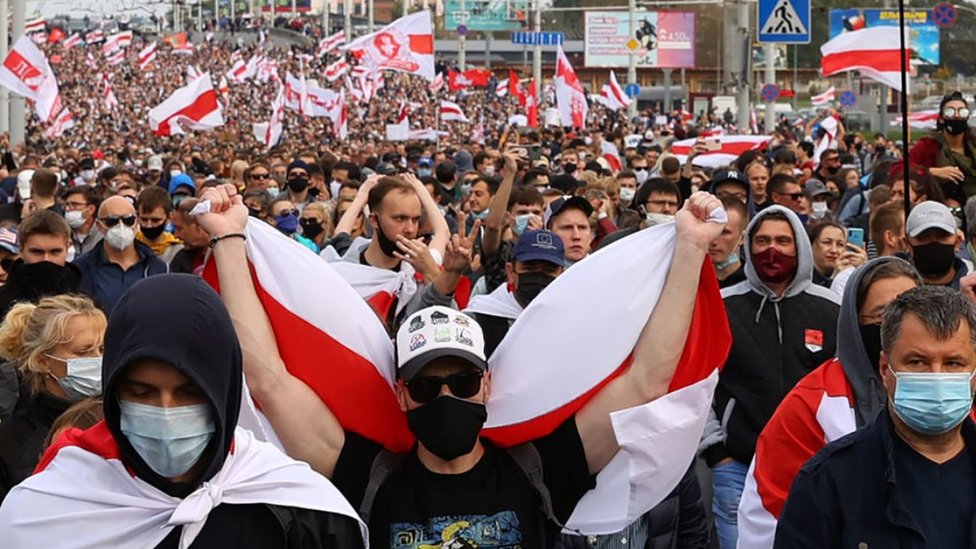
Huge crowds rally in Minsk every Sunday despite a heavy police presence Getty Images
This past Sunday brought out an enormous number of Belarusians protesting against the fraudulent election of the president of Belarus, with an estimated 100,000 out in force for the eighth consecutive protest against Alexander Lukashenko's reign. The rigged ballot that gave him his presidential 'victory' is not a celebrated event in Belarus, an event that has the unquestioning support of the Russian Federation. Lukashenko's victory at the ballot box was a reflection of Vladimir Putin's similar acclaimed victory, two leaders who see no reason whatever why they cannot be designated rulers-for-life.
The European Union has seen fit to sanction no fewer than forty Belarus officials; pointedly, for whatever reason they feel justified, excluding sanctions on Mr. Lukashenko himself. Canada and the United Kingdom have jointly taken a different route to indicate their displeasure at this mockery of democracy by levelling sanctions on the president of Belarus, along with his son and a number of government officials, in view of the fraudulent election and the abuse of the protesters.
At the UN General Assembly a week ago, Belarus's foreign minister gave warning to Western countries not to impose sanctions. Those same Western countries appear not to have taken due notice. As Dominic Raab helpfully pointed out, Lukashenko's disdain for human rights has been on full display when hundreds of peaceful protesters were tortured, along with the Lukashenko government's response to his restive population, of deportations and opposition figure arrests.
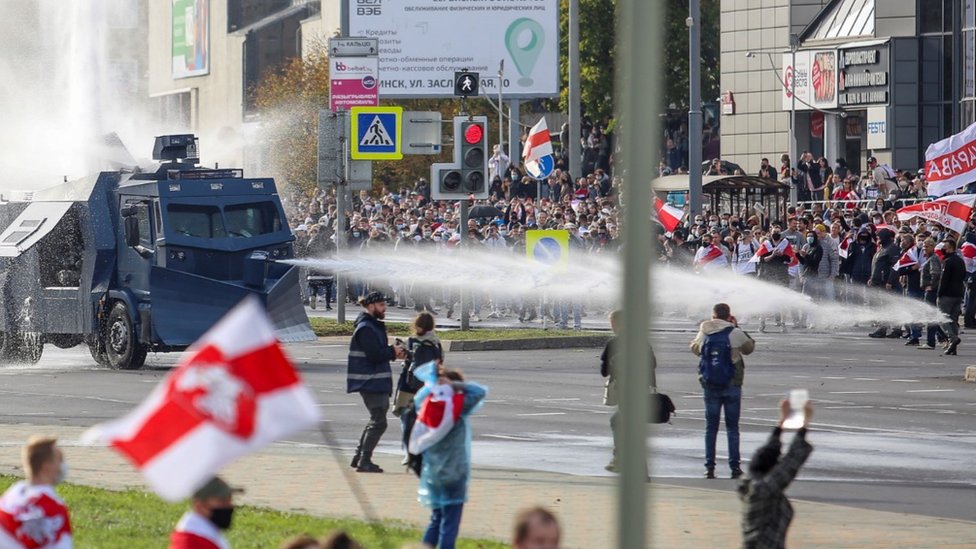
Officers used water cannons against the crowds in Minsk Reuters
Directly following the August 9 presidential election, mass protests have marked the people's preference that Lukashenko, who has ruled for 26 years, step down. Somehow, the electorate failed to be convinced on the evidence presented that they had voted 80 percent for the man who has ruled the nation with an iron fist. The government's response to the protests has failed to persuade critics of the vote and the candidate they hoped to see the last of, to stop coming out in droves to express their anger and disgust. And Sundays continue to host the largest of the rallies.
Svetlana Tikhanovskaya was evidently so unpopular, mounted so lacklustre a challenge, that she received a mere ten percent of the presidential vote. The manipulated vote count sparked the protests that were to follow when in the initial days following the vote, Lukashenko sought to regain control by brutal crackdowns, police detaining thousands of protestors, injuring many people with the use of truncheons, rubber bullets and stun grenades, the obvious sign of a benevolent dictator. That level of violence has since been reduced, while scores of protestors continue to be arrested, their leaders prosecuted.
Currently in exile in Lithuania, Svetlana Tikhanovskaya spoke to the demonstrations' purpose: "These are the people who, like Siarhei Tsikhanouski, [in forced exile] haven't
seen their family and children for several months. These are the people
who suffered for their convictions, and are still suffering. Our goal is
to free them. So I support everyone who takes to the streets in their
city today. Let the whole world see: Belarusians want to live in freedom, not in prison."
Lukashenko is shown delivering a speech during his
inauguration ceremony at the Palace of the Independence in Minsk on
Sept. 23. The authoritarian leader assumed his sixth term of office in
August. (Maxim Guchek, BelTA/Pool Photo via The Associated Press)
Neighbouring Ukraine has taken its own measures to support the protest movement in Belarus, with Ukrainian President Volodymyr Zelenskiy signing a new decree ordering his government to extend temporary stays for IT specialists from Belarus and their families to 180 from the current 90 days, and to grant residence permits for them within three days. Authorities are ordered to ease the issuance of work permits and taxpayer registration in a move to simplify regulations for Belarusian IT workers willing to relocate to Ukraine.
While the Belarus standoff continues -- reflecting its geopolitical dimension with Russia on one side, the West on the other, Svetlana Tikhanovskaya, the Belarusian opposition leader, plans to meet with Angela Merkel in Berlin to ask the German chancellor regarding "her potential participation as a mediator" in proposed talks between the government of autocrat Alexander Lukashenko and the protest leaders. Mr. Lukashenko has refused outright to take part in potential negotiations, bolstered by the unconditional support of Vladimir Putin.
"We will discuss ways to put pressure on Belarus, because Belarusians
think that only with pressure can we force the authorities into
dialogue with the people", she explained from
her office in Vilnius where she has been based since being forced to flee Belarus following threats expressed during a conversation with officials the day following the disputed election, when Lukashenko won his sixth term as president-for-life. "The Belarusian people already consider Lukashenko to be illegitimate. When we say negotiations with the government, we are talking
about people lower down; some people should take responsibility and
start these negotiations to find a way out of the crisis."