


The Moral of the Story: Beware, Take Care, Be Wise
"The Government of Canada [should] demonstrate stronger leadership on the issue of procurement and national security, including at the highest echelons -- the Prime Minister, ministers and senior officials.""[Government should] prohibit Chinese state-owned enterprises, partial state-owned enterprises, including companies receiving undisclosed government subsidies, and technology companies from obtaining federal contracts related to information technology or security equipment or services.""[The Privy Council Office should look] to develop, implement and oversee a policy to direct all government departments and agencies to review current contracts with China related to information technology or security equipment or services.""The Committee heard that the federal government should not always choose a supplier based mostly on the lowest price when evaluating bids for security equipment.""Where circumstances warrant, it should put greater emphasis on national security risks.""Throughout its study, the Committee became concerned that federal departments and agencies did not collaborate to assess potential threats to Canada's national security when the government was procuring a replacement of security screening equipment in Canadian embassies.""The Committee recognizes that closer collaboration among federal departments and agencies is required."House of Commons Government Operations Committee
Government procurement infamously selected a Chinese company's X-ray machines to be installed at all Canadian missions abroad until the absurdity of awarding such a contract to a Chinese company was highlighted by an investigative journalist, in the wake of Beijing arresting and charging two Canadians with espionage and imprisoning them on those trumped-up charges in an effort to apply pressure to have Canada release Huawei's CFO who had been detained by the RCMP at a stopover in Vancouver honouring an extradition request by the U.S.Department of Justice.
Relations with China have since descended to their lowest pitch, with Beijing threatening repercussions should Canada decide not to permit Huawei to take part in Canada's 5G upgrade as the rest of the members of the Five Eyes group (an integrated, collaborative intelligence-sharing between members, U.S., Britain, Australia, New Zealand and Canada) have done. Even under those strained relations, the Liberal government still decided to proceed in partnering with CanSino, a Chinese pharmacological company to joint-produce a vaccine for SARS-CoV-2, which Beijing chose to cancel unilaterally.
The Liberal government under Prime Minister Justin Trudeau, tutored and mentored by former Prime Minister Jean Chretien, hungered for a free trade deal between Canada and China. Canadian corporations headquartered in Quebec see such a free trade agreement with China as a profitable venture, sitting on the Canada-China Business Council continuing to promote business with China despite Beijing's hostility and threats.
Canada's government under the Liberals refuses to take China's cybertheft proclivities, political and academic infiltration and influence-peddling seriously. It is only very recently that in public fora, Justin Trudeau has stated Canada's opposition to China as a growing threat to the world order in its focus on control, power, monopolistic trade, influence and its soft power working hand-in-glove with its hard power. Investing in vital infrastructure loans to developing countries while threatening Taiwan, Hong Kong, and abusing the human rights of Tibetans, Christians and Uyghurs.
Now, a parliamentary committee has released a report calling on the federal government to place greater consideration on issues such as national security in tendering contracts and favouring bids by Chinese companies, all of which must, by Chinese law, answer to Beijing's call. Apart from the fact that many are state-owned corporations. The concerns expressed go across party lines since the committee is comprised of Liberal, Conservative, Bloc Quebecois and NDP members.
Government officials testified before the committee, along with experts on China and national security. The committee reviewed a threat assessment from the Department of Foreign Affairs, describing the Chinese company selected to install and service its security equipment on contract to the Canadian government with the company in question characterized as "a Chinese state-owned enterprise with direct connections to the People's Liberation Army and the Chinese Communist Party".
The X-ray machines were not considered a security risk since their use was in a publicly accessible area, unconnected to embassy computer networks. The committee was informed however, by an official with the government's Centre for Cyber Security, that this view of X-ray machines was outdated; they now typically come equipped with hard drives and USB ports potentially useful to hostile actors "with malicious intent". And that certainly describes Beijing's attitude toward Canada.
The report released by the committee found no effective government strategy in place to manage security risks revolving around China and federal procurement. Stronger security measures were recommended, to focus on screening companies and employees who install and maintain equipment in sensitive federal facilities such as embassies. There is room for improvement at flagging potential security threats.
"We are being introduced in a very rough way to a new world where the rules of the road are decided by the strongest.""We've always said in Canada that we needed a foreign policy that built on the international rules and regulations… but China is starting to play rogue."Paul Heinbecker, former Canadian ambassador to Germany, representative to the United Nations"Relations between the two countries can't be reset until the two Michaels [Spavor/.Kovrig] are set free. Once that happens, relations should be reset in a different way.""China is capable of acting aggressively against Canada. China is not our friend and we should stop treating it as though it is. We should form a relationship with China based on mutual needs.""We should treat China with respect but always protect our own interests and push back when necessary. We also need to find allies who will help us retain our sovereignty in a world where China is trying to encroach on it."Former Canadian ambassador to China David Mulroney (2009 to 2012)
 |
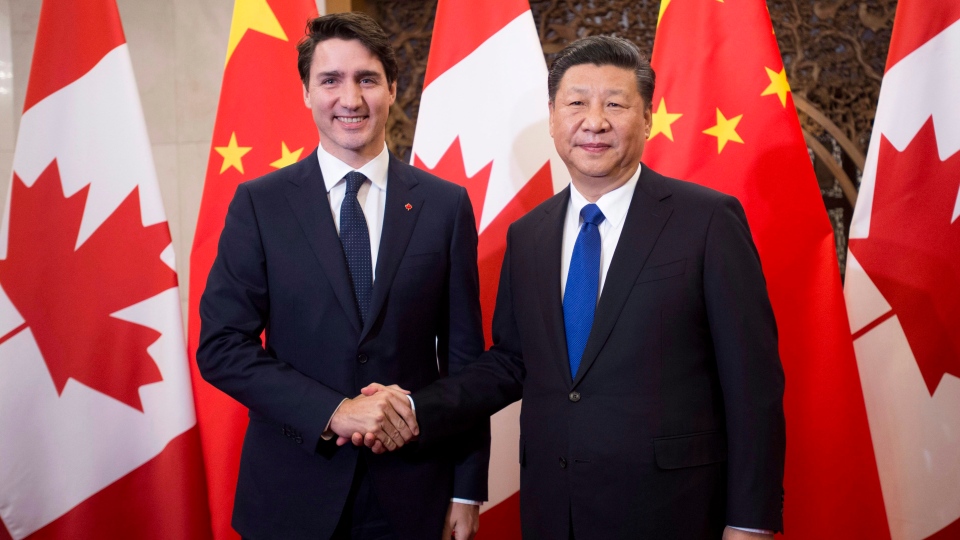
| China's President Xi Jinping and Canada's Prime Minister Justin Trudeau are shown at the Group of 20 summit in Osaka, Japan on June 29, 2019 (KAZUHIRO NOGI/AFP via Getty Images) |
Labels: Canada-China Relations, Hostility, Infiltration, Power, Security, Threats
posted by Pieface | 9:16 PM
|
0 comments


