Politic?

This is a blog dedicated to a personal interpretation of political news of the day. I attempt to be as knowledgeable as possible before commenting and committing my thoughts to a day's communication.

Tuesday, February 14, 2023

The Sheer Scale and Scope Of It

We're going away, but we have no idea what will happen when we get there."
"We have no goal. Even if there was a plan what good will it be after this hour?"
"I no longer have my father or my uncle. What do I have left?"
Musa Bozkurt, 25, Adiyaman, Turkey

"Those who have the means are leaving, but we're poor."
"The government says, go and live there a month or two."
"How do I leave my home? My fields are here, this is my home, how do I leave it behind?"
Fuat Ekinei, 55, farmer, Adiyaman, Turkey

"Everyone's saying they're not in charge. We can't find who's in charge."
"I've been begging and begging for just one crane to lift the concrete ..."
"Time's running out. A crane, for God's sake."
Keyser, Antakya, Turkey
https://images.theconversation.com/files/508380/original/file-20230206-29-1sdsvu.jpg?ixlib=rb-1.1.0&rect=60%2C1116%2C6720%2C3360&q=45&auto=format&w=1356&h=668&fit=crop
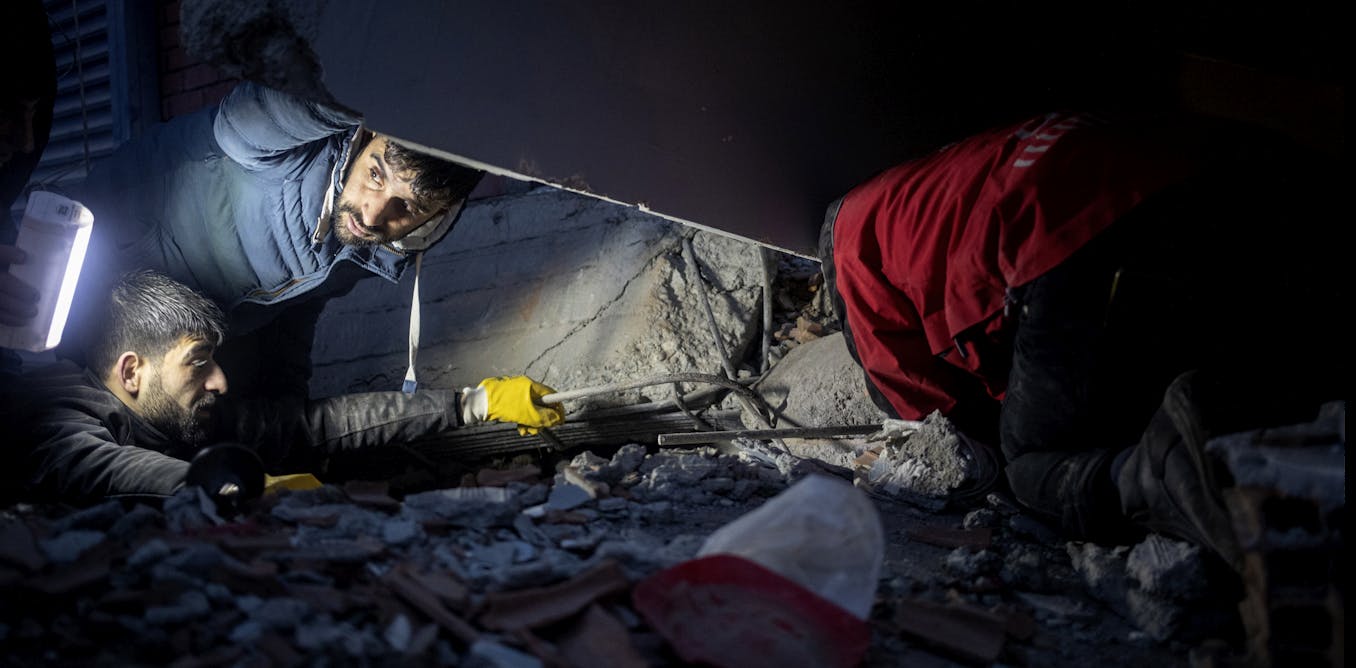
People search for survivors beneath the rubble in Diyarbakir, Turkey. February 6 2023. EPA-EFE/Refik Tekin
 
The woman who gives her name as Keyser in Antakya is desperate, but there is no one to help. Through "the stench of dead bodies waft[ing] through the cold, dusty air", her two sons, trapped below the rubble of their collapsed apartment building could be heard crying for rescue. She tried for two days to approach anyone with a vestige of authority to help rescue her children. In the end she failed. There was no one available, no emergency response leader she could make contact with, to order her sons' rescue.

A day later, neighbours reported that there were no more survivors pulled from the building's wreckage. "The general problem here is of organization, especially in the field of health", observed Onur Naci Karahanci, a doctor working out of Turkey's southeastern city of Adiyaman. There were not even enough body bags for the dead, an acute shortage in the first two days following the two earthquakes.
 
People stand on rubble
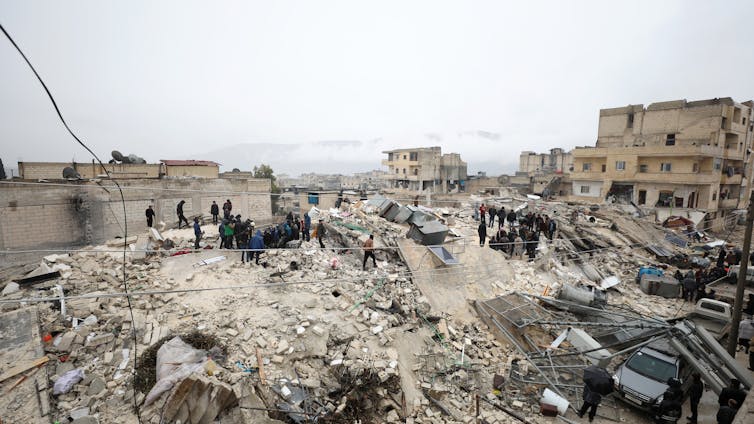
Collapsed buildings in Armanāz, Syria. EPA-EFE/Yahya Nemah
 
The trembling of the earth collapsed thousands of buildings in countless towns and cities, leaving rubble under which were thousands of people, a scant handful of whom were rescued. Antakya in particular, known historically as Antioch, the capital of Hatay province. The damage realized in Turkey was estimated by the Turksh Enterprise and Business Confederation at $84.1 billion. Human life was destroyed to a total of 30,000 in Turkey alone.

Rescue teams flew in from various countries, both near Turkey and Syria, and from parts distant. Astonishing stories of survival and rescue have surprised and encouraged rescue teams, but the total, still growing, and standing at 36,000 dead is a grim reminder of the force and extent of the catastrophic natural disaster. On one occasion, a father with a child in his arms was rescued, in another a baby with its mother's hair clutched in its fist; a newborn; a 13-year-old boy saved a week after being buried alive
 
Over 150,000 survivors have been moved to shelters outside the affected provinces, according to Turkish authorities. Turkey is now a country that has been markedly changed, where the massive earthquakes cut a slash through the landscape shifting roads, bending and breaking rail lines, smashing buildings to the ground. There are now new canyons across the East Anatolian Fault running through southern Turkey and northern Syria.
 
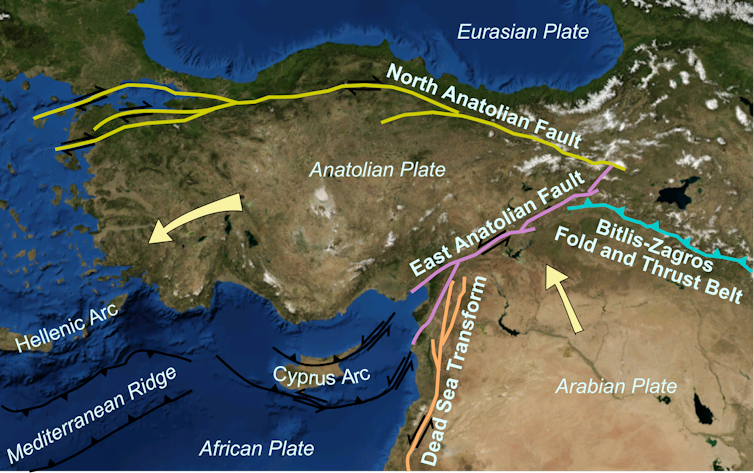
The window for finding survivors is fading. Rescue work moving vast tonnages of steel and concrete to find anyone still alive is now turning to the need to complete the work of destroying unsafe buildings partially destroyed. The work of the moving tectonic plates; where the fault line that slipped to cause the quakes -- the East Anatolian between Turkeys Anatolian Plate and the Arabian Plate -- moving northward created a double disaster.

Turkey's geologic crust was altered in a few seconds when the plates slipped side to side leaving rail lines bent into S-curves, roads laterally split. Where an olive grove in Altinozu split in two leaving a 200-metre-wide rocky chasm between trees growing in neat rows, once side-by-side.
Map of tectonic plate movements around Turkey
Arabia is bumping into Eurasia and pushing Anatolia westwards … or to non-earth scientists, Syria is bumping into Europe and squeezing out Turkey. Mikenorton/Nasa/wiki, CC BY-SA

Labels: , , , , , ,

Wednesday, September 13, 2017

Death and Destruction on an Island Paradise

"The storm was massive. Not only high-intensity, but it was massive in area. It ran along the north coast, but it was felt along the entire island."
"People are a little bit stunned by the impact that Irma had, even here in Havana, which was not as hard hit as other areas."
"The coastal communities were devastated by the winds. Houses have lost their roofs. Trees are down. The electricity is off just about everywhere. There are some communities that even today are under feet of water."
"When people return home, they may find their house might not have a roof. Their possessions might be lost."
"We're looking at a minimum of ten thousand people we want to get to in the immediate aftermath."
Richard Paterson, CARE Canada worker, Havana, Cuba
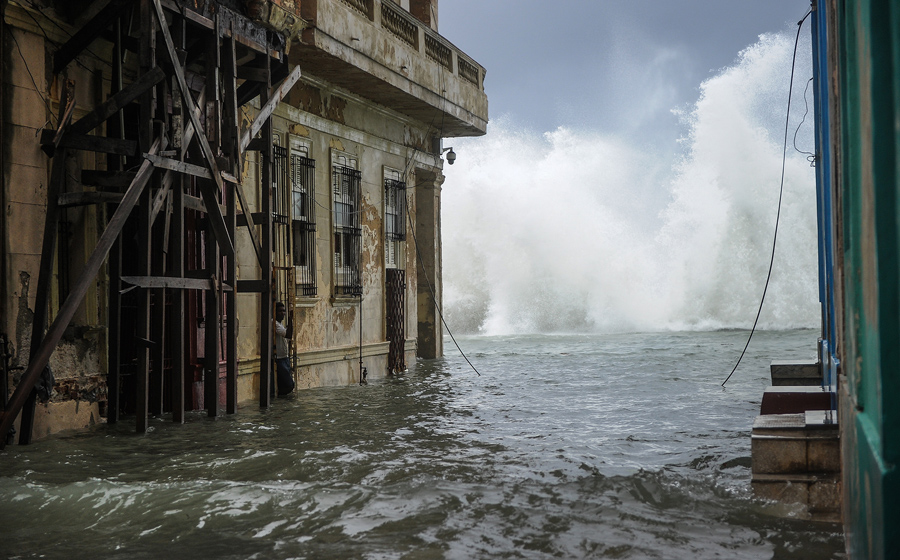
Water battered the city's pier and flooding some low-lying areas of Havana on Saturday.
Water battered the city's pier and flooding some low-lying areas of Havana on Saturday.    CNN

In the Cuban countryside some plantations were completely destroyed; crops devastated. Agricultural yield on the island, highly dependent on its own natural resources, has lost three or four months of production, at the very least. In the broader perspective, getting back on track to normalcy croplands may only recover in three or four years from the catastrophic effect of the hurricane.

Cuba is anything but a wealthy country; it gets by. The storm that struck Florida after it had moved through the Caribbean as a Category 5 storm had weakened considerably, to a 4, then a 3-1/2 Category, still packing whopping powerful winds and drenching rains, causing destruction and flooding. The U.S. will recover far more quickly from its costly ordeal than the islands in the Caribbean, that are much more vulnerable to such catastrophic weather events.
More than 5,000 tourists were evacuated from the keys off Cuba’s north-central coast, where the government has built dozens of resorts in recent years.
More than 5,000 tourists were evacuated from the keys off Cuba’s north-central coast, where the government has built dozens of resorts in recent years.  (YAMIL LAGE)

As a Category 5 storm striking the eastern tip of Cuba last Friday, the shore was pounded for 800 kilometres before the storm turned north heading for the Florida Keys. The popular resort town of Varadero was one of those catching the greatest impact, with about 14,000 tourists hunkering down for its duration, experiencing a drama they hadn't bargained for when they contemplated the sun and the sand and a getaway holiday in an island paradise reserved for tourists.

The island's trees were stripped of their foliage, left gaunt and skeletal, an eerie counterpart to destroyed buildings. Sea water surged inland for half a kilometres in certain places; even on some Havana streets rivers of muddy water ran deep and swift. Many communities with all power lines downed, will lack electricity for weeks on end, and because of shortages of fuel, travel isn't much of an option.

A flooded street near the Malecon in Havana, Cuba, on September 10, 2017. Deadly Hurricane Irma battered central Cuba on Saturday, knocking down power lines, uprooting trees and ripping the roofs off homes as it headed towards Florida.
Yamil Lage / AFP / Getty

Labels: , , ,

Tuesday, September 13, 2016

Between Nuclear Tests and Natural Disasters

"Whole villages have been washed away by flash floods. Families have lost everything, including their kitchen gardens and livestock, which many households depend upon to supplement their diets."
"The floods came just before the harvest period, when the crops were still in the ground."
Darlene Tymo, representative, country director, North Korea,  U.N. World Food Programme (WFP)

"The effects of this flooding will be even more dramatic and devastating than initially thought. The people there are in a very desperate situation."
"My impression was that this was a much worse disaster than the statistics indicate. The damage is very extensive, and there is clear evidence that the floodwaters were not only very high — you can see the watermarks above the window frames — but also moving very rapidly in some places."
"In the communities we visited, we were allowed to meet with local people, and we could see their spirit and their energy and their support for each other. These are people who are doing the best they can. They’re just normal, everyday people."
Chris Staines, the head of the Pyongyang office of the International Federation of Red Cross and Red Crescent Societies.
Damaged caused by flooding in North Hamyong province, North Korea (7 Sept 2016)
AFP -- In some areas entire villages appear to have been washed away
As August came to a close, typhoon Lionrock lashed its way through northeast Asia. Authorities in North Korea estimated that 44,000 people had been displaced by massive flooding that ripped through the area. Later figures place that initial estimate at over 100,000 people left homeless, a figure reached by aid workers who had visited the area in the past week.

According to the North Korean government, 133 people died as a result of the disaster with another 395 missing because of the flooding claimed to be the worst the country had ever experienced. North Korean officials have lost little time launching appeals for donations from the international community. This, at a time when it has thumbed its nose at, taunting the international community with its largest yet nuclear test.

Simultaneously with ordinary North Koreans schooled to regard their dictator Kim Jong-un as an immortal who can do nothing wrong and has only their very best interests in heart as they struggle to survive on subsistence rations, their neighbour's defence ministry has warned that Pyongyang is likely to order another nuclear test at any time.

The country that suffers chronic food shortages, that sees fit to incarcerate complete families who complain about their plight and which threatens instability not only in the region but as far afield as its increasingly powerful ballistic missiles can reach, continues to expand lavish support on refining its nuclear nuclear program, now boasting of miniaturization enabling it to launch missiles with nuclear warheads, rather than use its treasury to import sufficient food to feed its population.

China, enraged over plans by the United States to reassure South Korea and Japan that it will defend the region from the North's aggression by installing an advanced missile defense system in South Korea, has deflated its willingness to remonstrate with Pyongyang over its nuclear tests. Beijing views the Terminal High Altitude Area Defense system (Thaad) as a threat to its own security, and it fears the prospect of upheaval related to war more than it does North Korean provocations.

Beijing doesn't relish the thought of North Korea becoming so unstable that China will be forced to take in thousands of refugees, resulting from the upheaval of conflict between the two Koreas. China "shares important responsibility" for the latest nuclear test, insists U.S. Defense Secretary Ash Carter. "It's China's responsibility. It's important that it use its location, its history, and its influence to further the denuclearization of the Korean Peninsula."

Even with the chaos and potential disaster looming over the region with China's belligerence over the East and South China Seas and North Korea's following in its mentor's shadow to flaunt its disregard for international sanctions for which China takes up the slack in trade, the world, through the United Nations, will respond to the dire need of ordinary civilians in desperate straits through the latest natural disaster, rescuing North Korea from the necessity to look after its own.

Damaged caused by flooding in North Hamyong province, North Korea (7 Sept 2016)
Destruction to crops will worsen North Korea's existing chronic food shortages -- AFP

Labels: , , , ,

Saturday, May 14, 2016

Struggling Against The Fires of Hell

"What happens there [when wildfires occur as a result of human activity], and the driver may not be aware of what's going on, is little bits of organic material -- it looks like mud but there's a fair bit of organic material -- sticks to the muffler [of all-terrain vehicles tearing through the brush of a forest interior]." It heats and starts to smoulder and then you go over a bump and it drops off onto some dry fuel [detritus lying on the forest floor]."
"I'm guessing this will be probably around 100,000 kilowatts/metre. It developed its own thunder storm. This happens during high-intensity fires. It generated lightning that started new fires. It's the mother of new fires."
Mike Flannigan, professor of wildland fire, University of Alberta

"Winter's just finished and there hasn't been rain for two months."
"We threw the kitchen sink at it [the Fort McMurray wildfire]. Usually if you can catch them [wildfires emerging] when they're small enough, you can prevent them from getting larger. Unfortunately it doesn't matter how good  your firefighting force is, there are going to be times when Mother Nature just beats you, and this is one of those cases."
Chad Morrison, senior wildlife manager, Province of Alberta 

"That fire hit us, it was about three blocks wide, and it had 100 feet of flame coming at you. It's loud and it's coming fast. That's the only time I've ever seen something like that in my life."
"We're like, 'Oh man, it's going to roll over us real easy', because the wind's coming at us, too'." "[About 100 metres off where his team had soaked the tree line and nearby houses] it just kicked it right down. The huge rolling flame just calmed right down. There was huge smoke. We stopped the rollover [flames] on top of the trees. We never lost a house in that area."
Mel Angelstad, Suncor firefighter
Jerome Garot
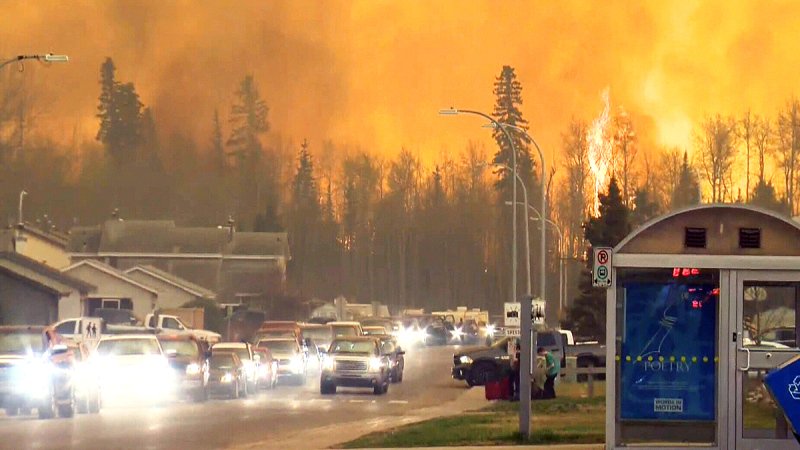
Jerome Garot   Wildfires encroach on Highway 63 near Fort McMurray as citizens evacuate the city on 
May 3, 2016.

It was all hands on deck, not only the local firefighting contingent, and firefighters volunteering and being dispatched from surrounding areas and other provinces, but those hired by the oil patch to protect their oil-extraction installation investments, were also quick to respond to a wildfire that literally took everyone by surprise through its power, strength, resilience and determination to eat its way over, through and under whatever stood in its way.

Highway 63, the major, main and virtually only highway leading north and south out of Fort McMurray was solid traffic as 90,000 people were evacuated to escape the potential of physical harm resulting from the out-of-control wildfire that was consuming everything in its path. In the space of a mere few days, the residents of the town moved from trust that this was just another wildfire that might come a bit too close for comfort to realization that their property and lives were in real danger.

On Sunday, May 1st, a provincial wildfire agency helicopter on a routine patrol had spotted a fire estimated at that time to have been two hectares in size, about four football fields in size, at 4:00 p.m. A really hot day, this was, after a dry winter and spring. The wildfire had erupted at the very start of the region's fire season, and was around nine kilometres southwest of the city, near Horse Creek.

Fire-protection officials responded by an alert. Alberta has around 1,600 wildfires annually, 95 percent of which are brought under control in a space of a day or so. Once the fire was spotted, the helicopter dropped a four-person crew equipped with all the gear needed; pumps, hoses, chainsaws and axes to initiate a targeted response. The helicopter crew hooked a bucket to the helicopter to enable it to scoop up water from nearby sources to help dowse the fire.

Air tankers were called in for fire retardant mixed with water to be dropped over the fire, the first of which appeared on scene 45 minutes after the initial fire sighting. Another three joined them, and two added helicopters came along to help, placing a dozen firefighters at ground zero. Within two hours, despite that response, the fire had swelled to 60 hectares, and those fighting the blaze could be forgiven for believing they were losing the battle as soon as they had joined it.
Brian Cornforth
Brian Cornforth

Soon, in the 30C heat bulldozers worked overnight to clear trees for the creation of a fireguard, an open gap freed of trees meant to starve the raging fire of vital fuel. "Nine times out of ten, that would really knock down a fire", said wildfire ranger Kent Jennings. When he showed up with his crew to check out the barrier, they helplessly witnessed embers flying through the barrier on high winds, handily igniting trees on the opposite side.

Originally, evacuation orders had been issued for southern parts of the city. Then, 24 hours later the municipality issued a full evacuation order for people to immediately abandon their homes. The fire had doubled in size overnight, seizing on perfect conditions for it to leap from treetop to tinder-dry treetop, with the crown fire shooting out embers to begin new fires kilometres' distant, across the Athabaska and Hangingstone rivers.

People were desperate to escape the threat of a fire that now seemed to assume the proportions of total destruction, a force that seemed to be motivated by some malign order, pursuing them. Evacuation was taking place through a tunnel of wild towering hot flames with dense smoke reducing visibility to a near-blank state. This past Monday it was clear that the incredible work and expertise of the first responders had succeeded against what had seemed like odds stacked against them by a giant, unmoved entity of destruction.

Despite the loss of 2,500 homes and buildings, 90 percent of the city, including the downtown, had been saved. The fire had been persuaded by a combination of true grit on the part of firefighters, and serendipity on the part of prevailing winds and weather conditions, to veer away from the city and continue its rampage to the east. Two days ago the fire was estimated to be covering 241,000 hectares, burning its way toward the Saskatchewan border.

Still fighting that fire were  509 wildland firefighters, 31 helicopters, and thirteen air tankers.

Larry Wong/Postmedia News
Larry Wong/Postmedia News   Homes in Fort McMurray destroyed by a massive wildfire that forced 
the entire evacuation of Alberta's fourth largest city.

Labels: , ,

Thursday, May 12, 2016

A Record 38-million People Displaced

"This is the equivalent of the combined populations of New York City, London, Paris and Cairo grabbing what they can carry, often in a state of panic, and setting out on a journey filled with uncertainty."
"Put another way, around 66,000 people abandoned their homes every day of 2015."
Jan Egeland, the Secretary General of the Norwegian Refugee Council (NRC)

"Having comprehensive and accurate figures is essential to efforts to alleviate the suffering and needs of tens of millions of highly vulnerable people. National governments have primary responsibility for collecting this data, and for protecting and assisting internally displaced people. Sadly, this responsibility is not fulfilled in many contexts."
"This report illustrates the many challenges to addressing this global crisis of internal displacement. It also highlights the glaring absence of political solutions to address displacement, and constitutes an important wake-up call to national governments and global policy-makers alike." 
"By reporting on all situations of internal displacement, regardless of their cause, our intention is to provide an ever more holistic picture of what has truly become a global crisis."
Alexandra Bilak, Director, IDMC [NRC's Internal Displacement Monitoring Centre

Photo: IDMC
Photo: IDMC

What could appear more staggeringly tragic than to see the classic picture of people forced to abandon all they hold dear, their homes and neighbourhoods, jobs, schools, every element of comfort and security, leaving all their possessions behind to flee for their lives in the hope that they will find haven elsewhere. The bleakness and hopelessness of people trudging away from the familiar, from all they have worked to attain, leaving their aspirations behind in a bid to sustain their lives is heart-wrenching.

The warning issued by the humanitarian group to national leaders to pay attention to the needs of their populations is rather redundantly absurd under the circumstances where tyrants and their cohorts, where fanatical sectarian imperialism mandates that those not of their persuasion must die, where corrupt governments haven't a thought to spare for the welfare of the indigenous poverty-stricken, rule, and prosecute their wars. The plight of those they oppress is of no concern to them whatever; their obligation is only to their ruling aspirations.

According to the figures amassed for this major aid agency, the Norwegian Refugee Council, a truly staggering 38-million people globally have been internally displaced as a result of ongoing conflicts, along with the dislocation that occurs when natural disasters strike. This global crisis expresses the consequences of both conflict and nature delivering extenuating catastrophes in the space of a single year. Ten countries have been identified as being the source of the highest number of internally displaced people through conflict. Of that ten, five have been on the list annually since 2003.

Colombia, Democratic Republic of the Congo, Iraq, South Sudan and Sudan have taken their place on the list for the past dozen years. Natural disasters added to the fallout and displacement in 2015 that occurred in 113 countries with the numbers affected through internal displacement estimated at 19.2 million. In the space of the past eight years, according to the data released by the report, disaster-related displacements record a total of 203.4 million people. South and east Asia have been the most seriously affected. India, China and Nepal account for 3.7 million, 3.6 million and 2.6 million respectively.


Yemen, states the group's report, accounted for one quarter of conflict-related displacement globally in 2015, the result of the country's grip in yet another sectarian Muslim war, with the Shiite Houthi rebels, supported by the Islamic Republic of Iran, battling forces loyal to the internationally recognized government whom Saudi Arabia's intervention is supporting, in an obviously proxy war between the two regional sectarian antagonists, Iran and Saudi Arabia. In Yemen's case, 2.2 million people have been uprooted in that impoverished country.

Displaced people from minority Yazidi sect, fleeing violence from forces loyal to Islamic State in Sinjar
town, walk towards Syrian border, on outskirts of Sinjar mountain (Photo: Stringer Iraq / Reuters, August 2014).
Displaced people from the minority Yazidi sect, fleeing violence from forces loyal to Islamic State in Sinjar town, walk toward the Syrian border, on the outskirts of Sinjar mountain (Photo: Stringer Iraq / Reuters, August 2014).


Syria, with its 1.3 million displaced, and Iraq with 1.1 million, round out the top three conflict-riddled countries responsible for the greatest number of internally displaced. Which doesn't address those having left the geographic boundaries of their home countries to become refugees, currently flooding European nations in their attempts to escape the dysfunctional dangers of their countries mired in ongoing conflicts that have their genesis in tribal, sectarian antipathies leading to massively bloody assaults.

Nepal's earthquakes represented the dangers of geophysical hazards created by unsettling natural environments, while other weather-related hazards such as catastrophic storms and floods created their own issues of frantic internal displacements. Criminal violence in Mexico and Central America, tied to illegal drug cartels and prevailing corruption have been another source of internal displacement affecting an estimated million people.


Labels: , , , , , ,

Friday, May 06, 2016

Nature's Inferno Unleashed

We humans have a tendency to go where we should not, particularly. We love the challenge of living in unsustainable areas; floodplains, for example, and far too close to forests, making our lives and the infrastructure that has such meaning in our lives vulnerable to nature's idiosyncratic weather systems that can impact so disastrously on what we think, in our naivete, is permanence.

"Fire itself is always going to occur in these forest ecosystems. But we try and come up with solutions as far as mitigating the impact of those fires on communities."
"[FireSmart Canada's function is to help homeowners, industry and communities living at the intersection of the] wildland urban interface [cope, to protect themselves]."
"It keeps the fire [clearing out dead brush, pruning trees] on the ground, so there's a higher likelihood of success for firefighters on the ground of suppressing the fire."
"The first ten metres, we really focus on trying to significantly reduce the fuels, period. We really discourage the presence of conifer trees within the first ten metres and flammable vegetation, like junipers, within the first ten metres of homes, as well as sheds, wood piles, fences -- anything that can burn and help transition a fire towards the structure."
"Unfortunately ... with climate change and our forest health conditions, these fires are burning in conditions that we've never seen before. And they're burning hotter, bigger, faster and more aggressively than the fires that we've seen in the past and they're becoming a big challenge."
Kelly Johnston, executive director, Partners In Protection Association, FireSmart Canada

"It's important for people to understand that all the air tankers, all the suppression equipment, people, when conditions line up and that fire's ripping, it's going to do what it wants to do. You won't put it out, unless  you do that work with the fuels."
Larry Fremont, wildfire education and prevention co-ordinator, Ministry of Environment, Saskatchewan
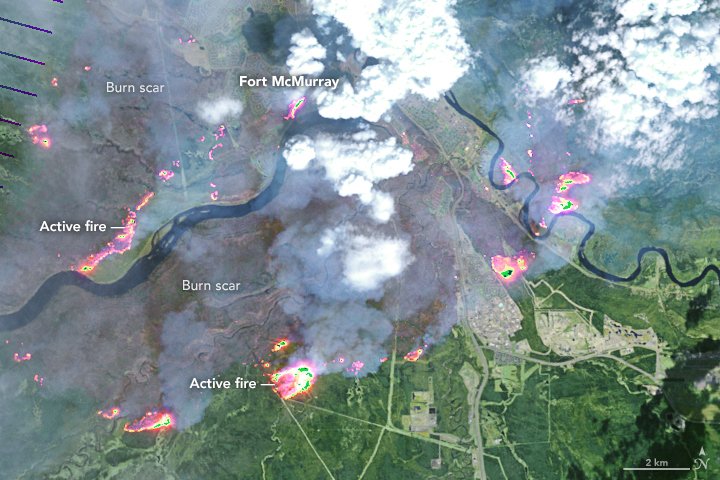
NASA Earth

Alberta forestry authorities cleared out strips of forest around eleven northern communities last fall, removing what was seen as potential fuel to encourage forest fires. Wildfire prevention co-ordinator Larry Freemont cautions, that despite that preemptive work, he has himself seen fires jump breaks, including rivers or lakes. And now he can also include six-lane highways, because the situation seen now in Fort McMurray is quite exceptional. And science tells us these conditions are here to stay.

On their way, perhaps to becoming even more flagrantly lethal to people placing their trust in the skills and courage of firefighters and the equipment that has been developed in the past to fight fires that no longer reflect the types of fire situation now seen in northern Alberta and forecasted to increase in numbers, depth and capacity, given climate change and the ferocious alterations in climate moisture, winds and heat.

A report produced in the wake of a devastating blaze that took place in Kelowna, British Columbia in 2013, warned that past protocols no longer work and indeed add fuel to the fire. A buildup of trees, brush and other dry vegetation in forests -- everything that a fire depends on to help it grow and sustain its impact -- left lying on the forest floor because of past fire suppression protocols, has helped to produce the perfect firestorm. That biofuel that has been built up represents the potential for more severe wildfires and greater numbers, where people and the forest intersect.

And because people live, and work and spend their leisure time in and around those intersections of human habitation and natural surroundings of dense forests there is a certain vulnerability quotient that can be triggered. Where, though many forest fires are set by lightning strikes, many more result from human carelessness. And experts evaluating this fire that has consumed Fort McMurray tend to believe that something as mundane and yet as dangerous as a flicked cigarette butt, or a campfire not adequately put out, might have triggered this blaze.

This current wildfire raging through northern Alberta, destroying Fort McMurray and the hopes and dreams of the tens of thousands of Canadian living there fits the pattern of the dire new expectations. Tens of thousands of people using the only highway permitting entry and departure north and south from Fort McMurray have found themselves stranded. They've had to drive through dense, dark smoke so thick at times visibility was almost nil. They've seen, as they've driven, the fire up close and very personal. They've been stuck in stop-and-stall whenever the highway is closed for safety reason, as when fire jumps across and fears become even starker.

Sara Peats: Praying I have a home to go back to. Fire isn't over officials say the worst is yet to come.

Some families have had to remain on the highway, stuck in a traffic line-up that will not begin again any time soon, for a day, for 36 hours, desperately awaiting the start-again. And Good Samaritans have set out from their comfortable and safe homes elsewhere in Alberta to truck in food, water, and gas in a convoy determined to do what they can to ensure that the residents of Fort McMurray who have lost everything they own but the clothes on their backs, their lives and those of their children -- and sometimes their pets, will know they're not forgotten. Some families fleeing the fire have taken shelter in communities north of their destroyed city, only to find the fire is tracking them there, too.

This fire, which looked serious on Monday, looked as though it might be under control by Tuesday, and then hot winds helped it grow tenfold from its Tuesday status, and mandatory notices went out to communities to flee. In one day it grew in size and ferocity 750 percent to encompass 850 square kilometres. People have taken the evacuation orders seriously. Although they will have lost everything they ever worked to own, none have yet lose their lives to the fire. Fort McMurray resembles a war zone, nature's own scorched-earth vendetta on humans who become too comfortable with themselves and their aspirations.

CTV News

Labels: , , ,

Tuesday, July 07, 2015

Drought and Wildfires

"They [evacuees] are just starting to roll into the city now."
"It's probably a terrible wind for fighting forest fires but it is blowing smoke away from the [Cold Lake] area -- so visibility and air quality will be improved today but I think the fire will be getting bigger with these kinds of winds."
Craig Copeland, Cold Lake Alberta mayor
A forest was ablaze off Highway 969 near Montreal Lake in Saskatchewan on Monday. More than 100 fires burned in the province as of Wednesday. Environment Canada warned Manitobans a second wave of smoke was on its way from the fires.
A forest was ablaze off Highway 969 near Montreal Lake in Saskatchewan on Monday. Environment Canada warned Manitobans a second wave of smoke was on its way from the fires. (Saskatchewan Highways)
"Walking downtown to work this morning I just keep thinking what if this all went to flames? What would we do then? And I keep thinking about what it was like hundreds of years ago for people, when life was much less certain, and safe. When people were threatened by things that were bigger than them."
Kristin Zerbin, Vancouver

"It is spooky. Because no one is used to this, and no one can remember something like this happening before. We have a fire season in British Columbia, obviously, but it happens in other places, not at your doorstep."
"It is like the zombie apocalypse. The sun looks like another planet. It makes you think about the end of time."
"Everybody is talking, but they only want to talk about one subject. All people want to talk about is the smoke."
Emily Murgatroyd, Tofino, northern tip Vancouver Island
An evacuation order has now been issued for two pumice mines in the vicinity of the Boulder Creek fire 23 kilometres northwest of Pemberton.
An evacuation order has now been issued for two pumice mines in the vicinity of the Boulder Creek fire 23 kilometres northwest of Pemberton. (BC Wildfire Service)

Last year at this time there were 187 fires that broke out in Saskatchewan. This year that number is 575 wildfires. In Montreal Lake, Saskatchewan, 40 homes were burned: "We lost our battle with Mother Nature", Chief Ed Henderson of Montreal Lake Cree Nation said. One percent of the population of the Province of Saskatchewan has had to take refuge from wildfires. About 3,000 people are taking shelter in hastily organized shelters.

Every fifty minutes the eruption of new fires are taking place in British Columbia. From across the continent, 120 firefighters have been streaming into Western Canada to help fight the fires. Canadian military personnel have undergone a brief training and are being assigned to help protect communities.

In just a two-hour period on Sunday, 60 smaller fires flared up in Surrey, B.C. The slightest spark now can start a brush fire in the hot and dry conditions being experienced there this year. In Vancouver, people are swamped with the smoke from forest fires.

Fifty communities in Saskatchewan have become ghost towns, emptied of their population, representing the largest single movement of people since the Canadian Pacific Railroad was built and the largest evacuation the Red Cross in Canada has ever seen. Gymnasiums and recreation centres across Saskatchewan and Northern Alberta have sprouted cots. Evacuated residents have been sent to Saskatoon, Regina, Prince Albert, and Cold Lake, Alberta.

Lightning and careless campfires are held responsible for the eruption of most of the fires sweeping through Western Canada. But officials soon understood that they were also dealing with the work of arsonists. Six fires near the community of Hall Lake were all deliberately set. The RCMP is attempting to track down the unknown arsonist.

"It's very disappointing that someone would neglect all of what was going on and cause extra impact for us", commented commissioner of emergency management, Duane McKay.

Huckleberry Wildfire
Fire crews are battling a wildfire burning about eight kilometres east of Kelowna that has forced the evacuation of about 140 homes. (BC Wildfire Service)

Labels: , ,

Monday, May 04, 2015

Coping With Insecurity and Fear

"A mountain is safer than this. Up there, climbing, I sometimes feel afraid, but not like this. This kind of danger is not in my hands."
Bikash Suwal, Nepali trekking guide
Nepalese Buddhists light incense sticks at the Boudhanath Stupa during Buddha Jayanti, or Buddha Purnima, festival in Kathmandu, Nepal, Monday, May 4, 2015. Hundreds of people have visited Buddhists shrines and monasteries in Nepal’s quake-wracked Kathmandu on the birthday of Gautama Buddha to pray for the country and the people who suffered during April 25 earthquake. (AP Photo/Bernat Amangue)

Fear is the emotion that floods Kathmandu. The death toll of Saturday's 7.8-magnitude earthquake has now grown to well over seven thousand. That includes six foreigners and 45 Nepalese, found on a popular Himalayan trekking route. The intense pulses of seismic energy unleashed by the cataclysmic quake crumpled ancient temples in Kathmandu. Many buildings constructed in the wake of a modern building code imposition also collapsed.

It has become clear to many in the Nepalese public that the flaky concrete and brittle metal pillars left after building collapses reveal a level of corruption and government enforcement rotten through indifference to regulations. Building experts speak of the corruption as an open secret, pointing to the unlicensed five- and six-story buildings rising in recent years. "We pay like this", Bahadur Khadwada, owner of the Kalika Guesthouse said, rubbing his thumb with his index finger. "They go away."

Bribery, casual tax law enforcement and a lack of land-use controls speak to buildings vulnerable to seismic disasters.  The very geology of Nepal complicates matters, since the city is on the ancient bed of a lake, and urban growth has led construction spreading out toward risky geological terrain. Scientists have warned in recent months that modern buildings constructed in haste would be vulnerable.

And then there's the problem of landing and distributing international aid in the country. Nepalese authorities were forced to close the main airport to large aircraft delivering aid to millions in the wake of the earthquake. Temporary closure was required because of damage to the main runway from the large military and cargo planes flying in aid supplies, food, medicines and rescue workers.

Relief material brought in from China lie at the Tribhuvan International airport in Kathmandu, Nepal, Sunday, May 3, 2015. Runway damage forced Nepalese auth...
Relief material brought in from China lie at the Tribhuvan International airport in Kathmandu, Nepal, Sunday, May 3, 2015.   (AP Photo/Niranjan Shrestha)

Cracks have appeared on the runway along with other problems at the only airport capable of handling jetliners. "You've got one runway, and you've got limited handling facilities, and you've got the ongoing commercial flights. You put on top of that massive relief items coming in, the search and rescue teams that has clogged up this airport. And I think once they put better systems in place, I think that will get better", explained Jamie McGoldrick, UN co-ordinator for Nepal.

The full extent of the damage in the country remains unknown, with reports filtering in from remote areas, many of which remain cut off from access. A spokesman for the British charity Oxfam, said the main problem were delays, "but these have more to do with the challenge of moving large volumes of goods than customs", responding to the Nepalese government having finally eased customs and other bureaucratic hurdles on humanitarian aid, following complaints from the United Nations.

Labels: , , ,

Tuesday, April 28, 2015

Witness To Catastrophe

"I was standing outside my dining tent about to have lunch when the ground started to rumble. Within seconds, it felt as though I was surfing on the normally rock-solid glacier floor. I immediately knew this was an earthquake, having experienced one here in Nepal in 2011.""
"We regularly hear avalanches here at base camp, but this one was in a category of its own."
"I witnessed what appeared to b e a 200 - 300 foot tidal wave of snow heading straight toward us and the rest of base camp. I dove into the dining tent with a few of the Sherpa staff and we waited for the avalanche to pass."
"I peered outside at the 30-second mark and all that could be seen was dense white snow. All I could think about was the rest of base camp who didn't have shelter. It was incredibly loud, thunderous rockfall combined with the power and sound of extremely high winds above 200 m.p.h."
"Our expedition leader's tent was ripped to shreds, electronics were scattered ten feet in every direction."
"At first, I decided to do my job. I filmed the events that were unfolding before my eyes. Climbers and Sherpas being carried on stretchers. Injured women and men bring assisted who suffered head traumas."
"It was completely destroyed [centre of base camp]. Tents shredded. Boots, packs, poles, water bottles, electronics, scattered and shredded. Debris everywhere. It was a war zone."
"It was hard to believe this was happening and unfolding before my eyes. Blood on the snow. Dozens of Western climbers shouting orders, trying to co-ordinate rescue efforts."
Ottawa filmmaker Elia Saikaly

ROBERTO SCHMIDT/AFP/GETTY IMAGES

Helicopters were diverted from other points in a Nepal devastated by the 7.8-magnitude earthquake, and its almost equally shocking after-quake that struck on Sunday, the result of which Nepal has lost over five thousand people and counting, with many more thousands injured, and awaiting evacuation from isolated villages. In contrast, about 170 mountaineers were stranded on the slopes of Mount Everest. Eighteen people lost their lives on the mountain and many more were injured, requiring immediate evacuation.

Ottawa filmmaker Elia Saikaly was there for a distinct purpose; to shoot pictures for a director at Under Armour, planning to summit six eight-thousand-metre summits in the space of a year. When the avalanche struck, Mr. Saikaly understood this was an event like none other. The massive avalanche off Pumori, a 23,000-foot peak adjacent to Everest, situated directly above the camp, inundated base camp, itself at 17,598 feet up the mountain slope.

It took but a minute, sixty seconds, for violent mayhem to take 18 lives on the mountain. The avalanche was the mountain's response to the earthquake that has taken over five thousand lives in Nepal, as well as being felt, and taking lives elsewhere, in India, and in Tibet. Even Pakistan felt the tremblor. So, once the avalanche had settled, that camera was kept rolling. The scene he found before him, was "surreal".

Helicopters began evacuating the severely wounded, while those who were killed were wrapped in tarps, awaiting evacuation.
ROBERTO SCHMIDT/AFP/GETTY IMAGES

"My heart is also with the injured, both Western and Sherpa, and, of course, the thousands in Kathmandu who are suffering at this time", said the young Canadian adventurer/filmmaker.

Labels: , , , ,

Tuesday, July 01, 2014

Coping With Nature

"We had a horrific amount of rain, but now we're going to have other issues. We'll be watching the Assiniboine carefully. It will take a couple days for the full impact to be clear."
Shari Decter Hirst, Mayor, Brandon, Manitoba

"The water is coming, it's ready to cross. I need pumps and no one is coming. My house is all I have."
"I'm stressed. So stressed."
Annette Warnatsch, Foam Lake, Saskatchewan
Heavy rains cut through farmland, roads and anything else that get in the way, including Highway 8, 22 Km south of Langenburg, Sask.  |  Robin Booker photo
Heavy rains cut through farmland, roads and anything else that get in the way, including Highway 8, 22 Km south of Langenburg, Sask. | Robin Booker photo
"I pinned 'er in reverse and got the rear end across. I didn't give it much thought. We had to get to that guy, and no way you could cross it by foot."
Calvin Annetts, Alida, Saskatchewan
It has been raining non-stop in parts of Saskatchewan and Manitoba, creating a flooding situation that seems impossible to deal with. Emergency officials in Saskatchewan are struggling to even grasp the entire scope of the disaster. Manitoba is bracing itself for the downstream flow to fully hit. Canada's Prairie flood zone is in emergency mode with a vengeance. Some fifty communities in both provinces have been placed under a state of emergency.


Ditches overflow with rain water near a car dealership in Melville, Saskatchewan on Sunday, June 29, 2014 . Highways are closing and communities are declaring states of emergency after a deluge of rain drenched southeast Saskatchewan and parts of Manitoba.
THE CANADIAN PRESS/Liam Richards    Ditches overflow with rain water near a car dealership in Melville, Saskatchewan on Sunday, June 29, 2014 . Highways are closing and communities are declaring states of emergency after a deluge of rain drenched southeast Saskatchewan and parts of Manitoba.

Water levels in communities subject to flash floods have seen the water beginning to recede, while other towns along the Souris and Assiniboine rivers, tasked by nature to carry all of that water ultimately, were bracing for high water and additional flooding. To aid the misery, heavy rainfall has continued, leaving no opportunity for the drenched land to absorb the water that previously fell over a prolonged period.

Residents of Fenwood try to pump out the town. Laurie Stopa, a resident of the town said a neighbour woke him up at 4 a.m. on June 30. He said the water was juststarting to run into the town, and within two hours his house was flooded.  |  Robin Booker photo
Residents of Fenwood try to pump out the town. Laurie Stopa, a resident of the town said a neighbour 
woke him up at 4 a.m. on June 30. He said the water was just starting to run into the town, and within 
two hours his house was flooded. | Robin Booker photo

One of the larger cities within the flood zone, Brandon, Manitoba, was experiencing dozens of flooded basements and overland flooding. Annette Warnatsch, a 46-year-old truck driver for whom the wet spring and early summer has left her out of work driving for the oil industry is distraught at the rising water flooding over Highway 310 which she relied upon as a dike to protect her home.

SaskEnergy, the provider of natural gas in the area had disconnected 1,150 flooded homes by Monday though municipal departments don't know how many people have fled their homes without alerting authorities. On Sunday night, a drama of truly humans-against-nature proportions took place when an oil rig worker failed to notice a sign that a road he was on was closed.

His rig went flying at 80 kilometres per hour over a three-metre trench that had been dug across the road to allow water to be re-directed. The crashing sound from the impact alerted a couple living nearby, and when they investigated its source, realizing what had happened, they were able to rescue the badly injured driver out of the flooded ditch.

With the arrival of emergency responders a new emergency arose; how to reach the injured man at the home of the couple who had rescued him. Another man living nearby and who works in the oil industry got into his pickup truck driving it directly into the trench to form a makeshift bridge enabling emergency personnel to walk across.

Flood water flows over a grid road on the south side of Highway 16, 3 Km. west of Foam Lake, Sask.  |  Robin Booker photo
Flood water flows over a grid road on the south side of Highway 16, 3 Km. west of Foam Lake, Sask. 
| Robin Booker photo

Volunteers tentatively walked across the hood, roof and box of the pickup truck: "I don't see we had much choice", commented volunteer firefighter Tracy Ross. Soon a forklift with extendable boom arrived and with its aid the injured man was hoisted to the ambulance to be taken to hospital in Oxbow, Saskatchewan.

As for Mr. Annetts' truck, it's still running though a little bashed up. "We just got 'er done and drank a few beers after", he said casually.

Labels: , , ,

Monday, March 24, 2014

Up to 108 missing after US mudslide

BBC News online -- 24 March 2014
Authorities confirm that 108 people have been reported missing

Authorities say they have 108 reports of people missing or unaccounted for after Saturday's huge landslide in the north-western US state of Washington.

Eight bodies have been recovered so far after the 54m (177ft) deep wall of mud swept near the town of Oso, about 90km (55 miles) north of Seattle.

Search crews have worked day and night, using helicopters in the dangerous conditions that destroyed 30 homes.
Several people, including an infant, were critically injured.

Snohomish County emergency management director John Pennington said the figure did not necessarily represent the total number of injuries or fatalities.

A man walks across the rubble on the east side of the mudslide near Oso, Washington, on 23 March 2014 The wreckage of a home after the mudslide
An aerial view of the area affected by a landslide near State Route 530 near Oso, Washington, on 23 March 2014 The landslide is said to have destroyed 30 homes in the area
The hillside that gave way and collapsed near Oso. Photo: 22 March 2014 The authorities say the landslide was caused by recent heavy rain
He said the list had been consolidated from a number of sources.
"It's a soft 108," Mr Pennington told a news conference, reports the Associated Press news agency.
"We have not found anyone alive on this pile since Saturday," he added.
Snohomish County fire chief Travis Hots told reporters: "The situation is very grim."
'Gone in three seconds' Authorities have continued their search-and-rescue operations amid a tangled debris field that Washington Governor Jay Inslee labelled "a square mile of total devastation".
Oso Community Church displays a sign reading "pray with us for our community" in Oso, Washington, on 24 March 2014 Oso Community Church displays a sign reading "pray with us for our community"
A man walks across the rubble on the east side of the mudslide near Oso, Washington, on 23 March 2014 A man walks across the rubble on the east side of the mudslide
A general view of the area affected by the landslide. Photo: 22 March 2014  The thick mud covered a square mile
 
An 81-year-old man and a six-month-old boy were said to be in critical condition at a Seattle hospital on Sunday.
An eyewitness told the Daily Herald that he was driving on the road near Oso and had to quickly brake to avoid the mudslide.

"I just saw the darkness coming across the road. Everything was gone in three seconds," Paulo Falcao told the newspaper.

Robin Youngblood, another witness, told the Seattle Times: "All of a sudden there was a wall of mud. Then it hit and we were rolling.

"The house was in sticks. We were buried under things, and we dug ourselves out."

The landslide cut off the city of Darrington and clogged the north fork of the Stillaguamish River.
This prompted fears of severe flooding downstream if the build-up of water behind the debris breaks through suddenly.

The authorities say the landslide was caused by recent heavy rain.
The area has had problems in the past with unstable land.

Map showing town of Oso in the State of Washington.


Labels: ,

Thursday, November 14, 2013

"Help Us"

"There are lots of little children begging by the road. It's raining hard and they are drenched."
"The people are expressing their urgent need for food, water and shelter."
"I saw children suffering from fever. Many people have colds, there is diarrhea. Some people look really bad."
Aaron Aspi, World Vision aid worker
typhoon-haiyan-nov-12-6
This aerial photo shows destroyed houses in the city of Tacloban, Leyte province, in the central Philippines on November 11, 2013, only days after Super Typhoon Haiyan devastated the town on November 8. (Photo credit: Getty Images)

The situation is desperate, without an iota of doubt. People are in dire need. Thousands have perished in the maelstrom that was Typhoon Haiyan, particularly around Tacloban. Filipinos are resourceful, hopeful people, finding strength in their steadfast devotion to Christianity. But the extend and the depth of this natural disaster has devastated them beyond their worst possible nightmares. It was, in fact, an impossible nightmare; the worst such event to ever have hit shore.
"People are just scavenging in the streets. People are asking for food from relatives, friends. The devastation is too much ... The malls the grocery stores have all been looted. They're empty. People are hungry. And [the authorities] cannot control the people."
Joselito Camoy, Tacloban truck driver
Nonetheless, the President of the Philippines has taken grave exception to the figure of dead bruited about by Chief Superintendent Elmer Soria and he has been removed as head of the regional office that oversees police operations in the central Philippines where Typhoon Haiyan unleashed massively destructive gale-force winds, whipping up 15-foot-high storm surges and destroying cities. He cited a death toll of ten thousand, and this was the figure repeated by the United Nations.


“We all know for one thing, Police Chief Supt. Elmer Soria has been through a lot for the past days and may be experiencing what you call ‘acute stress reaction,’” said Col. Reuben Sindac, spokesman for the Philippines National Police . “As such, it was deemed by higher headquarters that he might need to go through a stress debriefing.” The official figure of the dead is around two thousand.

People are living in fear. They are attempting to protect whatever little of their possessions they had managed to salvage from their homes. They're fearful of being invaded and looted. The widespread looting that resulted soon after the collapse of infrastructure with an absence of law and order became a vicious contest for survival with the desperation of the survivors to circumvent death from deprivation and starvation.
"It really breaks your heart when you see [the corpses]. We're limited with manpower, the expertise, as well as the trucks that have to transport them to different areas for identification. Do we do a mass burial, because we can't identify them anymore? If we do a mass burial, where do you place them?"
Major General Romeo Poquiz, commander, 2nd Air Division
Hundreds of injured people, pregnant women, children and elderly are awaiting medical treatment. Pregnancy complications, fractures, injuries from cuts are presenting along with pneumonia, dehydration, diarrhea and infections. But the area has little in the way of medical equipment, few facilities and inadequate numbers of doctors.

"The priority has got to be, let's get the food in, let's get the water in. We got a lot more come in today. But even that won't be enough. We really need to scale up operation on an ongoing basis", said Valerie Amos, the UN humanitarian chief, after touring Tacloban. Emergency relief funds have been released by her office reflecting funding pledged by the international community.

The World Food Program distributed rice and other foodstuffs to almost 50,000 people in the Tacloban area. But there are 600,000 displaced people, homeless, hungry and thirsty. Authorities are dealing with looters, and are attempting at the same time to focus on clearing up bottlenecks holding up aid material. And bags of rice meant to alleviate the desperation of the hungry, are among those items being looted, both by thugs and by the desperate survivors of the tragedy.

"There's a lot of dead bodies outside. There's no water, no food", said Dr. Victoriano Sambale at the airport clinic attempting along with a handful of other medical staff, to tend to the thousands seeking medical help. "Patients had to endure the pain", he said, reflecting the reality of few supplies, no anaesthetic, and patients in trauma.

typhoon-haiyan-nov-12-3
Members of the Philippine National Police talk amongst themselves next to body bags containing victims of Typhoon Haiyan on November 12, 2013 near Tacloban, Leyte, Philippines. (Photo credit: Getty Images)


Labels: , ,

() Follow @rheytah Tweet