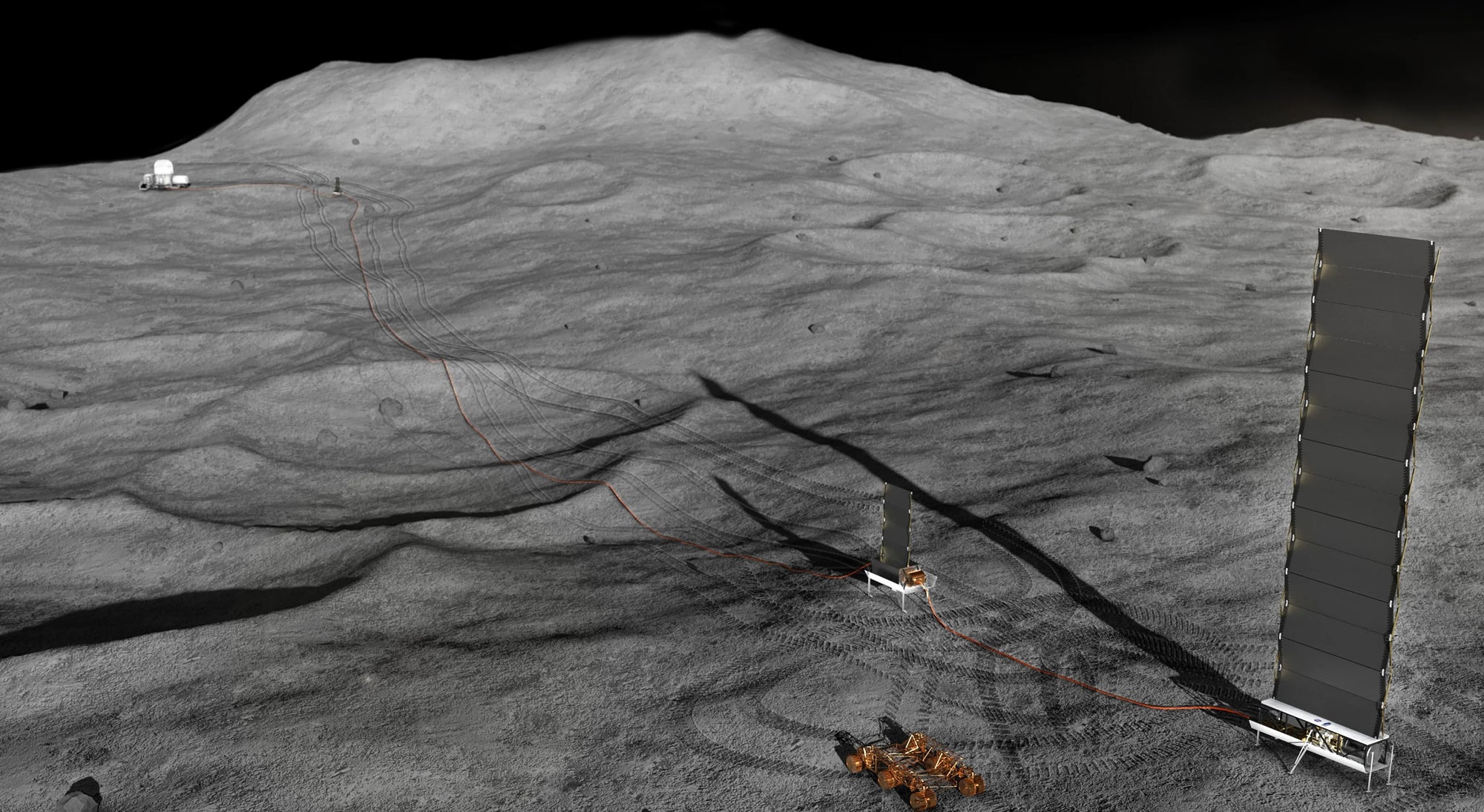
Politic?

This is a blog dedicated to a personal interpretation of political news of the day. I attempt to be as knowledgeable as possible before commenting and committing my thoughts to a day's communication.

Monday, April 20, 2026

Lunar Competition

"They [Chinese space exploration] may be early. And recent history suggests we might be late."
"This time the goal is not flags and footprints [in returning astronauts to the moon]."
"This time the goal is to stay [sustaining a permanent presence on the moon]."
Jared Isaacman, NASA administrator 
The United States, considering itself the alpha nation in scientific innovation and advances was somewhat chastened and humiliated when it was Soviet Russia, whose own scientific entrepreneurship was considerable enough to enable it to be the first nation on Earth to send a cosmonaut into space to orbit Earth in 1961, advancing space exploration through a 108-minute mission to orbit Earth, making Yuri Gagarin the first human to leave the bounds of the planet.   
 
It took another eight years for the United States to catch up with Russia's space mission, when the Apollo 11 Mission carried three astronauts to the surface of the Moon, resulting in first Neil Armstrong's famous walk on the Moon, followed by Buzz Aldrin's, while Michael Collins remained in orbit. No country has since returned to the Moon. China has developed its own space program and ambitions for the Moon. Although Neil Armstrong planted the American flag during his 2-hour walk on the Moon's surface, the race is now on to see who will plant the next flag. 
 
Buzz Aldrin on the Moon in a photograph taken by Neil Armstrong, who can be seen in the visor reflection along with Earth, the Lunar Module Eagle, and the U.S. flag.
 
The present era in space travel sees China and the United States in a competition over who will first land humans on the Moon not merely for continued exploration purposes and greater familiarity with its surface and conformations and minerals, but to advance development plans for a permanent presence there, a manned station from which other missions further into the depths of outer space to reach Mars and possibly establish a colony there. 
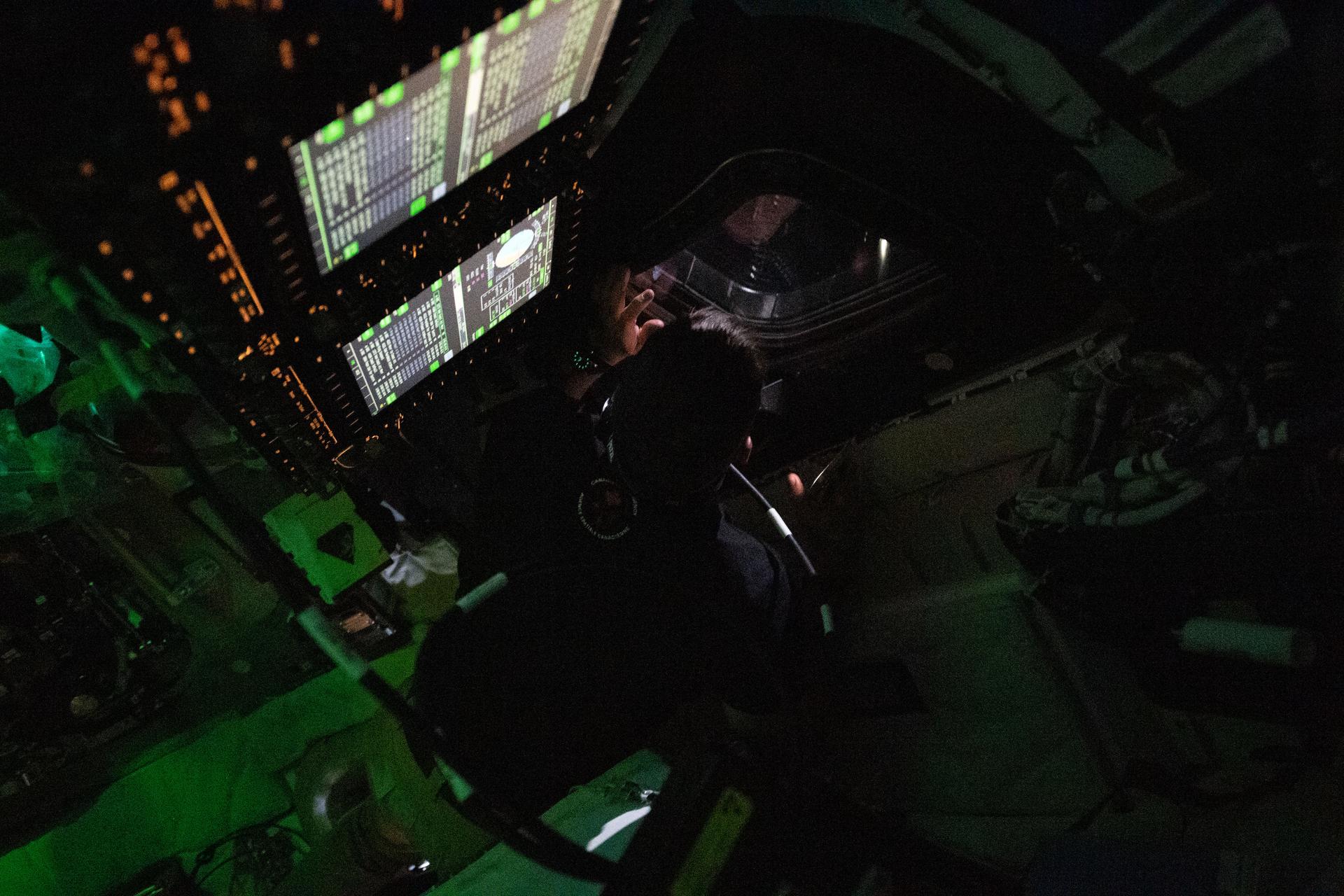
 
CSA (Canadian Space Agency) astronaut Jeremy Hansen – in the center of the image – peers out the window of the Orion spacecraft on day 3 of NASA's Artemis II mission. The controls over the commander and pilot seats are illuminated in the foreground, but the cabin is otherwise dark to avoid unnecessary glares on the windows.

CSA (Canadian Space Agency) astronaut Jeremy Hansen – in the center of the image – peers out the window of the Orion spacecraft on day 3 of NASA's Artemis II mission. The controls over the commander and pilot seats are illuminated in the foreground, but the cabin is otherwise dark to avoid unnecessary glares on the windows.  Image Credit: NASA

China's space mission has already distinguished itself for having landed an unmanned mission on the never-before seen far side of the Moon where a robotic probe programmed to retrieve mineral samples succeeded in bringing them back to Earth for Chinese scientific study identification. China plans its seventh robotic mission to explore the lunar south pole, with its Chang'e 7 space capsule. Chinese astronauts are to revisit that part of the Moon where the Apollo 11 mission landed.
 
In April U.S. astronauts were sent by NASA on a ten-day lunar flyby, doing a figure-8 loop around the Moon and back, then returning to Earth, having flown further and higher than any other manned mission. As a prelude to plans to once again land astronauts on the Moon where both China and the U.S. plan to build nuclear reactors to power the lunar bases they intend to build as space-launch sites. 
 
China's plan is to build outposts around the south pole of the Moon, planning to tap frozen water, hydrogen and helium in that region. China's target for a return with a manned mission has a date of 2030. NASA hopes to beat them at it, knowing it's a long shot, but they plan on returning to the Moon with astronauts in 2028, two years sooner than China. The reality is that China with its centralized control funding projects decades ahead, has been where the U.S. has not yet ventured.
 
And it is the south pole that the U.S. too plans to return to, a competition that may determine, according to which country first reaches its target, which will be able to assume the greater authority over the region. NASA's plan is to launch six-month missions, arranging for a sustained presence. The U.S. spacecraft Orion carried the four astronauts (one Canadian) on the Artemis 11 mission this month. 
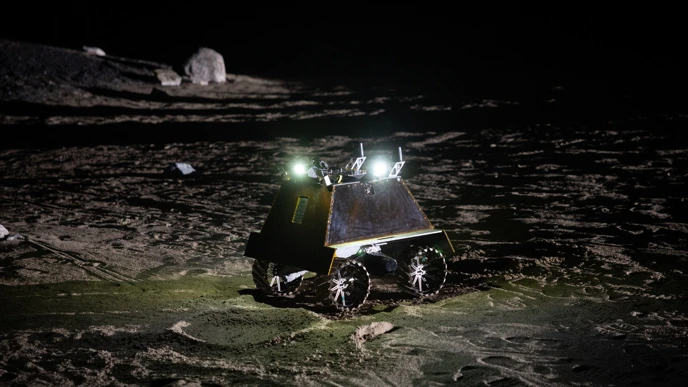
 
https://img-s-msn-com.akamaized.net/tenant/amp/entityid/AA1YD7tG.img?w=688&h=387&q=90&m=6&f=webp&u=t
The lunar robot initiative is part of China’s broader 'AI in steel' strategy—embedding artificial intelligence into physical machines for real-world tasks.
 
Artemis 111 is to be launched next year, to test a lander being developed by SpaceX called Starship, while Blue Origin has another lander in development. Whichever lander is completed will be tested by NASA first. Artemis could be sped up in a new timescale through a recent program overhaul to include more launches to test components, lower risks and gain confidence.
 
China has two programs; crewed missions under the purview of the military, and civilian robotic missions. The Long March 10 is a Chinese government-built rocket, half as tall as a 30-story building, with seven engines at its base. The United States has the jump on China with rocket technology in that China cannot match SpaceX's reusale Falcon 9 rocket. 
 
A new spacecraft called the Mengzhou ('Dream Boat') is being developed by China to carry up to seven astronauts, designed for lunar missions and trips to the Chinese space station, some 450 kilometers above Earth. 
 
The Mengzhou is to carry astronauts to a lunar orbit where a rendezvous with a lander to take the astronauts to the moon's surface will be carried out. Once the Chinese astronauts get to their Lanyue lunar lander, it will turn toward the lunar surface where on landing it will become the astronauts' temporary home, data center and energy source. 
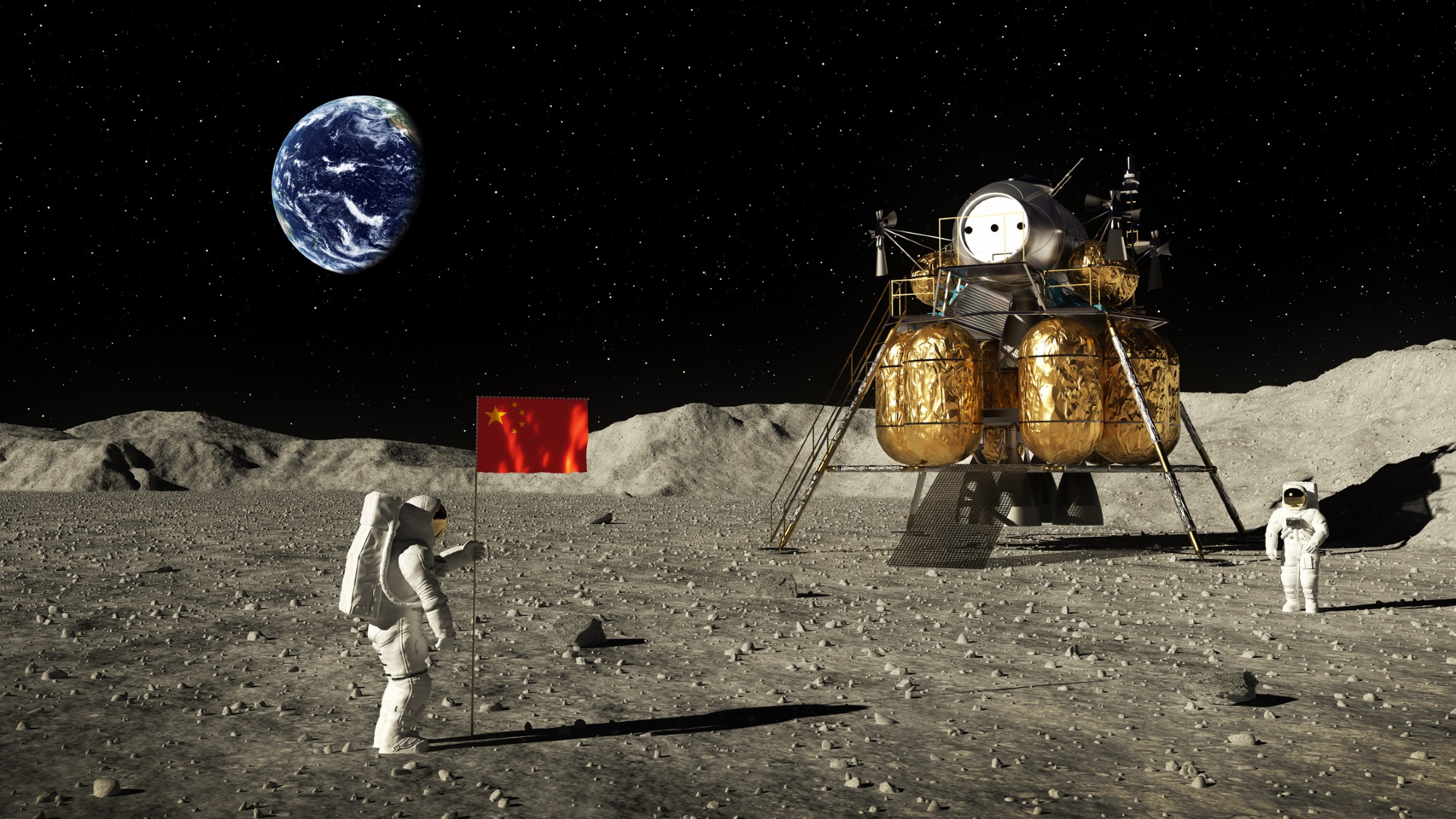
 
Artist's illustration of astronauts on the moon planting a Chinese flag. (Image credit: 3DSculptori/Stock/Getty Images)
 

Labels: , , , ,

Wednesday, August 06, 2025

Colonizing the Moon and Mars With Nuclear Power Generation

https://bigthink.com/wp-content/uploads/2022/09/Lunar_libration_with_phase_Oct_2007_continuous_loop.gif 
 
"Since March 2024, China and Russia have announced on at least three occasions a joint effort to place a [nuclear] reactor on the Moon by the mid-2030s."  
"The first country to do so could potentially declare a keep-out zone, which would significantly inhibit the United States from establishing a planned Artemis presence, if not there first."
NASA directive 
 
"The facility will be fully manufactured and assembled on Earth, then tested for safety and to make sure it operates correctly."
"Afterwards, it will be integrated with a lunar lander, and a launch vehicle will transport it to an orbit around the moon."
"A lander will lower it to the surface, and once it arrives, it will be ready for operation with no additional assembly or construction required."
CNBC  2020 report
 
"We're in a race to the moon, in a race with China to the moon. And to have a base on the moon, we need energy. And some of the key locations on the moon, we're going to get solar power."
"But this vision technology is critically important, and so we've spent hundreds of millions of dollars studying."
"Can we do it? We are now going to move beyond studying, and we are going.We have given direction to go."
"Let's start to deploy our technology, to move to actually make this a reality."
U.S.  Transportation Secretary and acting NASA Administrator Sean Duffy  
https://i.abcnewsfe.com/a/86022072-4779-4466-8560-fffdae264c2a/sean-duffy-epa-gmh-250708_1752002707642_hpMain.jpg?w=750
Secretary of Transportation Sean Duffy attends a cabinet meeting in the Cabinet Room of the White House in Washington, July 8, 2025.    Aaron Schwartz/Pool/EPA/Shutterstock

There was a sudden, surprise announcement out of Washington, that the United States is rushing to place nuclear power reactors on the moon and on the surface of Mars. Hopes by the Trump administration and by extension NASA, are that the first system would be launched by the end of the decade; 2029 at the earliest. First reported by Politico, a new NASA directive  calls for the appointment of a nuclear power czar for the selection of two commercial proposals within a six-month period. 

The Trump administration frames the push as a critical issue with a laser focus on outpacing a linked China-Russian effort to do the same.

Acting NASA chief Sean Duffy signed the directive in his dual capacity as U.S.  transportation secretary. The latest sign of the agency's shift in prioritizing human space exploration over scientific research under U.S. President Donald Trump, the July 31 memorandum makes it clear that this president sits atop a world that he has taken  unusual steps to dominate, so why not extend it to outer space? 

https://static.scientificamerican.com/dam/m/66ff3756785068bc/original/fission_surface_power_project_concept_illustration.jpg?m=1754408240.054&w=2000

A concept illustration showing NASA’s Fission Surface Power Project on the moon. Under a new directive, the space agency is seeking to develop bigger and more powerful nuclear reactors that could reach the lunar surface by 2030. NASA

NASA, since 2000, invested $200 million in the development of small, lightweight fission power systems. None has yet progressed toward flight readiness, but the urgency of the administration's wish to power ahead makes it clear that technological work will proceed apace to ensure those power systems will be ready in light-year time to ensure flight readiness without compromising the administration's and NASA's ambitions to beat Russia and China to the game.

In 2023, the completion of three $5-million industry study contracts represented the most recent effort to focus on generating 40 kilowatts of power, sufficient for the running of 30 conceivable households continuously for a ten-year period. Fission systems are operational around the clock, unlike solar power; an invaluable dependency during lunar nights that last for weeks, or in the case of Mars, interfering dust storms.
 
Technological advances have resulted in systems that are increasingly lightweight and compact. In December of 2024, NASA formally committed to the use of nuclear power on Mars, representing the first of seven specific decisions of primary functional requirements for human exploration of Mars. Elon Musk must be salivating in anticipation, while working on his diplomatic skills to inveigle himself back into the fond regard of President Donald Trump. 

https://bigthink.com/wp-content/uploads/2025/08/moonpower.jpg?lb=960,540
Humanity has long dreamed of establishing a robust and continuous presence on another world, such as the Moon or Mars. One of the keys to such a successful colony would be the continuous generation of power, with nuclear power plants remaining a prime, and arguably our best, option. But that may not be the true motive behind NASA administrator Sean Duffy's recent announcement. Credit: NASA; edited by E. Siegel

Surface power needs are expected to be at least 100 kilowatts, based on feedback by industry, to enable the support of "long-term human operations including in-situ resource utilization". Issues of such crucial matters as the provision of reliable life support measures, communications and mining equipment to be able to collect surface ice, in the absence of running water are being tended to.

Plans to proceed assume use of a "heavy class lander", capable of carrying up to 15 tonnes of mass, to target a "readiness to launch by the first quarter of FY30", aka late 2029. To the present, the sobering news that NASA's Artemis program -- the intention to return to the moon to establish a lasting presence near the south pole -- has faced repeated delays.  

https://bigthink.com/wp-content/uploads/2013/05/origin-505.jpg?resize=768,432
Humans have often dreamed of colonizing other worlds: both within our Solar System and beyond. While we may be a long way from a Martian colony involving skyscrapers, as illustrated here, many contend that a small, domed structure on another world, such as Mars or the Moon, could represent a key step toward that ultimate goal.  Credit: Corepics VOF/Shutterstock


Labels: , , , , , , ,

Tuesday, January 18, 2022

Meeting Heavenly Threats

"People [shouldn't lose sleep] over the chances of being hit by a devastating asteroid."
"In the event that we find something that is going to hit the Earth we would like to do something about it."
"It's not a matter of finding them and sitting there and letting it hit."
Professor Richard Wainscoat, University of Hawaii
 An asteroid is seen heading towards the planet in this artistic rendition. (photo credit: PIXABAY)
An asteroid is seen heading towards the planet in this artistic rendition.
(photo credit: PIXABAY)

A new study published in the journal Icarus claims that fifty percent of impactors (celestial bodies) that approach Earth from the East undergo periods of slow motion, making their presence difficult to detect. Asteroids the size of the 2019 body, named 2019 OK that came alarmingly near Earth as a "near miss" as it hurtled past the planet at a distance of 70,000 km. The asteroid, about 91 metres across, was identified a mere 24 hours previous to its alarming bypass.
 
And it was that incident that spurred the NASA-funded scientists to embark on their study where they identified a danger zone where potentially devastating asteroids have the potential to "sneak up" undetected toward Earth. Celestial objects in their East-direction approach in the dark night sky can give the appearance of being stationary, resulting from a quirk of Earth's daily rotation in its journey circling the sun.
 
The network of computerized telescopes whose purpose is to watch out for such threats are bypassed by this newly-identified approach with its consequential outcomes. NASA was tasked by the US. Congress to identify 90 percent of asteroids of a size 140 metres across or larger, determined to be a size which could wreak a devastating impact on a region the size of a large city or small state, once it hit terra firma.
 
With the recognition of the potential, however seemingly dim, that such an impact could occur with its devastating outcome, the agency is developing preventive measures as well, to avoid such grimly possible scenarios. NASA launched an experimental mission last year meant to smash a heavy spacecraft into the moonlet of a comet, a measure to determine whether it would knock the moonlet off course.
"A 330-foot- (100 m) wide asteroid designated 2019 OK passed just 43,500 miles (70,000 km) from Earth on July 25, 2019. It was discovered by the Brazilian SONEAR survey just days ago, and its presence was announced mere hours before it zoomed past our planet. 2019 OK is not a threat to Earth right now. However, this and other near-Earth asteroids do pose a genuine risk. The Tunguska explosion in 1908 and the Chelyabinsk meteor in 2013 were equivalent to large nuclear explosions, and under the wrong circumstances a meteor impact could devastate a city."   Jul 31, 2019 by The Conversation, SciNews
An illustration of an asteroid in space. Image credit: NASA / JPL / Caltech.
An illustration of an asteroid in space. Image credit: NASA / JPL / Caltech
 
Algorithms governing observation telescopes alert to asteroids are programmed to flag moving objects in order to avoid incorrectly identifying phenomena such as supernovas and flare stars, taking account of the fact that objects in their approach to Earth appear to drift west in the sky, reflecting Earth's eastward axis spin.When asteroids approach Earth from an area of the Eastern sky the planet's spin and curved orbit around the sun can have the effect of making the objects appear stationary.
"Astronomers are well aware of the risks posed by asteroids hitting Earth. Meteor craters can be found around the globe, and some relatively fresh examples include Wolfe Creek in northern Australia and the imaginatively named Meteor Crater in Arizona."
"A huge asteroid impact 65 million years ago near Chicxulub in modern-day Mexico initiated the fall of the dinosaurs."
SciNews
 An asteroid is seen heading towards the planet in this artistic rendition. (credit: PIXABAY)
An asteroid is seen heading towards the planet in this artistic rendition. (credit: PIXABAY)


Labels: , , , ,

() Follow @rheytah Tweet