Politic?

This is a blog dedicated to a personal interpretation of political news of the day. I attempt to be as knowledgeable as possible before commenting and committing my thoughts to a day's communication.

Monday, October 09, 2023

Damning Statistics

"The majority [87 percent] of homicides involving Indigenous women and girls reported by police between 2009 and 2021 were cleared by police, in that an accused person was identified in relation to the case."
  • Between 2009 and 2021, the rate of homicide against First Nations, Métis and Inuit women and girls was six times higher than the rate among their non-Indigenous counterparts. Homicides of Indigenous women and girls take complex pathways through the Canadian criminal courts, from police laying or recommending charges to court processes and outcomes.
  • The majority (87%) of homicides involving Indigenous women and girls reported by police between 2009 and 2021 were cleared by police, in that an accused person was identified in relation to the case. This proportion was slightly lower than in homicides of non-Indigenous women and girls (90%).
  • Most Indigenous women and girls were killed by someone that they knew (81%), including an intimate partner (35%), acquaintance (24%), or family member (22%). In most cases, the person accused of their homicide was also Indigenous (86%).
  • Police were less likely to lay or recommend a charge of first-degree murder—the most serious type of homicide charge—when the victim was Indigenous (27%) compared to when she was not (54%). Instead, charges of second-degree murder (60%) and manslaughter (13%) were more common. Manslaughter charges were also more common when the accused person was Indigenous.
  • When incidents of homicide of Indigenous women and girls moved to court, manslaughter charges were twice as common when the victims were Indigenous women and girls (41% of homicide charges) than when they were not (20%).
Statistics Canada Report 
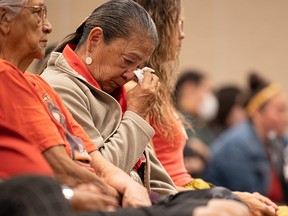
Indigenous people crying for murdered family members.
490 Indigenous women and girls between the years 2009 and 2021 were murdered, according to the latest Statistics Canada report, representing a rate of 5.3 per 100,000, six times higher than for non-Indigenous women and girls. Over that same period 1,533 non-Indigenous women and girls were murdered, the rate of 0.7 per 100,000 substantially reduced from the experience of Indigenous girls and women. 

Indigenous men like their female counterparts are killed at a rate far outstripping non-Indigenous Canadian men. Statistics Canada reported last year that between the years 2015 and 2020, among Indigenous men the homicide rate was 13.2, over triple the rate for Indigenous women. It is only relatively recently that the realization of lethal violence was leading to such a high death rate for Indigenous men in Canada.

And it bespeaks a condition of generally greater violence from within Indigenous communities themselves. It is inter-communal violence, for whatever the basic social-cultural-environmental conditions involved, that leads to such disturbingly high death rates within the community. Men in Indigenous communities are both perpetrators and victims of a society that grapples with over-average violence.

Years ago when it became public knowledge that Indigenous women and girls were being mysteriously killed at a societally-above-average rate, it was not revealed that this was the result of inter-communal dysfunction. That has changed, statistics reflect the reality that the vast majority of murdered Indigenous women have been killed by other Indigenous people, to the extent of 86 percent.

In 2015 when that reality was first released, the Indigenous community was indignant and angry, accusing both the RCMP Commissioner of the time and the Aboriginal Affairs Minister of circulating incorrect data that resulted in "victim-blaming". This race-based data was rejected by those who insisted that an enquiry be struck into the issue of missing and murdered Indigenous women, striking out 'race-based' data as inappropriate. 
 
Aboriginal homicide chart
 
Accusations that police fail to take adequate investigations seriously in the case of murdered Indigenous women have also fallen by the wayside with the numbers reported in the latest issue of the Statistics Canada report. The solving of such homicides is close to a match for those investigations of non-Indigenous victims. 

There is, however, one glaring discrepancy. The criminal justice system in Canada treats Indigenous male offenders who commit serious crimes far more leniently than it does non-Indigenous men guilty of murder. The prevailing attitude has been that something must be done about the fact that male Indigenous incarcerants far outnumber non-Indigenous prisoners for like crimes, hugely disproportionate to their numbers in the population.

Which led to the general agreement among politicians and the justice system that the law must treat Indigenous criminals more gently in view of their less privileged environmental backgrounds and their aboriginal status with cultural and social values at variance with the rest of the population. A situation that saw much reduced penalties in prison time for commissions of violent crime. 

Leading to a situation that Indigenous men who murder Indigenous women being less likely to be charged with homicide, but with lesser charges such as manslaughter, and tending to receive milder sentences. The average sentence for an Indigenous man charged with homicide is three years less on average than that for the capital offence committed by a non-Indigenous man: 11.4 years in prison as opposed to 14.4 years.
Labels: , , ,

Tuesday, March 23, 2021

Canada's Aboriginal Justice System

"She was not a street person. She was missing, and she was murdered."
"It was horrific and I try not to dwell on it. Its like trying to get out of a dark pit."
"[Muchieiwanape is] evil [and] sadistic [he] should be locked up permanently."
"While incarcerated, he has received his education and job skills. How nice. What supports were put in place for my sister and her family after he washed my sister's blood from his hands?"
"I'm filled with anger. They should be held accountable for being lenient with these dangerous inmates. What now? Who's to blame if he harms another innocent person?"
Darlene Clarke, Aboriginal heritage, Selkirk, Manitoba
Darlene Clarke, left, is pictured with her sister Kimberley Clarke, right, in an undated family photo. The woman in the middle is their late mother, Sarah Clarke. (Submitted by Courtney Bear)
"When a person is sentenced in federal custody, a big part of that sentence is supposed to be tied to the severity of the crime, and some kind of deterrent or punishment factor. But once that person starts their sentence, another big part of what becomes part of the decision process is what is that person's needs for rehabilitation?"
"Often first-degree murderers may end up in the maximum type of prison environment, but over time ... they're continually evaluated. In some cases, that means taking down steps in their security levels at their institutions."
"...But for the majority of people that are serving federal sentences, there is a lot of value in the rehabilitation activities they do."
Mary Campbell, director, Centre for Criminal Justice Studies, University of New Brunswick
The issue in Canada of 'missing and murdered Indigenous women' is a sad and sorry statement of malfunction and dysfunction; malfunction on the part of government penal agencies and dysfunction out of the larger Aboriginal population. Indigenous, First Nations women and children have a higher degree of violence committed against them than their counterparts in the general population. The same can be said for First Nations men; who also suffer violence disproportionately.
 
More First Nations children are taken into protective custody than are non-Aboriginal children in the general population. Substantially greater numbers of First Nations men are incarcerated for all manner of crimes, and again hugely disproportionate to their numbers in society. Many First Nations people live in remote, isolated communities, but those who have left their ancestral tribal communities to live in urban centres are prone to the same behavioral frailties as their tribal cousins living on reserves. 

Addiction to drugs and alcohol run rampant through their communities, much of it driven by bio- and cultural-inheritance. Colonialism takes its fair share of responsibility for the plight and neglect of First Nations people. Tribal leaders have great influence over the course of events of their people, exerting that influence persuasively in issues such as non-integration into non-Aboriginal social streams and allegiance to their heritage and lands. Which keeps them isolated, living in remote communities where health care and social services are less accessible.
Kimberley Clarke, 36, was murdered under Winnipeg's Redwood Bridge in 1998. She had three children. (Submitted by Jade Frost)
 
The issue of violence in native communities is an ongoing failure of both First Nations and government agencies tasked to give aid, to solve. Criminal behaviour is too common but much worse is the violence enacted against one another, and most particularly toward girls and women. Missing and murdered Aboriginal women has its start right there, with the responsibility that should be laid directly at the feet of those leaders who fail to address it but point a finger of blame at 'white colonists' and issues such as residential schools whose purpose was to give Indigenous children a contemporary education to enable them to meld into the greater society.

Many Aboriginals have done just that, with and without the aid of residential schools, propelling themselves into respected positions in the professions of law, medicine, journalism, government, social services and more. Just as some tribes have succeeded in pioneering for themselves positions as leaders in commercial ventures that have been hugely successful and remunerative, while others are dismal failures, led by reserve councils that are corrupt and unaccountable.
 
Escaped prisoner Roderick Muchikekwanape.
Through all of this, the federal government and provincial governments tread a fine line between honouring Aboriginal traditions and culture and imposing the laws of the land. Unevenly, as it happens, with heavy consideration to treating First Nations law-breakers more leniently than non-First-Nations criminals. In the case of Canadian murderer Roderick Muchikekwanape, 42, freedoms of a nature ill-deserved by his murderous past. He bludgeoned an Aboriginal woman to death and sexually assaulted her.

The two met at a party in Winnipeg in 1998. They were seen walking together, when security at a nearby business called police after hearing screams and seeing someone running from the source of the tumult. When police arrived they discovered a trail of blood which led to the river. Kimberley Clarke's body was discovered after two days; she had been beaten to death. Roderick Muchikekwanape was found guilty at trial and sentenced to life imprisonment. Months ago, he walked away from a minimum-security Mission Institution in British Columbia.

These are open grounds, with few security features, where those institutionalized are on an 'honour' system to remain within the grounds. Accommodation is casual, there is no resemblance to the usual penal institutions where hardened criminals and murderers are kept in federal prisons. And these minimum-security alternatives are meant exclusively for the Aboriginal criminal class. It is thought that these places are more in keeping with First Nations cultures and systems of justice for malefactors. Several months ago Roderick Muchikekwanape walked out of Mission Institution and he is still at large.
The minimum-security Mission Institution in B.C. where Roderick Muchikekwanape was serving his life sentence has a long history of inmate escapes.
The minimum-security Mission Institution in B.C. where Roderick Muchikekwanape was serving his life sentence has a long history of inmate escapes. Photo by Francis Georgian/Postmedia/File
 
A video capture last saw him in Washington State where U.S. Marshalls feel he is likely to "claim to belong to a tribe in the U.S." Royal Canadian Mounted Police, at the time of his escape, said he has "a history of significant violence". Correctional Service of Canada issued a news release that he was unaccounted for at an evening count, leading to a warrant being issued for his arrest. His has not been the only high-profile escape from the Mission Institution which houses hundreds of medium- and minimum-security Indigenous prisoners.

Barb Van Vugt, the then-warden in 2017 described no physical barrier preventing inmates from leaving the prison. "We believe a gradual release into society is safest and best for everyone", she stated following Robert Dezwaan, serving a sentence for the sexual assault of 16-year-old Cherish Billy Oppenheim whom he had beaten to death and buried under rocks, had also decided to leave the prison. Convicted of a 2004 fire-bombing in Calgary where two young children were killed, Michael Sheets was another escapee. And there are more.

As for Muchikekwanape, the Pacific North-west Violent Offender Task Force is looking for him. Just over six feet in height, black hair, brown eyes, he has a number of aliases. He was last seen, according to the U.S. marshals, boarding a bus to Mount Vernon, another bus to Everett, on his way to Sumas, Washington -- on the Canada-U.S.border.

Labels: , , ,

Friday, June 07, 2019

Acknowledge History, But Move to the Future

https://www.mmiwg-ffada.ca/wp-content/uploads/2019/05/header-report-1.jpg
"[There exists] a race-based genocide of Indigenous Peoples -- empowered by colonial structures -- leading directly to the current increased rates of violence, death, and suicide in Indigenous populations."
Final Report of the National Inquiry into Missing and Murdered Indigenous Women and Girls
"...Any of the following acts committed with intent to destroy, in whole or in part, a national, ethnical, racial or religious group, as such: 
  • (a) Killing members of the group;
  • (b) Causing serious bodily or mental harm to members of the group;
  • (c) Deliberately inflicting on the group conditions of life calculated to bring about its physical destruction in whole or in part;
  • (d) imposing measures intended to prevent births within the group;
  • (e) Forcibly transferring children of the group to another group." 
Article 2 of the United Nations Convention 
Women embrace during the closing ceremony of the National Inquiry into Missing and Murdered Indigenous Women and Girls in Gatineau, Quebec, Canada, June 3, 2019.REUTERS/Chris Wattie

The National Inquiry into Missing and Murdered Indigenous Women and Girls was struck by the federal government to look into the murder or disappearance of an estimated 1,200 Indigenous women over a period of perhaps a decade. These were for the most part unsolved crimes. There had been previous studies of the situation, one or more of which was conducted by the Royal Canadian Mounted Police, Canada's federal police force.

Although the current committee, after interviewing Indigenous women throughout Canada, had concluded they were justified in naming the murdered and missing women the result of a genocide -- in the process trivializing the meaning of a word meant to convey the wholesale and focused state-sanctioned annihilation of a specific demographic -- what they conveyed was a misplaced sense of dramatic accusation, for the crimes were not state-sanctioned nor were they "committed with intent to destroy in whole or in part" any racial or ethnic group.

According to the 1946 United Nations General Assembly, "Genocide is a denial of the right of existence of entire human groups, as homicide is the denial of the right to live of individual human beings". Such was far from the reality of the missing and murdered Indigenous women in Canada. The actual, glaring fact of reality is that the murder of Aboriginal women is attributable largely to the community in which they live, sharing their lives with Aboriginal men who are the perpetrators.

Statistics from the RCMP as well as other sources are clear; 90 percent of the murders in question are committed by intimate partners, men who knew their victims within the Indigenous community, where 72 percent of Aboriginal women are murdered in their homes, very few among them were involved in the sex trade, murdered by clients. On the other hand, Indigenous men comprise an even greater number of murdered, and they as well within their own communities.
A woman holds a sign during the closing ceremony of the National Inquiry into Missing and Murdered Indigenous Women and Girls in Gatineau, Quebec, Canada, June 3, 2019. REUTERS/Chris Wattie

Of the 20,313 national homicides that took place between 1980 and 2012, five percent of the victims were Aboriginal women; in contrast 70 percent of murdered or missing Aboriginal individuals were men. The public at large is aghast at these numbers. But it is from within the Aboriginal communities themselves that this symptom of mass dysfunction exists. What these inner circle and domestic pathologies represent is conditions of isolation, broken homes, family trauma, addiction and welfare dependence and a culture of abuse.

Canada's Aboriginal population represents the fastest-growing demographic in the country; there are more Aboriginal children and young people than any other group in Canada. Indigenous Canadians were the victims of racism in the past, and that racist attitude still exists although it is waning. On the other hand, there is the issue of counter-racism, where Aboriginal women are denied the privilege accorded Aboriginal men, to live within their community if they marry outside the tribe to non-Aboriginals.

If there is any whiff of 'genocide', the finger of blame should be shifted from the Canadian population as a whole, toward the Aboriginal communities that fail to practise self-respect. By living on remote reserves in favour of refusing to join the general population where employment is available and Aboriginal people can live the very same lives as other Canadians, independent and self-sufficient, the ongoing inclination is to live 'traditionally'. But the traditional way of life is eschewed for a welfare, unemployed existence that leads to poverty and resentment.

Massive amounts of tax dollars have been expended in support of the reserve lifestyle, with those on reserves living in government-supplied homes where they see no stake in what is normal household upkeep on their part so accommodation deteriorates and the expectation is that new homes be built. With idleness due to lack of employment opportunities, boredom sets in for all age groups, and access to drugs and alcohol lead to addiction and familial neglect with children's needs poorly cared for. A self-inflicted harm absent values.

It really is past time for Canada's Aboriginal communities to follow the example of some among them that have proudly established commercial enterprises in successful bids to become independent and capable of serving the needs of their communities. Weeding out the corruption known to exist in other communities would go a long way to guiding them toward an improved future.

Simply banking on the utility of inducing guilt in the greater Canadian population with historical claims of racism and ill-guided measures for inclusion of Aboriginals serves no function but to continue the social abrasion that has mounted a wall of disaffection between both communities.

Labels: , , ,

Tuesday, June 04, 2019

Lights, Camera, Action! Trivializing Genocide

"Many people, non-Indigenous and Indigenous, many institutions will find this day, this report, these truths difficult, challenging and uncomfortable."
"We take this day as an essential day in the history and the future of this country and we will walk forward together."
Prime Minister Justin Trudeau

"We don't need to hear the word 'genocide' come out of the prime minister's mouth, because the families have told us, the survivors have told us their truth."
"Governments must fully implement the calls for justice to ensure the safety and dignity of Indigenous women, girls and 2SLGBTQQIA people."
"The continuing murders, disappearances and violence prove that this crisis has escalated to a national emergency that calls for timely and effective responses."
"Although we have been mandated to provide recommendations, it must be understood that these recommendations, which we frame as 'Calls for Justice', are legal imperatives -- they are not optional."
Chief commissioner, Marion Buller, National Inquiry into Missing and Murdered Indigenous Women
Chief commissioner Marion Buller and, left to right, commissioners Brian Eyolfson, Qajaq Robinson and Michele Audette prepare the final report by the National Inquiry into Missing and Murdered Indigenous Women and Girls in Gatineau, Que., on Monday. (Adrian Wyld/Canadian Press)

"We're going to leave the discussion of the actual use of the term 'genocide' to academics and experts."
"The important thing today is not about definitions but about action."
Justice Minister David Lametti

"The RCMP will study the final report and its recommendations, and give careful consideration to changes that strengthen investigations, support survivors and their families, bring stakeholders and partners together, and reduce violence against Indigenous women, girls and the Two-Spirit-LGBTQ community."
"We are committed to achieving reconciliation with Indigenous peoples through a renewed relationship built on the recognition of rights, respect, cooperation, and partnership."
RCMP Commissioner Brenda Lucki
Women hold signs during the closing ceremony of the National Inquiry into Missing and Murdered Indigenous Women and Girls. REUTERS/Chris Wattie

There have been calls for years for an official enquiry into the weighty issue of missing and murdered Indigenous women and girls. The Conservative government of Prime Minister Stephen Harper refused to authorize such an enquiry citing the reality that there have been previous such commissions looking into the very issue. One conducted by the RCMP. All the conclusions of such enquiries pointed to the fact that the majority of assaults and killing of Indigenous women and girls resulted from intimate partner, family or acquaintance killings within the Indigenous community itself.

From that reality it would appear that this is a matter of cultural dysfunction. That being obvious, it was also pointed out that background was the major issue at play, that poverty, disaffection, bigotry, drug and alcohol addiction and widespread child neglect, added to the collective and individual trauma attributed to both isolation (a chosen 'traditional' way of life on reserves) and primarily the faults attributed to the issue of residential schools where Indigenous children were taken from their families to live and study under religious organizations for the purpose of exposing them to a way of life other than that of their tradition.

The Liberal party and its leader during the 2015 run-up to the federal election, made a commitment to establishing an enquiry. One of its first acts on winning the election and taking government from the Conservatives was to make good on its promise. The resulting Missing and Murdered Inquiry on Indigenous Women was troubled from the outset with accusations, squabbling, resignations, and its mandate was extended until the report was presented on May 3. The report hangs on the thread of 'Canadian genocide' against Indigenous people in its 1,200 pages containing 231 recommendations.

Possibly the most controversial of the recommendations is that which claims that violence or murder committed against Indigenous women and girls should be considered a capital offence of first degree murder, elevating such murders above the criminality of those committed against non-Indigenous women. Crown-Indigenous Relations Minister Carolyn Bennett has revealed that this recommendation had immediate reaction from a number of sources, among them women of non-Indigenous origins who have recoiled at the very suggestion that killing them is less serious than the killing of an Aboriginal woman.

And therein lies a dilemma; since most Indigenous women meet violent death through the hands of an Indigenous male, and Canadian courts of law take into account a Gladue law when dealing with aboriginals accused of crimes which means their backgrounds must be considered in an enlightened manner to reduce punishment in recognition of their deprived status; how will it then be feasible to prosecute an Indigenous murderer of an Indigenous woman or girl under those circumstances? Taking also into account that Indigenous inmates of Canadian federal prisons outweigh in numbers their percentage of the population.

Yet the report insists that all governments are "to develop laws, policies and public education campaigns to challenge the acceptance and normalization of violence". Society in general does not normalize violence. It is within the tribal groups, the reserves where the culture of violence appears to have been normalized, to explain its ubiquity and where male Aboriginals suffer violence and death at even greater numbers than women and girls. And is that not within the purview and responsibility of Indigenous groups themselves where that old adage of doctor cure yourself holds?

Prime Minister Justin Trudeau greets attendees at the closing ceremony marking the conclusion of the National Inquiry into Missing and Murdered Indigenous Women and Girls at the Museum of History in Gatineau, Quebec on June 3, 2019.

"My daughter Hilary went missing on September 15, 2009."
"When I went to the police, they assumed she was out partying and did not look for her."
"My community ended up looking for her. We called the media and when the media got involved and it blew up on television, the police started looking for her."
"When my daughter was found, it was discovered that her first cousin had murdered her."
Pamela Fillier, Esgenoopetitj First Nation, New Brunswick

"It was unlike my sister to not come home because she was a young mother... When my mom went to the police, she was met with the stereotype that because she was only 24, she was probably just out with friends and would show up."
"Unfortunately, my sister's remains were found four years later. It was devastating because where she was found was less than a kilometre from her home."
"My hope would be that there is an immediate change of how the police handle Indigenous files on or off-reserve so there's no delay in pursuing every possible option to find that missing or murdered loved one."
Melanie Morrison, Mohawk Mi'kmaq woman, Quebec

Labels: , ,

() Follow @rheytah Tweet