Politic?

This is a blog dedicated to a personal interpretation of political news of the day. I attempt to be as knowledgeable as possible before commenting and committing my thoughts to a day's communication.

Tuesday, October 12, 2021

Arab-on-Arab Violence in Israel


"To only speak about crime in the Arab sector is to not understand all the factors surrounding the issue. There are issues between families, weapons within easy reach."
"The first address [people turn to] is always police, police, police, but that isn’t right [when a key issues is the infrastructure of the Arab towns, particularly in northern Israel]."
"In all the Arab villages the roads are terrible; they are packed full and overcrowded. It is so crowded and difficult, and people are coming and going from every direction.When you live in a place like that... that feels like a slum and looks like a slum [it affects you], and in the Arab sector it is really terrible."
"Many of the youth – they don’t have income, they don’t have a profession [many turn to gangs and organized crime groups, offering opportunities]. They see the groups and ask themselves, What do I want in life? Do I also want that? and they grow close to [the organized crime groups]... they earn salaries, sometimes high ones."
Leah Leshem, Israel Police spokeswoman, Northern District
 
"We always feel threatened when we enter shooting or stabbing incidents. It is frightening because after every such incident, the police arrive after extreme delays, and we are already inside the scene of the crime."
"About a year ago I arrived at the scene of the murder of a woman at the hands of her partner. We went up to the apartment to treat the woman, who was in critical condition, and the murderer was walking around outside at the entrance to the house. The police arrived very late."
"In my opinion, the eradication of weapons in the Arab sector would significantly lower the level of violence."
"Every morning there is a new murder. The year is not over yet and we have already almost broken a record for crime compared to the previous years."
"It is a huge failure, in my opinion, because we do not see increased activity to eradicate crime. We see the opposite, that the level of crime is rampant at a very high frequency."
Marwan, volunteer EMT, United Hatzalah
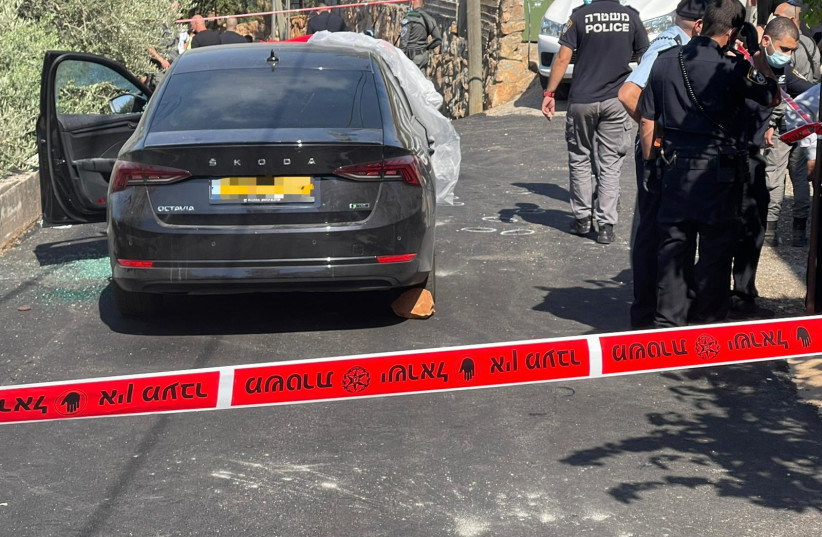
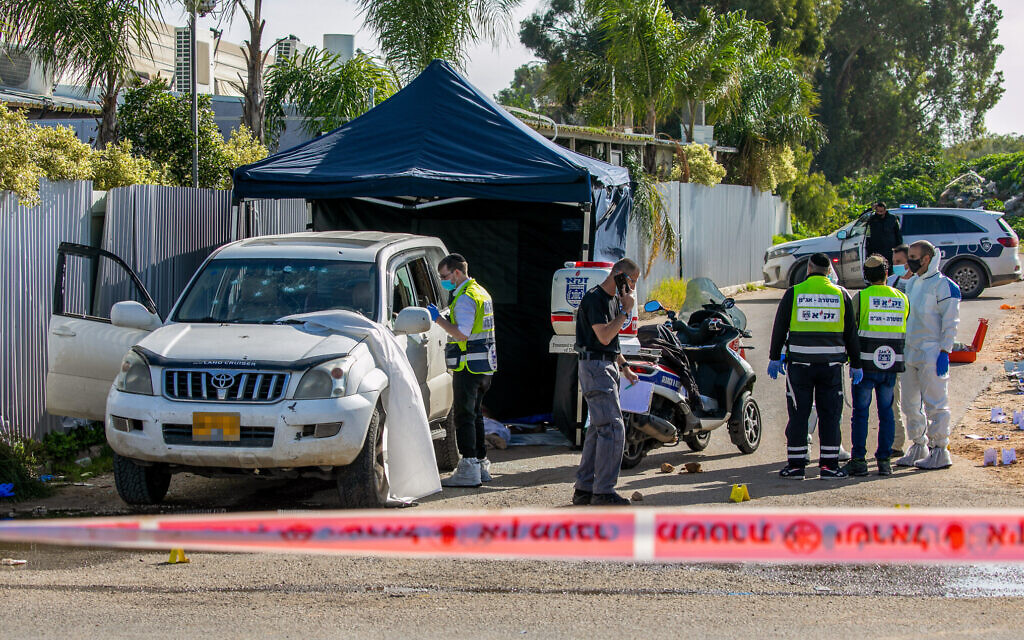
 Murder scene in Rama where Education Ministry adviser Sahar Ismael was shot dead on Sunday, August 15, 2021.  (photo credit: ISRAEL POLICE SPOKESMAN)
Murder scene in Rama where Education Ministry adviser Sahar Ismael was shot dead on Sunday, August 15, 2021.  (photo credit: ISRAEL POLICE SPOKESMAN)

Within Israel homicides inside the Arab community has seen a notable upward spiral in recent years. From 58 murders that took place in 2013 in the Arab sector of Israel, 98 have taken place so far in 2021. Of those murders, fewer than a quarter have been solved. And critics claim that this is an issue of police indifference -- along with Arab distrust of the police. That, despite that 700 Arab recruits into the Israeli police force has taken place in recent years.
 
Of over 3,300 shootings in 2019 that occurred in Arab communities, a mere five percent resulted in indictments. A situation that police say results from difficulties in gathering evidence and locating suspects and witnesses in the same Arab communities that bitterly complain of a lack of police presence. The spike in internecine violence is attributed by Arab leaders and government officials to the rise of armed Arab crime syndicates.
 
Loan sharking and protection rackets are brutally enforced by unemployed, aimless young Arabs prepared to act as foot soldiers for the earnings involved. That, however, is just part of the story. Personal grudges, land disputes between neighbours, petty slights between schoolchildren, all add to the numbers of crimes committed. Some situations escalate into lethal clan vendettas. Guns are turned against women during domestic violence in "honour killings".
 
In Jewish communities of similar size and population to those of the Arab communities, there are after-school social gatherings where children can communicate with one another, share common interests, find themselves involved in community events, learn new skills, but no such after-school groups are organized in Arab towns and villages. Some Arab families send their children to attend the Jewish social groups in nearby villages, but generally Arabs tend not to favour their children interacting with Jewish children. 

The Arab criminal class is growing, accounting for roughly 70 percent of all homicides in Israel, even as Arabs represent slightly over 20 percent of the total population of the country. The entire country has been shocked by the surging violence, amid the general acknowledgement that government neglect in Arab communities plays a part in the burgeoning crime taking place there. Infrastructure is not the priority in Arab communities by government agencies that it is in Jewish communities.

There is endemic poverty and people live in close proximity, in crowded conditions bordering on the squalid. The crime wave has resulted in Arab leaders pleading for police action. Arab communities are full of illegal weapons, and when disputes take place they readily become lethal. Although the Arab population of Israel is under two million strong, estimates of illegal gun numbers in Arab communities range from tens of thousands to hundreds of thousands.

"Nobody really knows how to quantify it", Tomer Lotan, director-general of the Ministry of Public Security, stated. Mass protests have been organized by Arab politicians, and activists call on government to intervene in the situation. There was a march from the northern city of Haifa to Jerusalem a year ago by mothers of victims. Protests have been staged in recent weeks, once again calling on government authorities to prioritize intervention in criminal activities in Arab communities.

What is clear is that the Arab communities themselves are not prepared to tackle their own problems. Even when murders are committed between Palestinians by criminal gangs, in honour killings, in clan disagreements, the solution is to call on Israeli police to intervene. When complaints among Arab Israeli citizens are rife of police interfering in their lives, of targeting Arab Israelis, in a population where distrust and anger is a fact of life.
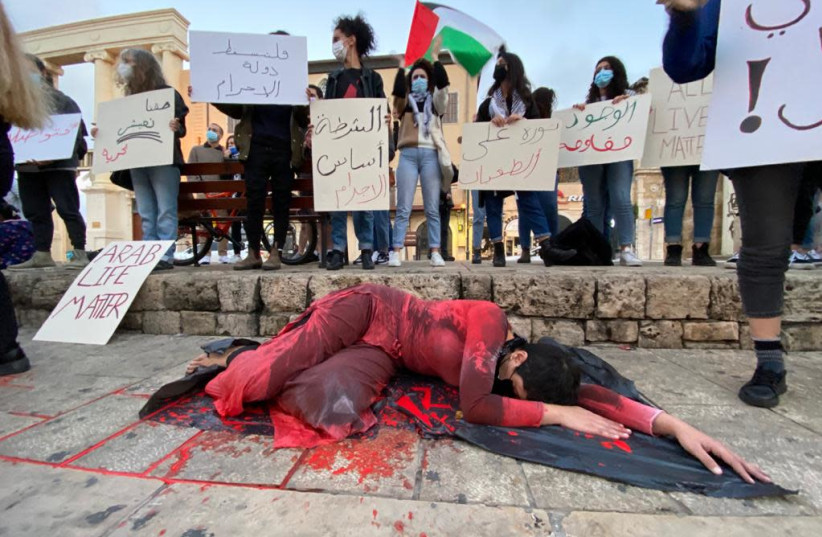
 
A protest against the rising crime and violence in the Arab sector in Israel, Jaffa, Saturday, February 6, 2021. (credit: SASSONI AVSHALOM)
 

Labels: , , , ,

Monday, March 22, 2021

Israeli Palestinian Cities Strangled by Palestinian-on-Palestinian Violence

"Many Arab Israelis blame the violence on organized crime, and accuse police of devoting too few resources to root it out in Arab cities, towns and neighborhoods. Experts, policymakers and activists argue that even as Israeli police have cracked down on crime among Israeli Jews, not enough has been done to combat endemic violence in the Arab community, which has long suffered from official neglect."
"Over the past few years, Arab criminal groups have proliferated and taken over spaces vacated by state institutions and police. A new reality has been created in Arab towns and cities, one in which powerful protection rackets have access to an enormous quantity of weapons, lend money and collect payments at the barrel of a gun, and open fire at Arab mayors and their family members."
"The metastasizing phenomenon has also fueled gang wars between different groups jockeying for turf and clientele, turning towns into battlefields and sometimes catching innocent bystanders in the crossfire. 'It is the Arab crime organizations who rule Israel today when it comes to the criminal underworld. They are strong, determined, forceful and they don’t screw around. They have enough weapons for an entire army', an anonymous senior cop told Channel 12 in 2018."
"The underworld violence is mostly confined to Arab areas of the country, as seen in the disproportionate number of killings among the Arab community compared to Jewish areas of the country. Even though Arab Israelis constitute roughly 21% of the population, they accounted for 71% of the 125 homicides in Israel in 2019."
Aaron Boxerman, The Times of Israel, 31 December 2020
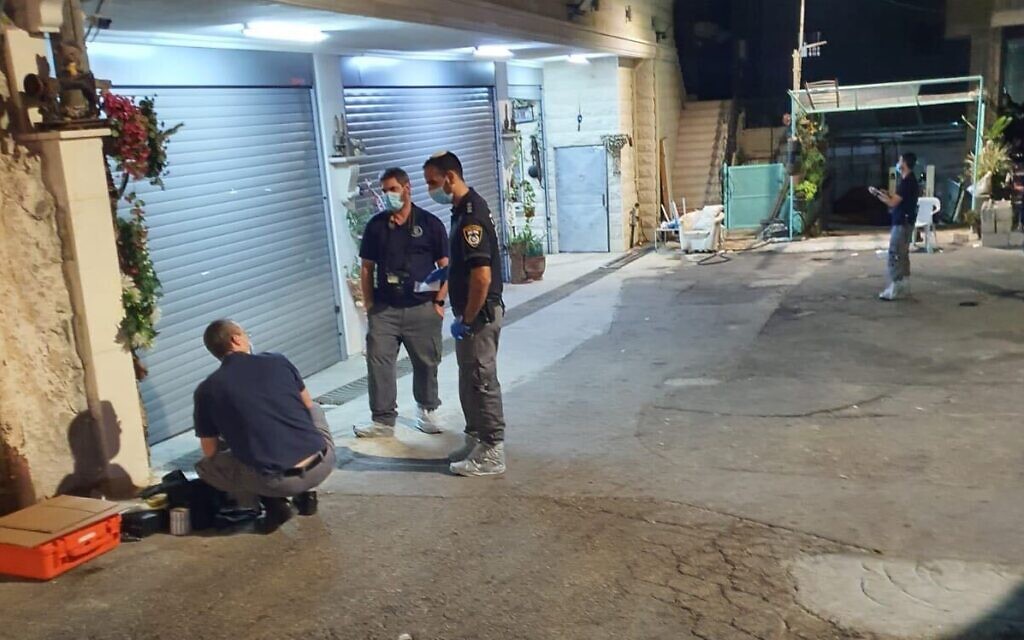
Police at the scene of a fatal shooting in the northern town of Bi’ina, October 4, 2020 (Israel Police)

What is it about Palestinian history and culture that might be responsible for a seeming proclivity to violence and gangsterism? The Palestinian Authority ostensibly has no influence on Palestinians living in Israel as part of the Israeli population with full citizenship. It does, on the other hand, exercise influence on all Palestinians when Mahmoud Abbas exhorts Palestinians to 'resist' the 'occupation', when he sees to it that Palestinian children under his autonomous rule are taught from Israel-hating curricula where Jews are portrayed as killers of Palestinians and children are urged to join the 'resistance' and plan their future as martyrs.
 
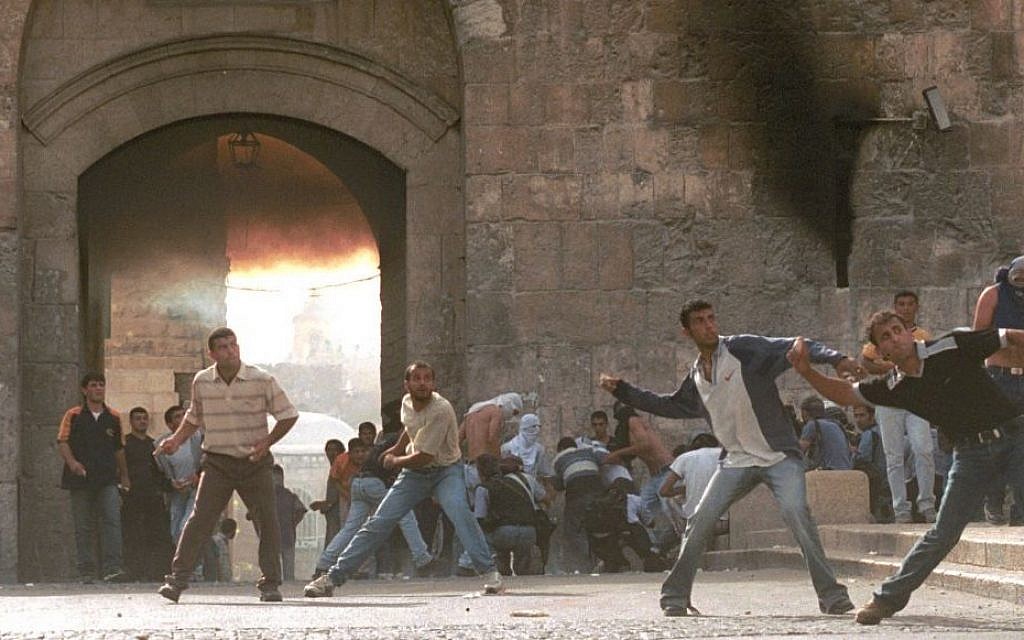
Arab residents of Jerusalem throw rocks at Israeli police near the Lions Gate in Jerusalem’s Old City on October 6, 2000, at the outset of the second Palestinian intifada, or uprising (Nati Shohat/Flash90)

Palestinian citizens of Israel are known to succumb to the invitation extended to them by the PA to vent their anger against Israelis and they do this with regularity through knifings, vehicular attacks and other means by which they hope to exact maximum damage through killing Israeli Jews and being glorified by the PA as martyrs to the cause, receiving generous monthly stipends if they're incarcerated, and if they die while committing atrocities those monthly payments for 'heroism' go to their families. It cannot help but have an effect on those within Palestinian society vulnerable to suggestive hatred.

Palestinian citizens living in Israel have called increasingly upon Israeli police to solve the problem of Palestinian-on-Palestinian crime. The response of the Israeli Police has been less than impressive to those calling for an end to the fear and violence they live with. There is that age-old conundrum of a society failing to influence its members for the better, that when an institutional force of another society enters the picture to try to bring order and security to bear, invariably criticism will surface to the effect that the 'intruding' society has been overbearing in its response.

Israel, sensitive to the never-ending criticism coming at its governance from outside sources such as states within the European Union, always highly critical of Israeli action as it applies to Palestinians, are quick to pounce declaring that Israel has trod on Palestinians' human rights. There will always be many within the Israeli-Palestinian community who plead for police action to clean up the crime the community is forced to live with, while others from within the community await the opportunity to claim undue force brought to bear by an 'apartheid' government.

The poisonous clamour from the international community over any hints that Israel's police force might exact stern measures to persuade the Palestinian criminal class that their days of free reign to sow terror among their own is over, goes a long way in dissuading the government of Israel from taking such action. To be sure, Israeli police respond to the violence, but in the same token even while they are aware of what is occurring, the reality is that information and evidence from the community itself to aid the police in their work is hard to come by.

Obviously for the simple enough reason that it is seen as a 'betrayal' for Palestinians to aid Israeli police in cleaning up the gangsters among them along with the certain knowledge that they and theirs will be punished by retributive action. Both sectors are between a rock and a hard place; the police for fear of recriminations by the foreign press and their government agencies, the Palestinian communities for fear of their own victimizing them even further through indiscriminate killings.
 
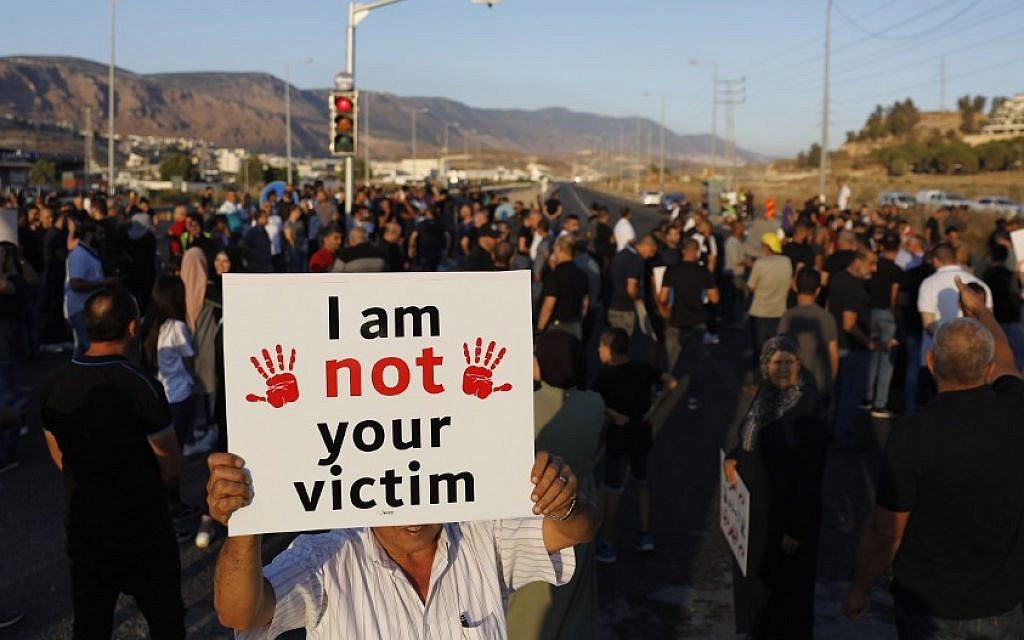
Arab Israelis protest against violence, organized crime and recent killings in their communities, in the Arab town of Majd al-Krum in northern Israel on October 3, 2019. (Ahmad GHARABLI / AFP)
 
Matters have become so desperate from within the Palestinian towns and cities cowering in fear from the violence of the gangs among them that huge protests have been  taking place calling on the Israeli government to protect its Palestinian citizens -- from other Palestinian citizens who have no regard whatever for the security and human rights of their own in the greater interests of terroristic glory and the acquisition of ill-gotten gains.
“I lost my husband and two children. They were shot dead right in front of us in our home, and yet there have been no arrests so far. In 2012, I participated in a Knesset hearing. I felt optimistic when the prime minister turned to me and promised that the case would be handled, and that they would find the murderers, but nothing actually came of that. When I saw that no progress was being made, I asked the district police in Haifa about where the investigation stood. One police investigator told me, ‘I can tell you who came into your house and shot your husband and children, but we need evidence.’ I refused to accept his response. I didn’t want to know who shot them, because I am sure that if I was Jewish, they would have found the murderer and arrested him in a matter of 24 hours."
Siham Egbariya from the Arab city of Umm al-Fahm
Arab Israelis protest against violence, organized crime and recent killings among their communities, in the Arab town of Majd al-Krum, northern Israel, October 03, 2019. (David Cohen/FLASH90)

“Contrary to the stereotype, these are not ‘crime families.’ In the families of those involved in organized crime, you’ll often find doctors and lawyers — and a crime boss, whose foot soldiers are mostly from outside the family", explained Walid Haddad, formerly a 15-year Israeli law enforcement officer in the Public Security Ministry, now a criminologist teaching at Western Galilee College
"In general, banks hesitate to provide loans in our Arab towns. This has led individuals, breadwinners, and business owners in the midst of the coronavirus pandemic to take loans on the black market. Most of them are asked to pay absurd amounts."
“How do these groups make people pay? They threaten their lives and their property. And those people who do manage to pay, in practice, fund the next series of crimes."
"Homicides are just one parameter in the violence: Attempts to gun down mayors, threats, extortion, blackmail, domestic violence, use of weapons in disputes."
Joint List MK Mansour Abbas
Police at the scene of a deadly shooting in the central city of Lod on December 28, 2020. (Yossi Aloni/Flash90)
   

Labels: , , , , , ,

() Follow @rheytah Tweet