Politic?

This is a blog dedicated to a personal interpretation of political news of the day. I attempt to be as knowledgeable as possible before commenting and committing my thoughts to a day's communication.

Friday, September 25, 2020

In God They Trust

"Throughout this pandemic, infection rates in Haredi [Ultra-Orthodox Jewish communities] and some Arab towns have been more than double the rate of the wider population. Encouraged by their religious leaders, who they revere and follow unquestioningly, they have resisted adhering to many public health measures intended to manage the contagion rate and have insisted that continued prayer will do more to contain the virus than masks or social distancing."
Vivian Bercovici, Journalist, Tel Aviv
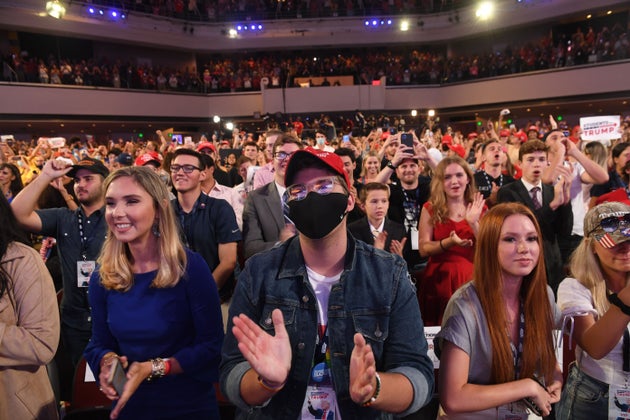
In the United States Evangelical churches have resisted public health and government instructions to close to normal activities during the pandemic. Drive-in services were put in place in many churches to allow congregations to meet in smaller, socially distanced numbers in church parking lots. In some churches built to accommodate huge memberships, there was resistance to mandated closures. Large church gatherings of fundamentalists in Korea and elsewhere were found to be responsible for massive COVID outbreaks.
Supporters listen as President Donald Trump speaks at a Students for Trump event at the Dream City Church...
SAUL LOEB via Getty Images
Supporters listen as President Donald Trump speaks at a Students for Trump event at the Dream City Church in Phoenix.
 
In Montreal in the early stages of the novel coronavirus, Hasidic communities with their large families and penchant for socializing, alongside congregations packed into limited interiors, cases of COVID rose quickly, particularly when congregation members travelled to synagogues in New York to meet with their American counterparts and brought infections back with them that spread in the community. Government and health authorities had little option but to impose 14-day lockdowns on a number of Hasidic communities in the Montreal area to control the outbreaks.
The Tash community, in Boisbriand, north of Montreal, has a population of roughly 4,000. (Ryan Remiorz/The Canadian Press) 
 
In many areas of the world religious fundamentals declared themselves protected from harm by their faith. That it was far more important to continue attendance at their places of worship to fervently pray and that those of faith could depend upon the protection that faith conferred on them. Nothing untoward could occur to these believers because a force more powerful than any mere virus would keep them safe from harm. It is as though religious fervour robs people of common sense. Their faith so intense no room is left for critical thinking.
 
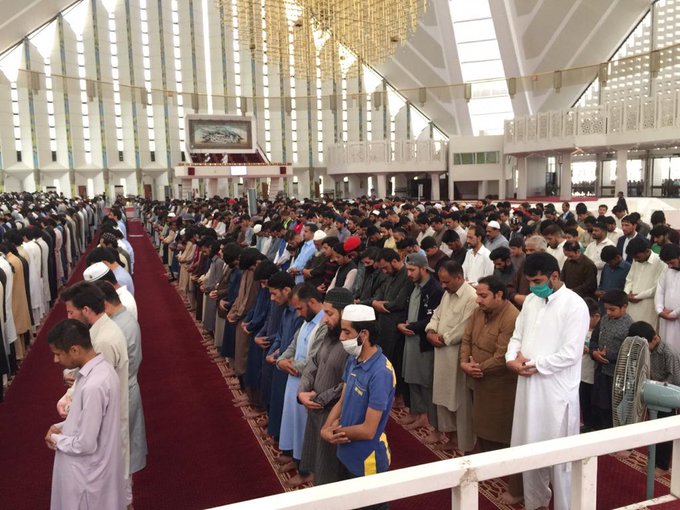
And norsis the the Islamic world free of fundamentalist Islmists who refuse the majority consensus of closing down mosques during the pandemic. From Cairo to Mogadishu, the risks of contagion were ignored in many mosques: "I am not telling you to reject the preventive measures, but there is too much exaggeration of coronavirus", Sheikh Abdi Hayi in Mogadishu said in his sermon, as people prayed on the street, the packed interior of the mosque now allowing them to enter.
Image
Faisal mosque in Islamabad during Jummah prayer  Photo Shazziya Mehmood: "Kindly arrest all of them, they put everyone at risk"

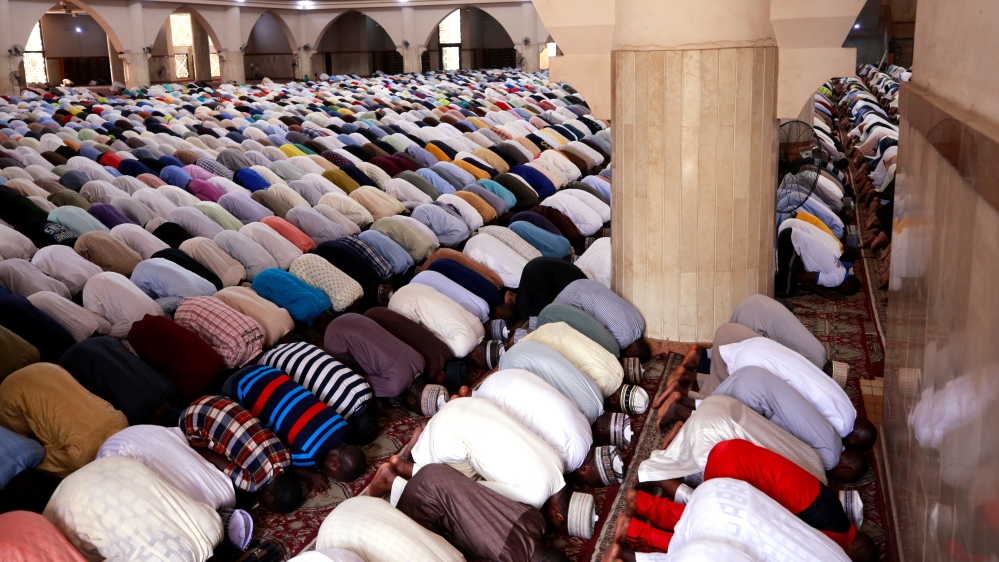
In Karachi, Pakistan’s biggest city, mosques were intensely crowded as the faithful flocked to hear a religious scholar inform his congregation via loudspeaker: "We are not too weak to let this one virus empty our mosques." And in the town of Depok, south of Jakarta, Inonesia, Aswin Jusar 76, stated "Allah is protecting those who abide by their obligations", as he prepared to attend a Friday prayer despite a call from the mayor for religious activities to be suspended.
Muslim faithfuls attend Friday prayers at the National Mosque in Abuja, Nigeria [Afolabi Sotunde/Reuters]
 
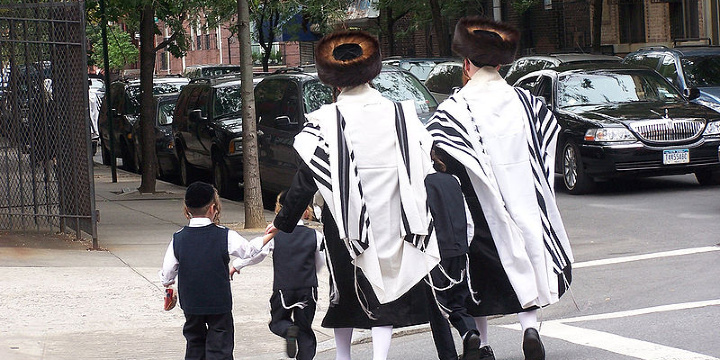
The religious communities in New York hosted an uncommonly high number of COVID cases throughout the pandemic, earning criticism from health and government authorities for their insistence on the vital importance in their lives of attendance at synagogue. In Brooklyn Orthodox Jews were preparing to mark Yom Kippur, the most sober, important day in the Jewish holidays calendar, raising the concern that praying in numbers would expose more people to infection in an area where community transmission is already much above the average.
Illustrative. Photo: Wikimedia Commons.

In Israel, with its nine million population, another lockdown, more strict than the original has been imposed on the entire country. It is not, however, the entire country where COVID cases have risen and continue to rise steeply, and for this reason alone, many Israelis are enraged at once again having their lives disrupted without sound purpose but to satisfy the demands of he ultra-Orthodox whose political wing holds the balance of power in the Knesset. Though small in numbers, by supporting the Likud and Prime Minister Benjamin Netanyahu, they are able to exert outsized influence in government decisions.

The Israel Democracy Institute, a non-partisan think-tank, released a poll report that 25 percent of the Israeli public have no trust now in the prime minister's management of the nation's COVID situation. In early April that number was 60 percent approval, reflecting trust in the ability of Prime Minister Netanyahu to act expeditiously and carefully to gain control of the virus's impact and its spread. Their trust was rewarded when case numbers plunged close to zero. The public was awarded an exhortation to relax and enjoy themselves; restrictions lifted.

Like publics everywhere in the world, released from the bondage of unnatural social life, evading all human contact, focusing on hygiene to an uncommon degree, and remaining socially isolated, the opportunity to break  free led people to behave recklessly and the predictable resulted with a steadily increasing case rise. This time the government was not as quick to take remedial, protective action. Its focus was on exterior politics and diplomacy, along with controversial plans of note drawing international concern.

As another crisis with an expanding case load loomed, the public became distrustful of their government and protests began mounting in numbers and frequency. Israel now posts one of the highest daily per capita infection rates globally. That has resulted in large numbers of Israelis testing positive and being seriously ill with hospitalizations so great in number hospital capacity and ability to care for the sick are near to collapse. The military has been tasked with setting up field hospitals for the overflow.

Closer inspection to numbers and locations demonstrate that it is the Haredi and some Arab towns responsible for the greater rise in infections. When the former director of the ministry of health, epidemiologist Ronnie Gamzu was appointed to manage the response to the pandemic, his expertise and initiatives have been knocked back by the prime minister when they focus on the number of cases in the Haredi community. A very small proportion of Israeli Jews belong to the ultra-Orthodox community, about 12 percent in total.

Yet that 12 percent wields hugely disproportionate influence, thanks to its role as Likud support in a minority government. Not just this time around, but following most elections when, small in number as they are, they end up holding the balance of power through their conditional support of the government. Conditioned on government listening carefully to their exhortations, and demands under threat of removal of support and the fall of the government.

In this instance, it is the coronavirus that the tail wags the dog over. Their insistence that should prayer and study halls close, outdoor political demonstrations must also be shut down. They demanded that the entire country, irrespective of many parts of the country having little reason to shut down, with low case loads -- be shut down, not only the Haredi communities where most of the cases arise. This is a situation that has enraged most Israelis, most of whom are not particularly religious, and many of whom are secular Jews.

Many Haredi during the first lockdown refused adamantly to follow government recommendations. Self isolation and mask-wearing was not for them, much less social distancing. this is an attitude that still prevails in many of the areas Haredis congregate within. The broader Israeli public is irate over this, bringing ever greater numbers of Israelis out to the protests. An effect of the latest, strict lockdown will be the death of many small and mid-size business interests.

Ultimately, fundamentalists anywhere and everywhere seek guidance from a mystical, mythical figure above, scorning and belittling the authority of elected governments dedicated to serve the best interests of everyone they represent. The loyalty of these people of hyper-faith beliefs is to their vision of an almighty spirit, never to the nations in which they are citizens. Their care and concern goes no further than their fellow congregants; none others need apply.

Ultra-Orthodox Jews in a Jerusalem synagogue, September 9, 2020.
Ultra-Orthodox Jews in a Jerusalem synagogue September 9, 2020, Photo: Ohad Zwogemberg

Labels: , , , , ,

Saturday, September 12, 2020

Israel: Case Study in How Not to Control a Coronavirus Epidemic

"A lot of parents were overwhelmed [during lockdown] with trying to handle schooling their kids. Many families might not have enough computers."
"Canadians have a much different idea of personal space. A lot of teachers in Israel don’t think it will be enforceable to keep kids separated because they haven’t grown up that way."
"There are a lot of questions out there and not many answers yet. But there is no perfect solution until there is a vaccine."
"I think it’s a cautionary tale [Israel's large numbers of coronavirus cases] of a rushed, naïve and overconfident start-up."
Marina Milner-Bolotin, education professor, University of British Columbia
Israeli school children wear face masks
Israeli school children wear face masks to help prevent the spread of the coronavirus as they walk in Tel Aviv, Israel, Monday, July 6, 2020. (AP Photo/Sebastian Scheiner)
 
A population of nine million people reports four thousand new cases on one day alone. A trend of upward spurting cases in Israel which had been confident in the early stages after its initial round of cases when SARS-CoV-2 first entered the country and surged then responded to action taken to lockdown, urging self-isolation, mandating against meeting in groups and persuading the population to wear masks. When the caseload became manageable and the government felt it had managed to effectively control the outbreak, a relaxation of the rules took place and jubilant Israelis went about life as normal.

Schools were re-opened and the pace of life and spontaneity returned as summer heated up and the population flocked to beaches while the orthodox returned to worship in synagogues; mosques and churches wee released from lockdown because, after all, COVID-19 had been nicely tamed, and the prime minister, smiling benevolently, assured the population that all is well and go and enjoy summer. Naive indeed. Although Israel's medical community no doubt felt qualms of what next to expect, chafing against a government decision that failed to consult as it should have.

Over the past two months cases maintained that surge of daily counts of 3,000 and 4,000 new cases overwhelming hospitals and leaving the indelible impression among the Israeli population that their government had spectacularly failed them. A government teetering on the brink of dissolution and prospects of yet another election, focusing on politics, viewing the pandemic as a mere side-issue. One that has in fact taken control of the country as it takes a deadly toll of public health.
 
A technician carries out a diagnostic test for coronavirus in a lab at Ichilov Hospital in Tel Aviv on August 3, 2020. (Yossi Aloni/Flash90)
 
The display of national discipline during round one of COVID-19 imbued both government and the people with confidence; they were doing the right thing. But then, lockdown was onerous and people got fed up with it all, and looked for ways to relieve the tedium, as cases tumbled and the future looked good. Late March succeeded in its persuasive need to be vigilant and isolated. By mid-May, fewer than 20 new cases were being reported daily. Everyone looked for release as restaurants re-opened.

It took until June to realize that the situation was reversing and case numbers were escalating even as children were exposed at school and community infection soared. By July, public health expert, epidemiologist Prof.Ronni Gamzu was appointed to the post of coronavirus czar, his mandate, to develop and implement a national strategy for containment. The public dreaded an order to lockdown again; resentment and anger toward their government built to a crescendo and public displays of dissatisfaciton became loud and demanding.
 
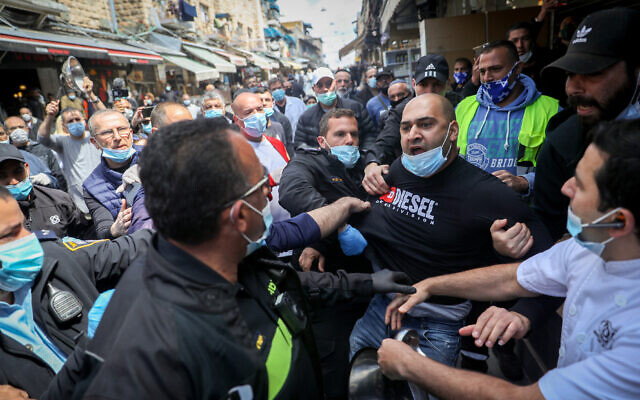
Store owners at Jerusalem's Mahane Yehuda market scuffle with police during a protest over the continued closure of open-air markets, April 25, 2020. (Yonatan Sindel/Flash90)
Store owners at Jerusalem's Mahane Yehuda market scuffle with police during a protest over the continued closure of open-air markets, April 25, 2020. (Yonatan Sindel/Flash90)  
 
The real and actual threat to the entire population was well enough known; ultra-Orthodox and Arab municipalities were never as amenable to precautionary moves that other citizens assented to. In those communities people live closer together; attendance at synagogue and mosques by congregants was viewed as vital, despite government orders. Those municipalities became hot-spots of infection. Orders to isolate went ignored and infections soared.
"The haredi political parties have a highly motivated voter base that consistently delivers enough Knesset seats to hand the leaders disproportionate leverage [in relation to their population] when it comes to negotiating coalition agreements. And so, as happned in March, haredi leaders told Netanyah recently that they wuld not accept being locked down unless the whole nation was and, as they did in March, when the mere notion of targeting haredi communities arose again in August, the ultra-Orthodox parties threatened to quit the colaition. Netanyahu, as he so often does, capitulated."
Vivian Bercovici, former Canadian ambassador to Israel
The large families typical of Arab and ultra-Orthodox Jews live in cramped, crowded quarters, and what they share is a negligent attitude toward authority in general, and directions to change the imperatives of their lifestyles directed toward worship and close physical association in particular. But those same communities, under Israel's system of electoral governance, often hold the balance of power; minority elected governments need the support of such groups and tend to cave in to their demands, for ongoing political gain.

The curfews imposed on 40 "red" municipalities throughout the country from 7 p.m. to 5 a.m., the orders not to hold large weddings and other group events went largely ignored and these typically super-spreader social events have created a disastrous situation of rampant infections. The medical authority's orders are spurned and cast aside; no one can tell these communities what to do; and the government is more concerned with the support it needs in the Knesset than enforcing the rules for the safety of all.
"A recently compiled list of 40 "red hot" municipalities are virtually all majorityArab or haredi [ultra-Orthodox]. And therein lies the problem. As they did in March, medical professionals, public servants and some politicians advocated early on this time that more stringent measures must be applied to affected municipalities on a targeted basis. This caused both constituencies -- but particularly the haredim -- to protest vigorously. They accused politicians and public health officials of discrimination."
Vivian Bercovici in Tel Aviv
The plan to place the ultra-Orthodox communities under lockdown reflecting this is where COVID cases are skyrocketing, while leaving the rest of the country under semi-lockdown conditions offends the Haredi populations who refuse to go into lockdown unless the entire country does. Even at a time when the country as a whole went into lockdown, these same communities exercised a relaxed attitude to the need to self-isolate and angrily rebuked the government when their communities were designated as "red hot" requiring special lockdown even as the rest of the country began relaxing theirs.


Labels: , , , , ,

() Follow @rheytah Tweet