Politic?

This is a blog dedicated to a personal interpretation of political news of the day. I attempt to be as knowledgeable as possible before commenting and committing my thoughts to a day's communication.

Monday, February 03, 2025

Ecuador's Juvenile Hitmen

"We want minors to stop being the preferred labour force of organized crime."
"Today it's cheaper to hire them, and the penalties are laughable. So we propose that, in serious crimes such as murder, they receive the penalty of an adult, although they serve it in a [special] correctional facility until they are 18."
Vincente Taiano, National Assembly of Ecuador

"It shocked me to see children nine or ten years old with rifles, learning to shoot. It's an image you can't easily forget."
"I spoke with children who had killed dozens of people as part of their training. They were willing to do it for ten or 20 dollars."
"They called their victims 'breasts' because they're worth what a chicken costs."
Monica Velasquez, journalist, independent digital media LaPosta
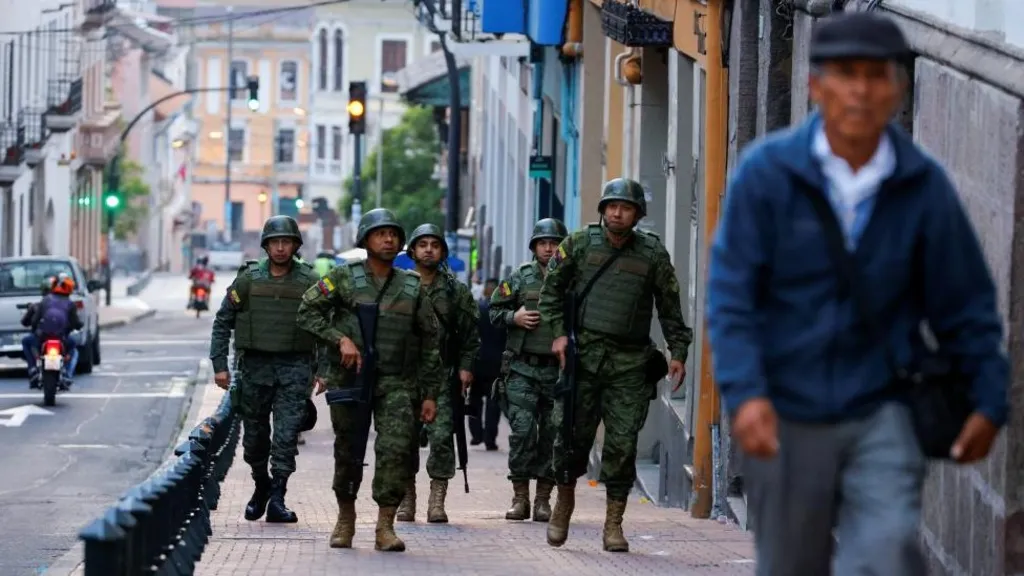
https://ichef.bbci.co.uk/news/1024/cpsprodpb/6A3C/production/_132269172_3b08e9d1fc18242b806ebb2805183e24619439f80_0_5500_36681000x667.jpg.webp
Soldiers have been deployed to boost security   Reuters
 
A documentary produced by Monica Velasquez in 2021 reported the phenomenon of 'hitman schools'. Her documentary revealed footage of armed instruction given to  youths with criminal aspirations. These schools take place on the streets of Duran, in Ecuador. The city became the world  homicide capital in 2023. Child involvement in crime is of such a magnitude that Ecuador's own statistics reveal that the leading cause of death among minors in the country is murder.

Because of her activist revelations, Ms. Velasquez was under constant threat of violence, convincing her that to preserve her life it was necessary to leave her country. She now lives, a refugee from Ecuador, in Canada. Organized crime groups' threats hounded her from Ecuador. She must now, as it happens, recognize that in Canada too -- not yet at the extent seen in Ecuador -- organized crime recruits adolescents to work with the group in drug trafficking and vehicle thefts; stolen for export abroad.

There were 6,964 homicides in Ecuador last year, reflective of the incidence of violent crime in the country. Of those homicides, many were at the hands of armed and trained teens embroiled in violence through organized crime. The South American country is now considered one of the most dangerous places in the world. Last spring a murder occurred that shocked even the most blase Ecuadorians accustomed to reading about criminal events in their country.

A 14-year-old boy was revealed in a brief video, seated on a bus, pulling a firearm out of his backpack, then threatening the bus driver, to extract money from him. The bus driver's young daughter happened to be seated beside her father and appealed to the boy to take the money and leave. From the bus steps as the boy was exiting, he suddenly turned and shot point blank at the driver's head, killing him instantly.

Someone like that 14-year-old committing a crime of that dimension under Ecuadorian law would receive no more than eight years of confinement in a juvenile court if he was convicted of the crime. With time off for good behaviour his sentence could be halved. There is a moral/justice dilemma for Ecuador to solve for itself in the face of these blatant, frequent crimes committed by children.
https://insightcrime.org/wp-content/uploads/2023/12/ColombiaA-spectrum-of-determinant-factors-in-cases-of-youth-participation-in-organized-crime-InSight-Crime-Nov-2023-1200x763.jpg
 
Violence in  the country is out of hand. Six of every ten members of local cartels are minors, according to a 2024 report by the Konrad Adenauer Foundation in Germany. The National Assembly of Ecuador is grappling with the dilemma of what can be done. Following the bus murder, Vicente Taiano, a conservative legislator, called for a debate too long in coming to address the critical and dangerous issues before it, of child violence associated with gang memberships. 

It is now up to the National Assembly to reach a consensus of how the issue can be addressed. It has been under discussion for months, with no forward movement. Under Ecuadorian law the age of criminal responsibility -- the lowest in the region -- is 12 years. However, says Parliamentarian Taiano, the penalties are "very soft". He then proposed a toughening of the criminal law, citing: adult crime, adult penalty.
 
Pierina Correa, president of the Legislative Commission for Children's Rights accuses the prospective change in youth criminal law proponents of being "penal populists". It is her opinion that children in Ecuador, while not exempt from prosecution, must also be recognized as requiring more guidance. "They are not turning to organized crime because they have a criminal vocation, but because the state has failed them in every way", she accuses.

Argentina and Peru also are in discussion respecting how they might address a similar social legal problem. Sweden, considered a developed country, found the number of children taking part in blood crimes there had tripled in 2024. The difference is that none of these countries have seen 'hitman schools' tutoring children in weaponry handling and financial incentives to commit violence, including killing people. 

And then, in Ecuador  another complicating factor has emerged. The internal armed conflict with the state declaring war on drug trafficking cartels has seen the military enlisted in the war on drug trafficking cartels. A military patrol of 16 soldiers had detained four children in Ecuador's south back in December. The children's bodies were found weeks later, mutilated and charred. The soldiers stand accused of forced disappearance.

https://assets1.cbsnewsstatic.com/hub/i/r/2022/05/16/cadfd9ae-6532-4fa9-abeb-e2f8e01c0a73/thumbnail/1240x818/07b4cae2d415b7554a36a72c684d91ca/ap22111790550575.jpg?v=aaeeb2bb1dd1cd7107e4d78154d17e02
Workers carry bundles of drugs seized in various police operations, to be incinerated in Cayambe, Ecuador. Dolores Ochoa / AP


Labels: , , , ,

Sunday, November 14, 2021

Ecuador Penitentiary System Deadly Gun Riots

"[In the initial fighting, inmates] tried to dynamite a wall to get into Pavilion 2 to carry out a massacre. They also burned mattresses to try to drown [their rivals] in smoke."
"We are fighting against drug trafficking. It is very hard."
Pablo Arosemena, governor, Guayas province, Ecuador 

"The first right that we should guarantee should be the right to life and liberty, which isn't possible if security forces can't act to protect."
"There will be more than 1,000 pardons, but this is part of a process [to eliminate prison overcrowding]."
"For example, installing a freight scanner in the Guayaquil Penitentiary to avoid the entry of arms costs $4 million."
Ecuadorian President Guillermo Lasso
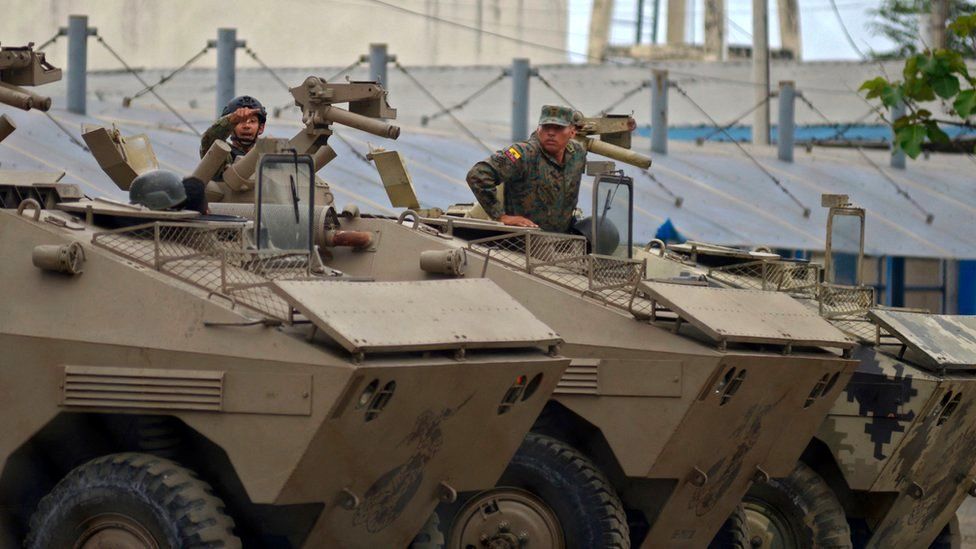
Soldiers in armoured vehicles secure the Guayas 1 prison in Guayaquil, Ecuador
Soldiers in armoured vehicles are positioned near the perimeter of the Guayaquil prison  Getty Images
 
Ecuador is badly in need of international financial assistance to enable it to meet the challenge it faces in attempting to secure the country and protect the nation from the wild violence of drug gangs. The nation's prisons cannot contain all those arrested for criminal activities connected with the movement of illicit drugs. The governor of the state of Guayas where the latest prison atrocities have killed hundreds in mass prison gunfights between inmates is badly in need of help. Aid, Governor Arosemena, announce, is expected in the form of resources and logistics.

Ecuador houses close to 40,000 prison inmates in its entire penitentiary system with an optimum capacity of 30,000, which means that ten thousand more prisoners than the system is built to accommodate present a problem for prison authorities in their capacity to exert control and maintain order and security. Of the total of those incarcerated, half have not yet even been sentenced. So the justice system has some catching-up to do, as well.

The country's president has stated that Ecuadorian authorities plan to deal with prison overcrowding through granting pardons where applicable, through relocating inmates, and transferring some foreign inmates back to their countries of origin. The outstanding problem the country and the penitentiary system faces aside from overcrowding is he introduction of guns and explosives smuggled into the hands of inmates.

A series of violent, deadly gun battles have taken place between rival gangs incarcerated in the largest prison in Ecuador. In the latest of these, at least 68 inmates have died, and dozens more wounded on Saturday. It took an entire day for authorities to regain control of the Litoral Penitentiary located in the coastal city of Guayaquil. The gun battles began before dawn with shooting lasting eight hours. New clashes took place in the afternoon before order was finally restored.

Fighting among prison gangs is linked to international drug cartels. Social media replayed videos showing bodies of inmates, some had been burned, lying on the ground in demonstrations of ferocious brutality. When night fell it was announced that "the situation is controlled throughout the penitentiary". Some 900 police officers had taken control. Two months earlier fights among gang members led to the deaths of 119 inmates at the prison, where over 8,000 inmates are kept.

Early in the day, according to police commander Gen.Tanya Varela, drones flown over the chaos revealed inmates in three pavilions to be armed with guns and explosives. Weapons and ammunition enter the prison into the hands of prisoners through the medium of vehicles delivering supplies and on occasion by drones. President Lasso in October issued a national state of emergency empowering security forces to fight drug trafficking.
 
More than 20 inmates have been killed during the latest prison riots in Ecuador.
 
The Constitutional Court however, refused recently to permit the military access into prisons, refuting the declared state of emergency. Soldiers can only assemble outside the Literal. Of the bloody fighting within Litoral prison when 119 inmates were killed in late September, five of the dead had been beheaded. In simultaneous riots in various prisons last February, 79 inmates were killed. In total for the year, over 300 prisoners died in penitentiary clashes across Ecuador.

"Enough of this. When will they stop the killing? This is a prison not a slaughterhouse, they are human beings", pleaded Francisca Chancay, whose brother has been imprisoned for eight months in Litoral. Those desperate to see an end to the slaughter call for the military to take control of the prisons. 
"Here you sleep with one eye open[ and now, word is spreading inside the prison of attacks on other pavilions in a few days]. They want to break you ... and gain control of the drug-trafficking routes and micro-trafficking [or local drug sales]."
"[At the Litoral Penitentiary], everything is arranged with massacres, extortion. If you don't cooperate you die, they decide who lives, who dies, who gets rich."
Unidentified inmate
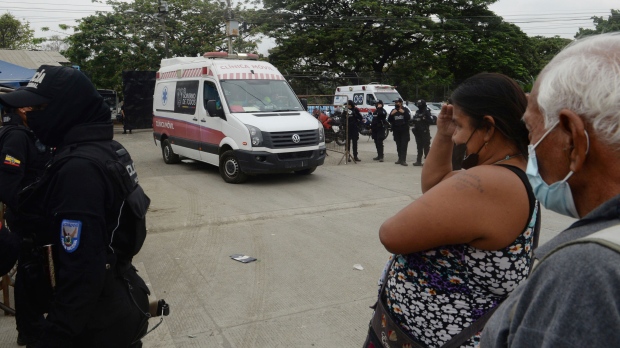
Ecuador prison
An Ambulance leaves the Litoral penitentiary the morning after riots broke out inside the jail in Guayaquil, Ecuador, Saturday, Nov. 13, 2021. (AP Photo/Jose Sanchez)

Labels: , , , ,

() Follow @rheytah Tweet