Politic?

This is a blog dedicated to a personal interpretation of political news of the day. I attempt to be as knowledgeable as possible before commenting and committing my thoughts to a day's communication.

Thursday, April 16, 2026

Canada Going Along to Get Along with Iran in the UN on Human Rights

"From the General Assembly resolution 3379 in 1975, which called Zionism 'a form of racism'; through the 2001 Durban human rights conference; to the 2003 election of a representative of Libya's Col. Qaddafi as chair of the Human Rights Council, the UN's veneer of legitimacy has worn thin."
John Ivison, journalist, National Post 
https://smartcdn.gprod.postmedia.digital/nationalpost/wp-content/uploads/2026/04/2016074_78856512.jpg?quality=90&strip=all&w=564&h=423&type=webp&sig=uU0YvDxvkrYg_NWhGeHb_w
The Security Council chamber at the United Nations in New York City. Photo by Spencer Platt /Getty Images
 
Once a year the UN's Economic and Social Council's [ECOSOC], 54 members which centrally coordinates the UN's work on economic, social and environmental issues, nominates a list of countries to join the UN Committee for Program and Coordination [CPC], which are generally confirmed. Currently the ECOSOC membership includes the United States, Germany, France, Spain, the United Kingdom and Canada, among many other countries. A week ago nominations for the CPC came up for debate. The Islamic Republic of Iran was one of those nominated. And the United States was the only ECOSOC member to dissent over its nomination, declaring Iran unfit to sit on the CPC.
 
In another month the CPC will take to reviewing United Nations programs that address gender equality, disarmament and terrorism prevention. Certainly, Iran knows a great deal about all three issues. And as a world-leader in abuse of women's rights, and the ultimate resistor-country to disarmament, as well as the globally-acknowledged leader in the promotion of terrorism, it could conceivably act as a poster for all that has gone wrong in human rights under its theistic rule. Other than that, what could it possibly add of any value to those items? 
 
Canada was one of the ECOSOC members, along with Germany, France, Spain, and the U.K. to rubber-stamp the Iranian nomination to the CPC -- and just coincidentally Iran had been elected to the group previously, in 2014, 2017, 2020 and 2023, as astonishingly corrupt as that might appear to any befuddled mind that continues to cling to the belief that the United Nations is a global institution whose mandate is one of promoting human rights and world peace. 
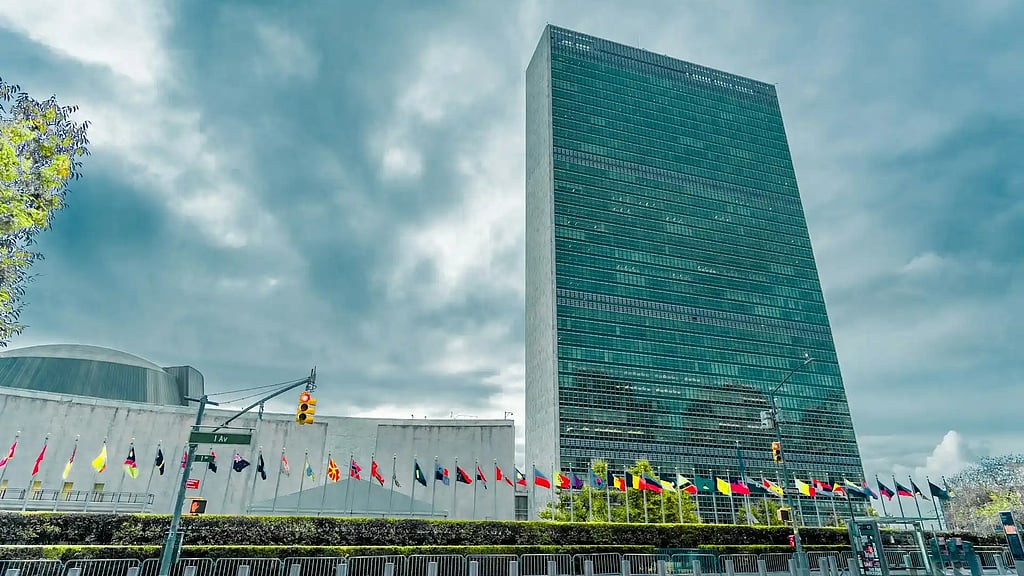
 
https://media.assettype.com/westernstandard%2F2025-10-17%2F38vj3980%2Fnils-huenerfuerst-fqzMMzpoUs4-unsplash.webp?w=1024&auto=format%2Ccompress&fit=max
United Nations Headquarters   Image courtesy of Nils Huenerfuerst on Unsplash
 
The following Tuesday in the House of Commons, Opposition Conservative MP Michael Chong, foreign affairs critic, questioned Canada's supine agreement for Iran. Foreign Affairs minister Anita Anand informed  him that there was nothing Canada could do: "As the position was uncontested, there was no opportunity for a vote", she explained. But the opportunity was there to object and Canada failed that metric of responsibility. "Canada will continue to work closely with partners to actively counter Iran's candidacies in UN bodies and will do so on all occasions", she emphasized, having just done otherwise. 
 
But then, of course, she was only relying on the outstanding leadership example of the leader of the Liberal party, Prime Minister Mark Carney, to lead the way on sanctimonious cynicism, as when in January his speech in Davos included this humdinger: "There is a strong tendency for countries to go along to get along. To accommodate. To avoid trouble. To hope that compliance will buy safety. It won't."
 
According to Canadian lawyer Hillel Neuer of UN Watch in Geneva, Anand's position  was "misleading". Canada could have acted with principle, but failed to. It had the opportunity to force a vote on the nominations, at the very least could have done what the U.S. did, to disassociate from the consensus that rubber-stamped Iran's committee membership, once again. The U.S. ambassador to ECOSOC made that abundantly clear, and included Cuba and Nicaragua. 
"To be clear, Canada joined the consensus in endorsing Iran and others, and it was not obliged to."
"I would say this is typical. Much of what happens at the UN is very cynical. If you want to be principled, you are going to be very busy and it is going to be unpleasant."
"Diplomats believe it is good to get along with as many countries as possible It is much easier to go along to get along."
"[Placing] serial abusers [at the helm of human rights at the UN is] like putting Al Capone in charge of fighting organized crime".
Hillel Neuer, UN Watch 
Iran secures UN role with backing from UK, France, Canada, Australia as US stands alone
 

Labels: , , , , ,

Tuesday, December 09, 2025

DEI, Woke, Critical Race Theory -- Canada's Identity Politics

"Some of the pilot data that has been collected tells us that food security, along with access to culturally preferred food items, continues to be problematic for this population."
"There is a lot of work to be done to strengthen marginalized voices and collectively dismantle barriers being experienced by BAC [Black, African, Caribbean] groups." 
"We want to better understand what is impacting the availability, accessibility and utilization of food for this community."
"The ultimate goal is to use what we learn to inform equitable food programs and policies that meet the needs of all people."
Cayley Velazquez, Canada Research Chair in Race, Food and Health, Kwantlen Polytechnic University, Surrey, British Columbia 
 
"When we're talking about food insecurity a lot of the time the narrative is you've got at least something that should be good enough."
"You should have the availability of food that would be appropriate for your culture and as well as your body and your health."
"Black and Indigenous households have a higher rate of food insecurity. Specifically, they are 3.5 times more likely to be food insecure."
"When we're talking about food insecurity, a lot of the time the narrative is you've got at least something that should be good enough. But there's dignity in your food and access to nutritious and cultural food is, and should be, a right." 
Anna Spyker, Kwantlen's 'Race, Food and Health' program
https://i.cbc.ca/ais/c12e18e6-5246-4387-8ffe-dfc76a5da2b3,1764911925919/full/max/0/default.jpg?im=Crop%2Crect%3D%280%2C0%2C1920%2C1080%29%3BResize%3D860
A grocery store in North Surrey, where many culturally specific food items for African and Caribbean communities are sold. (Sohrab Sandhu/CBC)
 
A press statement announcing that a Vancouver-area researcher had been given a federal grant worth $600,000 to determine how to ensure greater accessibility to African food becomes available in major cities in Canada to serve a growing population of African immigrants, as Black and Caribbean immigrants are migrating to urban centres in Canada, discovering that it is difficult for them to secure 'culturally preferred food', such as cassava and yams.
 
In Surrey, British Columbia, Kwantlen Polytechnic University has inaugurated a position for the study of "cultural, social economic and environmental factors" to determine why this shortage of African-appropriate-diet exists. There is a relatively small Black population in Vancouver and throughout British Columbia, compared to Toronto, Edmonton, Montreal or Ottawa. The most recent census reveals that 41,870 people of African descent represents the total in the entire Lower Mainland of B.C. Of that total, 12,870 were resident of Surrey, where the study is taking place. 
 
https://i.cbc.ca/ais/5a288cb5-5ebf-476e-b564-451bb0903fad,1764823103566/full/max/0/default.jpg?im=Crop%2Crect%3D%280%2C0%2C1280%2C720%29%3BResize%3D620
A group of volunteers from Surrey are taking on a project to research a lack of cultural foods, an initiative to understand and address food insecurity among Surrey's Black immigrant population.
 
A recent Canadian Broadcasting Corporation (CBC) report noted a thriving district of African grocery stores located in North Surrey (Greater Vancouver). In the immediate vicinity of Surrey's Gateway SkyTrain station alone, at least eight retail locations offer Caribbean and African foods. It is the fact that these stores are concentrated in one specific area of Metro Vancouver (which is where, incidentally, the African immigrants are themselves concentrated) is seen by researchers as a 'barrier' to be studied by the Kwantlen program.
 
The definition of 'food insecurity', it was noted in the CBC report, should not be interpreted of necessity that a lack of food exists; it can in fact, refer to food that is unfamiliar. Health Canada refers to food insecurity as "the inability to acquire or consume an adequate diet quality or sufficient quantity of food in socially acceptable ways"; perhaps that means poking about for discarded food in dumpsters
 
In most places where immigrants from abroad enter to live, they learn to use the food staples in the current markets. In time when sufficient numbers from any given foreign location appear, local food marketers notice and begin importing immigrant-culture foods.
 
The Kwantlen research saw a federal government write-up, noting a lack of inexpensive, readily acquired African and Caribbean food as a net drain on health and success achievable within Black communities. "Their findings will fill critical gaps in race-based data and reveal how systemic structures create or intensify inequities", it concluded. 
 
The Canada Research Chair program is the funding body for these selected research areas. The CRC program is among the largest sources of federal funding into the Canadian university system. While the recently released 2025 federal budget proposed broad cuts across federal government operations, the elimination of tens of thousands of civil service positions, the CRC program saw no decrease in its funding. And so the distribution of $311 million annually goes out to 2,000 full-time researchers at Canadian universities.  
 
https://i.cbc.ca/ais/a427e5fa-df36-4e61-afc5-3eb7af2b1ed8,1764912515054/full/max/0/default.jpg?im=Crop%2Crect%3D%280%2C0%2C1920%2C1080%29%3BResize%3D805
Members of Seeds of Change Surrey's Black, African and Caribbean advisory group visit a local grocery store as part of their research into access to culturally specific foods. (Sohrab Sandhu/CBC)
 
The Canada Research Chairs program is subject to a series of federally mandated quotas on race and ethnicity where recipients of Canada Research Chair funding are expected to meet strict guidelines of race and identity of research appointees. "Equity targets" must see 33.2 percent of Canada Research Chairs 'racialized'; 53.1 percent must be women or a member of a 'gender equity-seeking group'.
 
The result can be seen in Canadian universities publishing job positions limiting candidates based on race or sex. For example, University of British Columbia advertised a Canada Research Chair in Medical Physics; the posting excludes white, able-bodied male applicants. The post advertisement reads: "UBC is currently restricted in the recruitment, selection, and nomination of [Canada Research Chairs]"
 

Labels: , , ,

Thursday, November 06, 2025

The Wisdom of a Liberal Government

"The pace of arrivals began to exceed Canada's capacity to absorb and support newcomers in the way we are used to doing."
"Canada's new government recognizes that this system is no longer sustainable, and we are determined to make it so." 
Canada 2025 Liberal Budget Preamble 

 
To begin to solve the problem of Canada having embarked on a mission to become 'post-national' and speed up its intake of migrants, immigrants, refugees from all over the world, including foreign students and foreign temporary workers, amounting to a million newcomers a year that nudged Canada's population from the 36 million it was a few years ago to the new total of 41 million, in the process making housing unaffordable, schools crowded with students who have no facility with the two official languages, and the nation's universal health care system close to collapse, the new government of PM Mark Carney has decided to address the issue by speeding up a universal amnesty granting permanent residency status to hundreds of thousands of 'asylum seekers'.
 
Canada is now embarked on a mission to undo the damage deliberately invited by the previous Liberal government under then-Prime Minister Justin Trudeau, by bringing the mass immigration imbroglio "under control". It will do this by pursuing a "one-time" program fast-tracking "eligible protected persons", many of whom entered the country illegally, toward permanent residency. To any jaded Canadian this plan looks far more like -- more of the same.
 
Under Canadian law, an asylum seeker who has received approval by authorities to their refugee claim is considered a 'protected person'. At the present time there are more people encompassed by the Canadian refugee system than at any other time in history. A total of 497,443 individual "asylum claimants and protected persons" reside in the country, at taxpayer expense, in every conceivable way. Many of whom take the places meant to temporarily house the Canadian homeless population. Many of them regularly visit food banks.
https://www.ottawahospital.on.ca/wp-content/uploads/2023/01/Emergency-wait-times-1024x316.jpg
 Wait Times From 8 to 22 Hours...The Ottawa Hospital
 
The emergency rooms of Canada's understaffed hospitals regularly hold a significant percentage of migrants requiring medical treatment which has caused the wait for treatment to go beyond 8 hours and more at any given time. But $120.4 million has been allocated in an 'austerity budget' toward bringing that 'one-time' program of fast tracking those 'eligible' into protected status as a reward to many for having illegally entered the country as economic migrants, to register as refugees.
 
Apart from the number that Statistics Canada registered of close to a half-million in the category of 'asylum claimants and protected persons', another 187,786 claimants for asylum wait for their case to be heard by the Immigrant and Refugee Board of Canada. In 2015, when Justin Trudeau became prime minister, asylum claimants in Canada totalled 16,058 people. In ten years exponentially greater numbers entered Canada to claim refugee status, generously invited by Mr. Trudeau. 
 
Any foreigner passing a light security screening can claim asylum under the terms of the Immigration and Refugee Protection Act. That person is permitted to remain in the country with access to benefits and work permits  until such time as their case is adjudicated, and that can take years, and even longer considering the extensive backlog. While 2015 saw 7,100 asylum claims processed, in 2024 that number ballooned to 58,050, an increase of over 800 percent.
 
https://i.cbc.ca/ais/1.6704947,1672950639000/full/max/0/default.jpg?im=Crop%2Crect%3D%280%2C0%2C2304%2C1536%29%3BResize%3D805
A boundary monument marks the border between Canada and the United States at Roxham Road. The road is a well-travelled unofficial border crossing for asylum seekers crossing into Canada. (Charles Contant/CBC)
 
Migrants within the refugee system include the estimated 114,373 illegal border crossers swarming Canada since 2017, illegally crossing into Canada from the United States, deliberately bypassing the legal, authorized border crossing posts. Tens of thousands of temporary migrants entering Canada as students who claimed asylum once their visas expired are included, to a record of 20,245 claims last year. In the 'protected persons' category the vast number of claimants will see acceptance. 
 
Canada had become the fastest-growing country in the OECD after lifting pandemic lockdowns and opening all permanent and temporary migration in one fell swoop. It soon became obvious that the state of Canada's immigration system had become inefficient and dysfunctional through the impossibility of attempting to handle numbers that the system was never meant to be drowned in. 
 
https://i.cbc.ca/ais/1.6757172,1677111775000/full/max/0/default.jpg?im=Crop%2Crect%3D%280%2C0%2C2304%2C1296%29%3BResize%3D860
An RCMP officer looks on as asylum seekers cross the Canada-U.S. border at Roxham Road on Jan. 5, 2023. (Charles Contant/CBC)
 

Labels: , , , , ,

() Follow @rheytah Tweet