What is Beneath the Temple Mount?
As Israeli archaeologists recover artifacts
from the religious site, ancient history inflames modern-day political
tensions
- By Joshua Hammer
- Photographs by Polaris
- Smithsonian magazine, April 2011,
Subscribe

Non-Muslims use a wood ramp to enter the complex, home to the gilded
Dome of the Rock, an Islamic shrine, and the Western Wall, holy to Jews.
(Polaris)
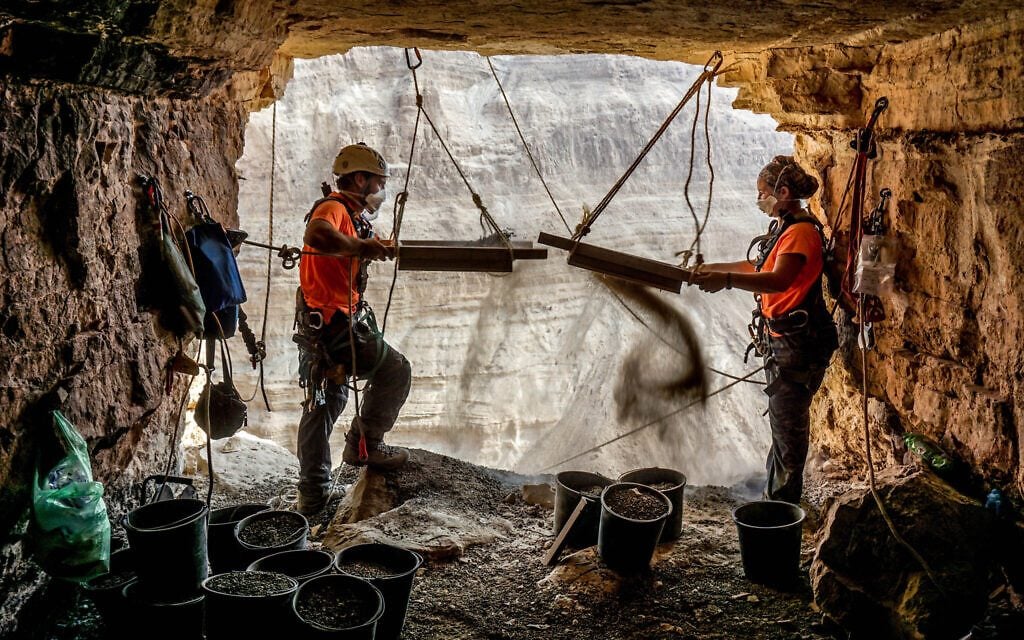
My stint as an amateur archaeologist began one morning on the
southern slope of Mount Scopus, a hill on the northern outskirts of
Jerusalem. Inside a large hothouse covered in plastic sheets and marked
“Temple Mount Salvage Operation,” a woman from Boston named Frankie
Snyder—a volunteer turned staffer—led me to three rows of black plastic
buckets, each half-filled with stones and pebbles, then pointed out a
dozen wood-framed screens mounted on plastic stands. My job, she said,
was to dump each bucket onto a screen, rinse off any soil with water
from a garden hose, then pluck out anything of potential importance.
It wasn’t as easy as it sounded. A chunk of what looked like
conglomerate rock turned out to be plaster used to line cisterns during
the time of Herod the Great, some 2,000 years ago. When I tossed aside a
shard of green glass I thought was from a soft-drink bottle, Snyder
snatched it up. “Notice the bubbles,” she told me, holding it up to the
light. “That indicates it’s ancient glass, because during that time,
oven temperatures didn’t reach as high as they do now.”
Gradually, I got the hang of it. I spotted the handle of an ancient
piece of pottery, complete with an indentation for thumb support. I
retrieved a rough-edged coin minted more than 1,500 years ago and
bearing the profile of a Byzantine emperor. I also found a shard of
glass from what could only have been a Heineken bottle—a reminder that
the Temple Mount has also been the scene of less historic activities.
The odds and ends I was gathering are the fruits of one of Israel’s
most intriguing archaeological undertakings: a grain-by-grain analysis
of debris trucked out of the Temple Mount, the magnificent edifice that
has served the faithful as a symbol of God’s glory for 3,000 years and
remains the crossroads of the three great monotheistic religions.
Jewish tradition holds that it is the site where God gathered the
dust to create Adam and where Abraham nearly sacrificed his son Isaac to
prove his faith. King Solomon, according to the Bible, built the First
Temple of the Jews on this mountaintop circa 1000 B.C., only to have it
torn down 400 years later by troops commanded by the Babylonian king
Nebuchadnezzar, who sent many Jews into exile. In the first century
B.C., Herod expanded and refurbished a Second Temple built by Jews who
had returned after their banishment. It is here that, according to the
Gospel of John, Jesus Christ lashed out against the money changers (and
was later crucified a few hundred yards away). The Roman general Titus
exacted revenge against Jewish rebels, sacking and burning the Temple in
A.D. 70.
Among Muslims, the Temple Mount is called Haram al-Sharif (the Noble
Sanctuary). They believe it was here that the Prophet Muhammad ascended
to the “Divine Presence” on the back of a winged horse—the Miraculous
Night Journey, commemorated by one of Islam’s architectural triumphs,
the Dome of the Rock shrine. A territorial prize occupied or conquered
by a long succession of peoples—including Jebusites, Israelites,
Babylonians, Greeks, Persians, Romans, Byzantines, early Muslims,
Crusaders, Mamluks, Ottomans and the British—the Temple Mount has seen
more momentous historical events than perhaps any other 35 acres in the
world. Nonetheless, archaeologists have had little opportunity to search
for physical evidence to sort legend from reality. For one thing, the
site remains a place of active worship.
The authority
that controls the
compound, an Islamic council called the Waqf, has long forbidden
archaeological excavations, which it views as desecration. Except for
some clandestine surveys of caves, cisterns and tunnels undertaken by
European adventurers in the late 19th century—and some minor
archaeological work conducted by the British from 1938 to 1942, when the
Al-Aqsa Mosque was undergoing renovation—the layers of history beneath
the Temple Mount have remained tantalizingly out of reach.
Thus the significance of those plastic buckets of debris I saw on Mount Scopus.
Today the Temple Mount, a walled compound within the Old City of
Jerusalem, is the site of two magnificent structures: the Dome of the
Rock to the north and the Al-Aqsa Mosque to the south. In the southwest
stands the Western Wall—a remnant of the Second Temple and the holiest
site in Judaism. Some 300 feet from the Al-Aqsa Mosque, in the southeast
corner of the compound, a wide plaza leads to underground vaulted
archways that have been known for centuries as Solomon’s
Stables—probably because the Templars, an order of knights, are said to
have kept their horses there when the Crusaders occupied Jerusalem. In
1996, the Waqf converted the area into a prayer hall, adding floor tiles
and electric lighting. The Muslim authorities claimed the new
site—named the El-Marwani Mosque—was needed to accommodate additional
worshipers during Ramadan and on rain days that prevented the faithful
from gathering in the open courtyard of the Al-Aqsa Mosque.
Three years later, the Waqf, with the approval of the Israeli
government, announced plans to create an emergency exit for the
El-Marwani Mosque. But Israeli officials later accused the Waqf of
exceeding its self-stated mandate. Instead of a small emergency exit,
the Waqf excavated two arches, creating a massive vaulted entranceway.
In doing so, bulldozers dug a pit more than 131 feet long and nearly 40
feet deep. Trucks carted away hundreds of tons of soil and debris.
Israeli archaeologists and scholars raised an outcry. Some said the
Waqf was deliberately trying to obliterate evidence of Jewish history.
Others laid the act to negligence on a monstrous scale.
“That earth was saturated with the history of Jerusalem,” says Eyal
Meiron, a historian at the Ben-Zvi Institute for the Study of Eretz
Israel. “A toothbrush would be too large for brushing that soil, and
they did it with bulldozers.”
Yusuf Natsheh, the Waqf’s chief archaeologist, was not present during the operation. But he told the
Jerusalem Post
that archaeological colleagues had examined the excavated material and
had found nothing of significance. The Israelis, he told me, were
“exaggerating” the value of the found artifacts. And he bristled at the
suggestion the Waqf sought to destroy Jewish history. “Every stone is a
Muslim development,” he says. “If anything was destroyed, it was Muslim
heritage.”
Zachi Zweig was a third-year archaeology student at Bar- Ilan
University, near Tel Aviv, when he heard news reports about dump trucks
transporting Temple Mount soil to the Kidron Valley. With the help of a
fellow student he rounded up 15 volunteers to visit the dump site, where
they began surveying and collecting samples. A week later, Zweig
presented his findings—including pottery fragments and ceramic tiles—to
archaeologists attending a conference at the university. Zweig’s
presentation angered officials at the Israel Antiquities Authority
(IAA). “This is nothing but a show disguised as research,” Jon Seligman,
the IAA’s Jerusalem Region Archaeologist, told the
Jerusalem Post.
“It was a criminal deed to take these items without approval or
permission.” Soon afterward, Israeli police questioned Zweig and
released him. By that point though, Zweig says, his cause had attracted
the attention of the media and of his favorite lecturer at Bar-Ilan—the
archaeologist Gaby Barkay.
Zweig urged Barkay to do something about the artifacts. In 2004,
Barkay got permission to search the soil dumped in the Kidron Valley. He
and Zweig hired trucks to cart it from there to Emek Tzurim National
Park at the foot of Mount Scopus, collected donations to support the
project and recruited people to undertake the sifting. The Temple Mount
Sifting Project, as it is sometimes called, marks the first time
archaeologists have systematically studied material removed from beneath
the sacred compound.
Barkay, ten full-time staffers and a corps of part-time volunteers
have uncovered a wealth of artifacts, ranging from three scarabs (either
Egyptian or inspired by Egyptian design), from the second millennium
B.C., to the uniform badge of a member of the Australian Medical Corps,
who was billeted with the army of British Gen. Edmund Allenby after
defeating the Ottoman Empire in Jerusalem during World War I. A bronze
coin dating to the Great Revolt against the Romans (A.D. 66-70) bears
the Hebrew phrase, “Freedom of Zion.” A silver coin minted during the
era when the Crusaders ruled Jerusalem is stamped with the image of the
Church of the Holy Sepulchre.
Barkay says some discoveries provide tangible evidence of biblical
accounts. Fragments of terra-cotta figurines, from between the eighth
and sixth centuries B.C., may support the passage in which King Josiah,
who ruled during the seventh century, initiated reforms that included a
campaign against idolatry. Other finds challenge long-held beliefs. For
example, it is widely accepted that early Christians used the Mount as a
garbage dump on the ruins of the Jewish temples. But the abundance of
coins, ornamental crucifixes and fragments of columns found from
Jerusalem’s Byzantine era (A.D. 380–638) suggest that some public
buildings were constructed there. Barkay and his colleagues have
published their main findings in two academic journals in Hebrew, and
they plan to eventually publish a book-length account in English.
But Natsheh, the Waqf’s chief archaeologist, dismisses Barkay’s finds because they were not found
in situ
in their original archaeological layers in the ground. “It is worth
nothing,” he says of the sifting project, adding that Barkay has leapt
to unwarranted conclusions in order to strengthen the Israeli argument
that Jewish ties to the Temple Mount are older and stronger than those
of the Palestinians. “This is all to serve his politics and his agenda,”
Natsheh says.
To be sure, the Mount is a flash point in the Middle East conflict.
Israel seized East Jerusalem and the Old City from Jordan in 1967. While
Israelis saw this as the reunification of their ancient capital,
Palestinians still deem East Jerusalem to be occupied Arab land (a
position also held by the United Nations). The Temple Mount is
precariously balanced between these opposing views. Although Israel
claims political sovereignty over the compound, custodianship remains
with the Waqf. As such, Israelis and Palestinians cautiously eye each
other for any tilt in the status quo. A September 2000 visit to the
Temple Mount by the Israeli politician Ariel Sharon was interpreted by
Palestinians as a provocative assertion of Israel’s sovereignty, and
helped spark the second intifada uprising, which, by some estimates,
claimed as many as 6,600 lives, as rioting, armed clashes and terrorist
bombings erupted throughout the Palestinian territories and Israel. At
its core, the Israeli-Palestinian conflict represents rival claims to
the same territory—and both sides rely on history to make the case for
whose roots in the land run deepest.
For the Israelis, that history begins 3,000 years ago, when the
Temple Mount—believed by many biblical scholars to be the mountain in
the region of Moriah mentioned in the Book of Genesis—was an irregularly
shaped mound rising some 2,440 feet among the stark Judean Hills. The
summit loomed above a small settlement called Jebus, which clung to a
ridge surrounded by ravines. The Old Testament describes how an army led
by David, the second king of ancient Israel, breached the walls of
Jebus around 1000 B.C. David then built a palace nearby and created his
capital, Jerusalem. At the site of a threshing floor atop the mountain,
where farmers had separated grains from chaff, David constructed a
sacrificial altar. According to the Second Book of Kings and the First
Book of Chronicles, David’s son, Solomon, built the First Temple (later
known as the Beit Hamikdash) on that site.
“The Temple Mount was the Parthenon of the Jews,” says Barkay,
describing how worshipers would have climbed a steep set of stairs to
get to it. “You would feel every step of the climb in your limbs and
your lungs.”
Still, “we know nothing about the First Temple, because there are no
traces of its physical remains,” says Benjamin Kedar, a history
professor at Hebrew University and chairman of the board of directors at
the IAA. Scholars, however, have pieced together a tentative portrait
of the Beit Hamikdash from descriptions in the Bible and architectural
remains of sanctuaries elsewhere in the region built during the same
era. It is envisioned as a complex of richly painted and gilded courts,
constructed with cedar, fir and sandalwood. The rooms would have been
built around an inner sanctum—the Holy of Holies—where the ark of the
covenant, an acacia-wood chest covered with gold and containing the
original Ten Commandments, was said to have been stored.
Until recently, Palestinians generally acknowledged that the Beit Hamikdash existed. A 1929 publication,
A Brief Guide to the Haram al-Sharif,
written by Waqf historian Aref al Aref, declares that the Mount’s
“identity with the site of Solomon’s temple is beyond dispute. This too
is the spot, according to universal belief, on which David built there
an altar unto the Lord, and offered burnt and peace offerings.” But in
recent decades, amid the intensifying quarrel over the sovereignty of
East Jerusalem, a growing number of Palestinian officials and academics
have voiced doubts. “I will not allow it to be written of me that I
have...confirmed the existence of the so-called Temple beneath the
Mount,” Palestinian leader Yasir Arafat told President Bill Clinton at
the Camp David peace talks in 2000. Arafat suggested the site of the
Temple Mount might have been in the West Bank town of Nablus, known as
Shechem in ancient times.
Five years after the Camp David talks, Barkay’s sifting project
turned up a lump of black clay with a seal impression inscribed with the
name, in ancient Hebrew, “[Gea]lyahu [son of] Immer.” In the Book of
Jeremiah, a son of Immer—Pashur—is identified as chief administrator of
the First Temple. Barkay suggests that the seal’s owner could have been
Pashur’s brother. If so, it’s a “significant find,” he says—the first
Hebrew inscription from the First Temple period to be found on the Mount
itself.
But Natsheh—sipping Arabic coffee in his office at Waqf headquarters,
a 700-year-old former Sufi monastery in the Muslim Quarter of the Old
City—is dubious. He says he’s also frustrated by Israeli dismissal of
Palestinian claims to the sacred compound where, he says, the Muslim
presence
—excepting the Crusader period (A.D. 1099-1187)—“extends for
1,400 years.” Natsheh won’t say if he believes in the existence of the
First Temple, given the current political climate. “Whether I say ‘yes’
or ‘no,’ it would be misused,” he tells me, fidgeting. “I would not like
to answer.”
According to contemporary accounts, the Babylonian Army
destroyed the First Temple in 586 B.C. The ark of the covenant
disappeared, possibly hidden from the conquerors. Following the conquest
of Jerusalem by the Persians in 539 B.C., the Jews returned from exile
and, according to the Book of Ezra, constructed a Second Temple on the
site.
In the first century B.C., King Herod undertook a massive reshaping
of the Temple Mount. He filled up the slopes surrounding the mount’s
summit and expanded it to its present size. He enclosed the holy site
within a 100-foot-high retaining wall constructed of limestone blocks
quarried from the Jerusalem Hills and constructed a far more expansive
version of the Second Temple. “Herod’s attitude was, ‘Anything you can
do, I can do better and larger,’” says Barkay. “It was part of his
megalomania. He wanted also to compete with God.”
Barkay says he and his co-workers have turned up physical evidence
that hints at the grandeur of the Second Temple, including pieces of
what appear to be opus sectile floor tiles—elements of a technique in
Herod’s time that used stone of various colors and shapes to create
geometric patterns. (Describing the temple, the ancient historian
Josephus wrote of an open-air courtyard “laid with stones of all
sorts.”) Other discoveries might offer glimpses of daily religious
rituals—notably ivory and bone combs that could have been used in
preparation for a ritual mikvah, or purifying bath, before entering the
courts’ sanctified interior.
On a cloudless morning, I join historian Meiron for a tour of the
Temple Mount. We enter the Old City through the Dung Gate and then
arrive at the Western Wall plaza. When the Romans destroyed Herod’s
temple in A.D. 70, they knocked the retaining wall down piece by piece.
But the stones from the top tumbled down and formed a protective barrier
that preserved the wall’s lower portions. Today, hundreds of Orthodox
Jews are gathered in devotion before the remnant of that wall—a ritual
that perhaps first occurred in the fourth century A.D. and has been
practiced continually since the early 16th century, after the Ottoman
conquest of Jerusalem.
During the Ottoman Empire and the British Mandate, this area was a
warren of Arab houses, and Jews who wanted to pray here had to squeeze
into a 12-foot-wide corridor in front of the Herodian stones. “My father
came here as a child and he told me, ‘We used to go through alleys; we
entered a door; and there was the wall on top of us,’ ” Meiron tells me.
After Israel claimed sovereignty over East Jerusalem in 1967, it
demolished the Arab houses, creating the plaza.
Meiron and I climb a “temporary” wooden walkway that leads above the
Western Wall to the Mughrabi Gate, the only entry point to the Temple
Mount for non-Muslims—and a symbol of how any attempt to change the
site’s geography can upset the delicate status quo. Israel erected the
wooden structure after an earthen ramp collapsed in 2004, following an
earthquake and heavy snowfall. In 2007, the IAA approved the
construction of a permanent bridge that would stretch from the Old
City’s Dung Gate to the Mughrabi Gate.
But members of both the Jewish and Muslim communities opposed the
plan. Some Israeli archaeologists raised an outcry over the bridge’s
proposed path through the Jerusalem Archaeological Park—the site of
excavations conducted in the Old City—saying the construction could
damage artifacts. The late Ehud Netzer, the archaeologist who discovered
King Herod’s tomb in 2007, argued that moving the entrance ramp could
effectively cut off the Western Wall’s connection to the Temple Mount,
thereby undermining Israel’s claims to sovereignty over the sacred
compound. And the Israeli activist group Peace Now warned the project
might alarm Muslims since the new route and size of the bridge (three
times the original ramp) would increase non-Muslim traffic to the Mount.
Indeed, when Israel began a legally required archaeological survey of
the planned construction site, Palestinians and Arab Israelis joined in
a chorus of protest. They claimed the Israeli excavations—although
conducted several yards outside the walls of the sacred
compound—threatened the foundations of the Al-Aqsa Mosque. Some even
said that it was Israel’s covert plan to unearth remains of the First
and Second Temples in order to solidify its historic claim to the Mount.
For the time being, non-Muslim visitors continue to use the temporary
wooden bridge that has been in place for seven years.
Such disputes inevitably send ripples throughout the
international community. Both the Jordanian and Turkish governments
protested Israel’s plans for the new walkway. And in November 2010, the
Palestinian Authority created a diplomatic kerfuffle when it published a
study declaring the Western Wall was not a Jewish holy site at all,
but part of the Al-Aqsa Mosque. The study contended, “This wall was
never part of the so-called Temple Mount, but Muslim tolerance allowed
the Jews to stand in front of it and weep over its destruction,” which
the U.S. State Department called “factually incorrect, insensitive and
highly provocative.”
Today, the scene is calm. At various spots on the wide, leafy plaza
Palestinian men gather in study groups, reading the Koran. We ascend
steps toward the magnificent Dome of the Rock—which was built during the
same period as the Al-Aqsa Mosque to the south, between A.D. 685 and
715. The Dome of the Rock is built on top of the Foundation Stone, which
is sacred to both Jews and Muslims. According to Jewish tradition, the
stone is the “navel of the Earth”—the place where creation began, and
the site where Abraham was poised to sacrifice Isaac. For Muslims, the
stone marks the place where the Prophet Muhammad ascended to the Divine
Presence.
On the east side of the Temple Mount’s retaining wall, Meiron shows
me the Golden Gate, an elaborate gatehouse and portal. Its provenance
remains a subject of debate among historians, pitting the majority, who
claim early Muslims built it, against those who insist it is a Byzantine
Christian structure.
Historians who argue that the Byzantines didn’t build the gate point
to ancient accounts describing how early Christians turned the Mount
into a garbage heap. The Byzantines, scholars say, saw the destruction
of the Second Temple as vindication of Jesus’ prophecy that “not one
stone shall be left here upon another” and as a symbol of Judaism’s
downfall. But other historians counter that the eastern entrance to the
Mount, where the Golden Gate was built, was important to the Byzantines
because their interpretation of the Gospel of Matthew holds that Jesus
entered the Temple Mount from the Mount of Olives to the east when he
joined his disciples for the Passover meal. And in A.D. 614, when the
Persian Empire conquered and briefly ruled Jerusalem, they took back to
Persia parts of the True Cross (believed to be the cross of the
Crucifixion) from the Church of the Holy Sepulchre. Fifteen years later,
after defeating the Persians, Heraclius, a Byzantine emperor, is said
to have brought the True Cross back to the holy city—passing from the
Mount of Olives to the Temple Mount, and then to the Holy Sepulchre.
“Thus you had two triumphant entrances: Jesus and Heraclius,” says
Meiron. “That’s enough to explain why the Byzantines would invest in
building that gate.”
While Barkay is in the camp that believes the Golden Gate is an early
Muslim structure, Meiron thinks the sifting project’s discovery of
Byzantine-era crosses, coins and ornamental columns supports the theory
that the gate was built by the Byzantines. “Now we’re not so sure the
Temple Mount fell into disrepair,” Meiron says. In addition, Barkay has
found archival photographs taken during renovations of the Al-Aqsa
Mosque in the late 1930s that appear to reveal Byzantine mosaics beneath
the structure—further evidence that some sort of public building had
been constructed at the site.
I visited Barkay at his modest apartment in East Talpiot, a Jewish
suburb of East Jerusalem. The grizzled, chain-smoking archaeologist was
born in Budapest in 1944, the very day the Nazis sent his family to the
city’s Jewish ghetto. After the war his father—who had spent a year in a
Nazi forced labor camp in Ukraine—established the first Israeli
delegation in Budapest, and the family emigrated to Israel in 1950.
Barkay earned his doctorate in archaeology at Tel Aviv University. In
1979, exploring a series of ancient burial caves in an area of Jerusalem
above the Valley of Hinnom, he made a remarkable discovery: two
2,700-year-old silver scrolls delicately etched with the priestly
blessing that Aaron and his sons bestowed on the children of Israel, as
mentioned in the Book of Numbers. Barkay describes the scrolls, which
contain the earliest-known fragments of a biblical text, as “the most
important find of my life.”
Barkay and I get into my car and drive toward Mount Scopus. I ask him
about Natsheh’s charge that the sifting project is infused with a
political agenda. He shrugs. “Sneezing in Jerusalem is an intensely
political activity. You can do it to the right, to the left, on the face
of an Arab or a Jew. Whatever you do, or don’t do, is political.”
Still, some criticism of Barkay stems not from politics but from
skepticism about his methodology. Natsheh is not the only archaeologist
to raise questions about the value of artifacts not found in situ. The
dirt excavated by the Waqf is landfill from previous eras. Part of that
landfill, Barkay says, comes from the Mount’s eastern section, which the
Waqf paved over in 2001. But most of it, he says, was taken from vacant
parts of the Mount when an entrance to Solomon’s Stables was blocked,
sometime between the reign of the Fatimid and Ayyubid dynasties.
Collectively, he says, the landfill includes artifacts from all periods
of the site.
But Israeli archaeologist Danny Bahat told the
Jerusalem Post
that, since the dirt was filler, the layers do not represent a
meaningful chronology. “What they did is like putting the remains in a
blender,” adds Jerusalem region archaeologist Seligman about the Waqf
excavation. “All the layers are now mixed and damaged.” Archaeologist
Meir Ben-Dov, a specialist on the Old City, has raised doubts as to
whether all the landfill even originated on the Temple Mount. Some of
it, he suggests, was brought there from Jerusalem’s Jewish Quarter.
Barkay, not surprisingly, rejects this suggestion, citing the
frequent finds of Ottoman glazed wall-tile fragments from the Dome of
the Rock, dating back to the 16th century, when Sultan Suleiman the
Magnificent repaired and beautified the shrine. And, though the
excavated soil is not in situ, he says that, even if one were to
discount the scientific value of the artifacts by 80 percent, “we are
left with 20 percent, which is a lot more than zero.”
Barkay identifies and dates the artifacts through “typology”: he
compares his finds with similarly made objects in which a timeline has
been firmly established. For instance, the opus sectile pieces Barkay
found in the soil were precisely the same—in terms of material, shape
and dimensions—as those that Herod used in palaces at Jericho, Masada
and Herodium.
We arrive at Barkay’s salvaging operation, and he greets a handful of
staffers. Then he leads the way to a worktable and shows me a sampling
of a single day’s efforts. “Here’s a bowl fragment from the First Temple
period,” he says. “A Byzantine coin here. A Crusader arrowhead made of
iron. This is a Hasmonean coin, from the dynasty that ruled Judah in the
second century B.C.” Barkay tells me that volunteers by the hundreds
arrive each week to help with the sifting—even ultra-Orthodox Jews, who
traditionally oppose archaeological excavations in the Holy Land. “They
say all the evidence is in the [scriptural] sources, you don’t need
physical proof. But they’re willing to make an exception, because it’s
the Temple Mount.” Barkay pauses. “If I look at some of the volunteers,
and I see the excitement in their eyes, that they with their own fingers
can touch the history of Jerusalem, this is irreplaceable.” He admits
the project has attracted “very few” Palestinians or Arab Israelis.
Leading me outside the plastic-covered building, Barkay squints into
the sunlight. We can see the Temple Mount in the distance, the sunlight
glinting off the golden-topped Dome of the Rock. “We’ve been working for
six years, and we’ve gone through 20 percent of the material,” he says,
pointing to huge heaps of earth that fill an olive grove below the
tent. “We have another 15 to 20 years to go.”
Joshua Hammer wrote about the Bamiyan Buddhas in the November 2010 issue.
Kate Brooks is an Istanbul-based photojournalist who has worked in Iraq, Lebanon and Afghanistan.
Labels: Archaeology, Conflict, Heritage, Islam, Israel, Judaism