

A Proud Tradition : Defunct
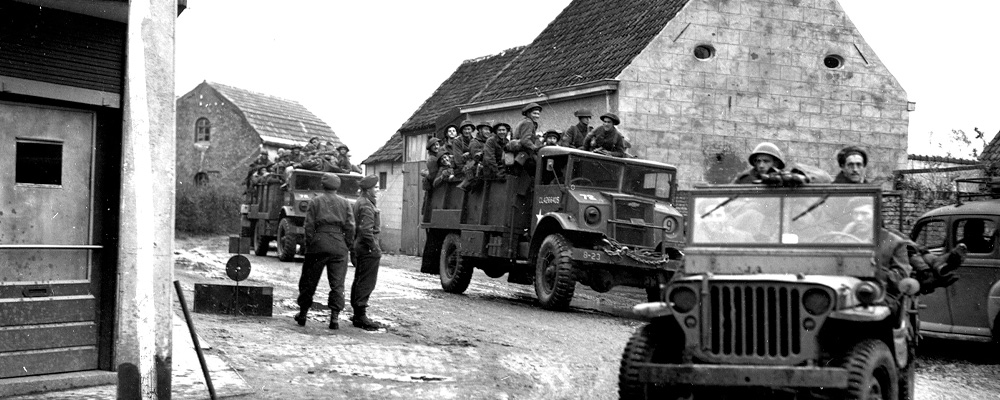
"During the Second World War, Canadians defended the east and the west coasts and fought in a series of long and difficult campaigns around the world—on land, at sea and in the air—to defeat the German, Italian and Japanese forces.""More than 1.1 million Canadian men and women served in the armed forces. The home front was largely directed to winning the war.""In 1939, Germany invaded Poland. This started more than six years of bitter fighting in the Second World War, which finally ended in 1945. More than one million Canadians and Newfoundlanders served in uniform, both here at home and around the world. Over 45,000 of our brave men and women in uniform gave their lives and another 55,000 were wounded before Germany was defeated in May 1945 and Japan in August of the same year.""Canada contributed significantly to the Allied victory. Revelations of the Nazi atrocities and the Holocaust shocked the world. The war also led to the decolonization of empires, the creation of the United Nations, and what became known as the “Cold War” between the United States and the Soviet Union, and their respective allies.Canada was fundamentally transformed by the war. More than a million veterans came home and would help lead Canada into its very prosperous second half of the twentieth century."Veterans Affairs Canada
 |
| Second World War -- 1939 -1945 |
"There is a risk that DND/CAF [Department of National Defence/Canadian Armed Forces] will not have the right military personnel, in the right numbers, with the right competencies at the right place, and the right time.""[In the Canadian air force and army it will take until 2032 for fleets to be] at least70 percent [functional. In the Royal Canadian Navy the 2032 target is] at least 60 percent. For the navy, while awaiting a] future fleet [of new destroyers, the first vessels are scheduled for completion in] early 2030.""The degradation in materiel readiness of the aging platforms within the existing fleet will present a significant challenge to maintaining ... operational readiness.""There are insufficient trainers, equipment, training facilities and other supports to meet training targets effectively.""In an increasingly dangerous world, where demand for the CAF is increasing, our readiness is decreasing."Department of National Defence internal report
 |
| Members of the Canadian Army Royal 22nd Regiment from Valcartier, Que. take part in an exercise in Metchosin, B.C. An internal Department of Defence document says just over half of the Canadian Armed Forces is in a state to respond to a crisis call from NATO allies. (Chad Hipolito/The Canadian Press) |
At the very time when the current federal government in Canada plans to triple defence spending, given NATO's latest demands of its member nations in operational military readiness as a group facing a hostile new world order, the Canadian military is revealing that the organization is overwhelmed and dysfunctional to the extent that it will not be capable of meeting even current duties for at least another seven years.
A year ago the Department of National Defence estimated it would have 90 percent of its forces by March 31, 2025, "ready for operations in accordance with established targets". That was then, this is now, when a new internal report estimates the forces will be incapable of meeting the benchmark until the more "realistic and achievable" date of 2032.The delay is partially caused by a sudden influx of new defence spending. The report points out it will take time to manage the "significant improvements" finally on order by Ottawa.
The Defence Department details in its report the burden it is under as a result of shortages in personnel, degraded equipment, and a chronic inability to obtain new kit. Equipment shortages are the most apparent issue with over half of the aircraft, ships and army vehicles effectively out of commission in the military. Annual statistics on what percentage of the Canadian Armed Forces' various vehicle fleets are considered to meet "training, readiness and operational requirements" are maintained.
The statistics reflect that in the navy, air force and army, the figures are all at historic lows of 45.75 percent. 48.9 percent and 49 percent operational respectively. For the time being, the navy remains largely dependent on a fleet of aging frigates described as "rapidly becoming combat inefficient." The dismal picture of operationality highlighted for the Canadian Military comes at a time when funding and recruitment -- two of its most chronic shortcomings -- have recently seen some relief.
 |
| Leaked internal documents obtained by CBC News paint an alarming picture of Canada's military readiness, including warnings about personnel challenges and 'unserviceable' equipment. CBCNews |
Spending for the military was recently promised at two percent of GDP, a previously-stated NATO goal for all of its members, only to be overtaken by the new NATO military spending guidelines at five percent of GDP, which the current Liberal government has agreed to. The Canadian military will receive $62.7 billion, rather than the previous budgeted support of $53.4 billion.
The Canadian Armed Forces announced earlier this year it was on track to meet its 2025 recruitment goal of 6,490 new members to be enrolled following three consecutive years of losing more members than were being gained by the military. Early results, however, indicate that new recruits have overwhelmed the capacity of the military to handle them. Up to one-tenth of new recruits, it was revealed months earlier, were leaving after waiting up to 200 days for training to commence.
The new departmental report notes as well that the Department of National Defence is stretched by both a demand to "address deteriorating global security", while yet increasingly being deployed for domestic disaster relief. The Canadian Armed Forces saw itself deployed to perform relief for a natural disaster just once, in 2010. By contrast, in 2023, they were called on no fewer than eight times to perform natural disaster-outcome relief. Making it clear that their role to respond to such emergencies rendered it incapable of responding, due to low manpower, to fulfill their international and national military assigned tasks.
"It means that Canada's falling further down the rank of allies. It means that the gap is growing between our international commitments and our capacity.""It impacts our credibility at NATO for sure, but it impacts our security interests, too. It's in our security interest to be a credible contributor to NATO.""[The presentation] should set off alarm bells."Kerry Buck, career diplomat, Canada's former ambassador to NATO
 |
| A Canadian soldier fires his machine gun during NATO Exercise Steele Crescendo, which took place outside of Riga, Latvia, in 2020. (NATO) |
Labels: 5 Percent GDP, Department of National Defence, Dysfunctional Military, NATO, Serviceability of the Canadian Military
posted by Pieface | 8:11 PM


0 Comments:
Post a Comment
<< Home